
Official statement
Other statements from this video 11 ▾
- □ Is Google's SEO documentation really accessible to non-experts?
- □ Why is your SEO traffic stalling even after six months of continuous effort?
- □ Why is your 500-recommendation SEO audit useless without prioritization?
- □ Should you really track every SEO metric, even when results are going downhill?
- □ Why does Google really demand such frequent communication with your SEO provider?
- □ Why should a serious SEO provider ask questions about your business before signing a contract?
- □ Why are cookie-cutter SEO formulas doomed to fail?
- □ Does proactive communication really define a high-quality SEO professional?
- □ Why does SEO fail without the involvement of other teams?
- □ Should you really advise clients NOT to do SEO in the short term?
- □ Why won't a good SEO consultant ever promise you Google's top 3?
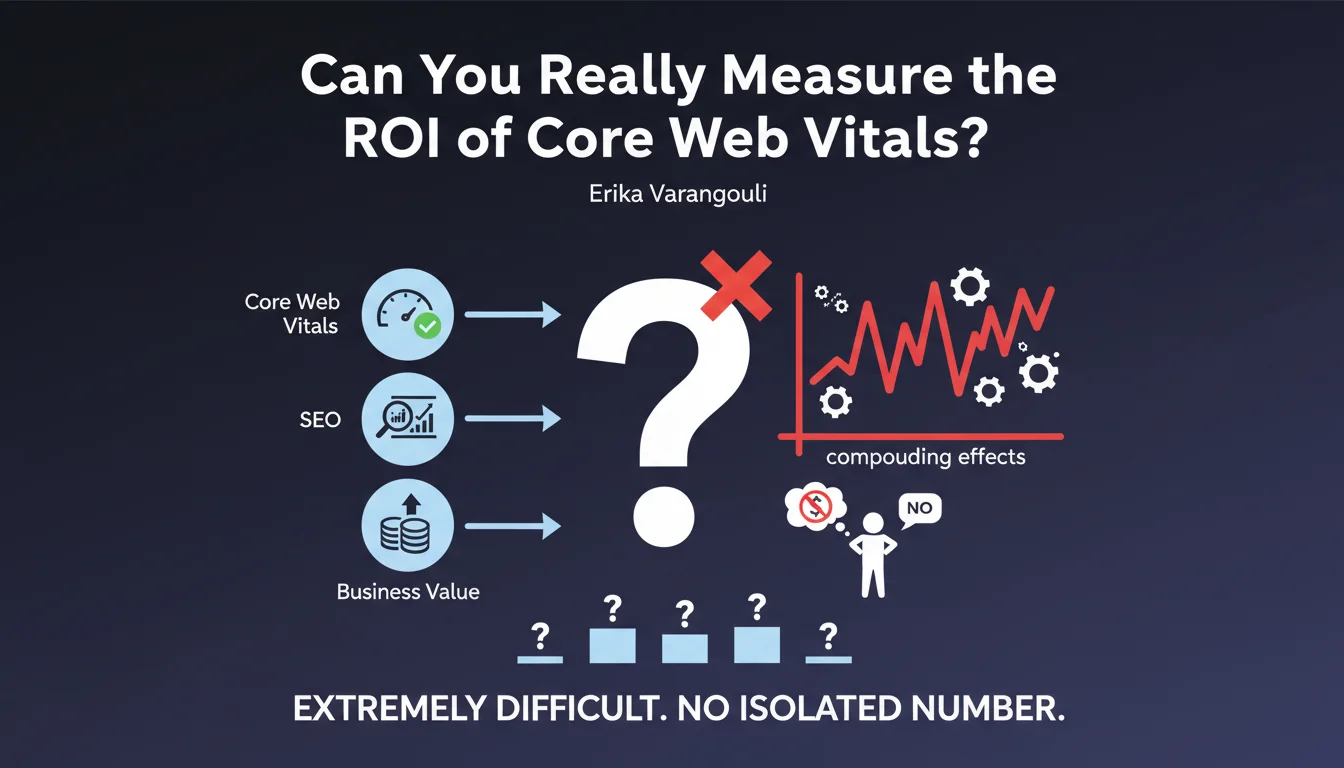
Google claims it's impossible to assign a precise business value to Core Web Vitals improvements. Any promise of a specific ROI figure on this lever is misleading. SEO works through compounding effects, not in silos.
What you need to understand
Why does Google refuse to quantify the impact of Core Web Vitals?
Google's position is clear: no precise figure can be advanced to quantify the business gain linked to Core Web Vitals improvement. Erika Varangouli says it bluntly — anyone claiming otherwise is probably lying.
This statement aims to correct a market where too many agencies sell CWV with fantastical ROI promises. The problem? Core Web Vitals interact with dozens of other signals: content quality, domain authority, technical structure, query relevance. Isolating their exact contribution is virtually impossible.
What does "compounding effect" mean in SEO?
Google emphasizes that SEO does not work in a vacuum. A site with excellent Core Web Vitals but mediocre content won't climb the SERPs. Conversely, a site with exceptional content but catastrophic technical performance will be handicapped.
The compounding effect is this mechanism where each SEO lever amplifies (or cancels out) the impact of others. Improving CWV potentially boosts conversion rate, which sends positive behavioral signals to Google, which improves ranking… but only if everything else follows suit.
Should you give up measuring the impact of technical optimizations?
No, but you need to change your metrics. Rather than looking for direct ROI in dollars, measure intermediate indicators: bounce rate, session duration, page depth, conversion rate. These KPIs are influenced by CWV and remain trackable.
Google isn't saying Core Web Vitals are useless — it's saying their value doesn't boil down to a linear calculation. The goal is to integrate them into a global SEO strategy, not sell them as a magic bullet.
- Impossible to isolate the exact contribution of Core Web Vitals to revenue
- SEO works through compounding effects: all levers are intertwined
- Measure impact via intermediate KPIs (user behavior, conversion)
- Beware of agencies promising precise ROI figures on CWV
SEO Expert opinion
Is this statement consistent with field observations?
Completely. Across hundreds of audits, I've found that improving Core Web Vitals boosts traffic… when the site is already solid elsewhere. An e-commerce site that goes from 3s to 1.5s LCP sees its bounce rate drop, but if its catalog is weak or prices disconnected from the market, nothing is saved.
On the other hand, on sites with good content and established authority, CWV gains often translate to better visibility on competitive queries — not because Google favors them directly, but because users stay longer, click more, convert better. Google captures these signals and adjusts ranking.
What nuances should be noted?
Google remains vague about Core Web Vitals weighting in the algorithm. We know they're part of the Page Experience signals, but their real weight? [To be verified]. John Mueller has stated multiple times that content trumps everything else, including CWV.
What's certain: CWV has a massive indirect impact through UX. A slow site kills conversion, increases bounce rate, degrades engagement. Google monitors these metrics. So yes, optimizing CWV remains essential — but not for the simplistic reasons often sold.
In which cases does this rule not apply?
If your site is a monopoly in a hyper-specific niche with zero competition, you can have catastrophic CWV and still rank number 1. But let's be honest — this scenario almost never exists. Once there's competition, every UX point counts.
Another exception: highly specific informational queries where content freshness or author authority crush everything else. An academic research article that's slow but an absolute reference will stay in the top 3, CWV or not.
Practical impact and recommendations
What should you do concretely?
First step: audit your Core Web Vitals with Google tools (PageSpeed Insights, Search Console, Chrome UX Report). Identify strategic pages (high-traffic landing pages, best-selling product sheets) and prioritize optimizations on these URLs.
Next, tackle quick wins: image compression (WebP, AVIF), lazy loading, effective caching, elimination of render-blocking resources. These actions often improve LCP and CLS without major rework.
But don't stop there. Monitor business KPIs in parallel: conversion rate, average order value, bounce rate. If CWV improves but these indicators stagnate, the problem is elsewhere — content, pricing, user journey.
What mistakes should you avoid?
Never sell Core Web Vitals as an isolated lever. Saying "We improve your LCP and you gain +15% traffic" is an empty promise. Google has reiterated: the effect is compounded, not direct.
Another trap: optimizing CWV at the expense of real user experience. I've seen sites remove essential features (carousels, videos) to gain fractions of a second on LCP and lose user engagement. UX always wins.
Finally, don't neglect mobile Core Web Vitals. Google indexes in Mobile First — if your desktop is perfect but your mobile is catastrophic, you're in trouble.
How do you integrate CWV into a global SEO strategy?
Consider Core Web Vitals as a technical prerequisite, not an end in itself. You don't gain rankings just because your LCP is under 2.5s — but you don't lose any either, and most importantly you maximize the odds that users stay and convert.
Integrate CWV optimizations into your regular development sprints. Audit quarterly. And most importantly, cross-reference data: Search Console for SEO, Google Analytics for behavior, business tools for conversion. It's in the convergence of these signals that you detect real impact.
- Audit Core Web Vitals on strategic pages with Search Console and PageSpeed Insights
- Prioritize high-impact optimizations: image compression, lazy loading, cache, render-blocking elimination
- Measure business KPIs in parallel (conversion, bounce, engagement) to validate real effect
- Never sell CWV as an isolated lever: compounding effect only
- Prioritize mobile optimization (Mobile First indexing)
- Audit regularly and integrate CWV optimizations into development cycles
❓ Frequently Asked Questions
Les Core Web Vitals sont-ils vraiment un facteur de ranking ?
Faut-il arrêter d'investir dans les Core Web Vitals si on ne peut pas chiffrer le ROI ?
Comment mesurer l'impact des optimisations Core Web Vitals ?
Un site avec d'excellents CWV mais un contenu faible peut-il bien ranker ?
Que signifie concrètement « effet composé » en SEO ?
🎥 From the same video 11
Other SEO insights extracted from this same Google Search Central video · published on 19/09/2024
🎥 Watch the full video on YouTube →
💬 Comments (0)
Be the first to comment.