
Official statement
Other statements from this video 17 ▾
- □ Pourquoi votre site n'apparaît-il pas dans Google : indexation ou ranking ?
- □ Pourquoi Google pousse-t-il Search Console pour diagnostiquer l'indexation ?
- □ L'URL Inspection Tool de Search Console remplace-t-il vraiment le test d'indexation manuel ?
- □ Le rapport d'indexation de la Search Console suffit-il vraiment à diagnostiquer vos problèmes d'indexation ?
- □ Faut-il vraiment chercher à indexer 100% de ses pages ?
- □ Pourquoi la page d'accueil de votre nouveau site ne s'indexe-t-elle pas ?
- □ Pourquoi votre homepage n'apparaît-elle toujours pas dans l'index Google ?
- □ Votre site est-il vraiment absent de l'index Google ou juste victime de la canonicalisation ?
- □ Hreflang fausse-t-il vos rapports d'indexation dans Search Console ?
- □ Pourquoi vos pages 'site en construction' ne seront jamais indexées par Google ?
- □ Pourquoi certaines pages s'indexent en quelques secondes et d'autres jamais ?
- □ Google peut-il encore indexer l'intégralité du web ?
- □ Google applique-t-il vraiment un quota d'indexation par site ?
- □ Faut-il supprimer l'ancien contenu pour améliorer l'indexation du nouveau ?
- □ Faut-il vraiment utiliser la fonction 'Demander une indexation' de la Search Console ?
- □ L'opérateur site: est-il vraiment fiable pour mesurer l'indexation de votre site ?
- □ Comment exploiter vraiment l'opérateur site: au-delà de la simple vérification d'indexation ?
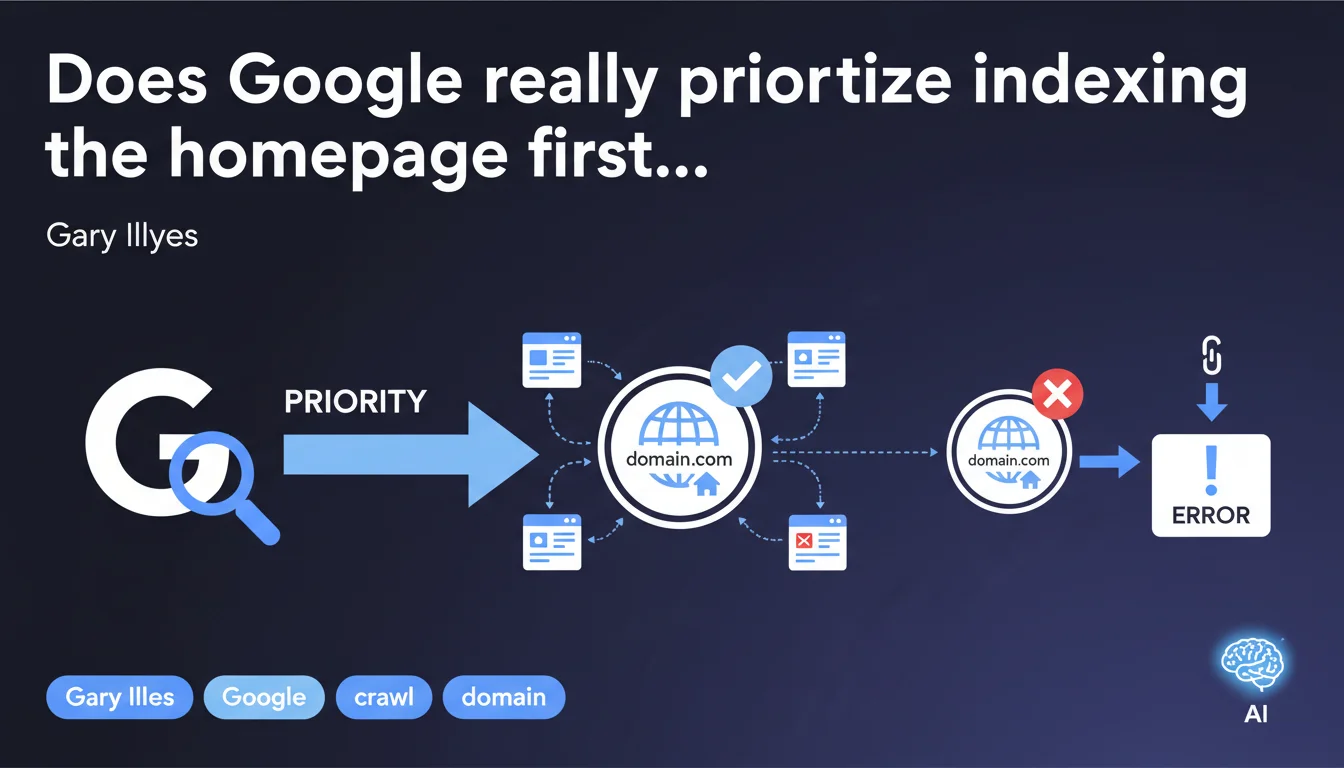
Google automatically prioritizes crawling and indexing the homepage (domain.com) on new websites. If your homepage isn't indexed quickly, it's a signal of serious technical issues blocking the robots. This statement confirms that the absence of indexation at the domain root is never "normal."
What you need to understand
Does Google really prioritize the domain root?
Gary Illyes' statement confirms what many suspected: Google's crawling algorithms are hardcoded to treat domain.com as the privileged entry point on recent sites. This isn't merely a preference — it's a logic embedded directly into the discovery systems.
For a new domain with no history, Googlebot has no internal navigation signals to exploit. The root becomes the natural anchor for mapping out the site. Crawlers expect to find links to main sections, clear structure, and freshness signals.
What does "indexed first" concretely mean?
It's not necessarily instant indexation, but rather a prioritization order in the crawl queue. On a new site, Google allocates a limited budget. The homepage consumes a significant portion of this initial budget — if it doesn't appear in the index within 48-72 hours, something's wrong.
This prioritization applies mainly to domains without authority. An already-established site with backlinks may see other URLs indexed in parallel, or even before the root if they receive direct links.
What technical signals can block this prioritized indexation?
Misconfigured robots.txt, noindex tag on the homepage, redirect loops, catastrophic response times (>5s), invalid SSL certificate — all of these barriers short-circuit Google's logic. Crawling can technically succeed without indexation following if the content is judged empty or duplicate.
- Google crawls the domain root with absolute priority on new sites
- A non-indexed homepage after 72 hours reveals an identifiable technical block
- This rule applies less strictly to established sites with authority
- Indexation depends on successful crawling AND content quality evaluation
SEO Expert opinion
Is this statement consistent with real-world observations?
Overall, yes. On the majority of new site launches I've tracked, the homepage does indeed appear in the index before deeper pages — often within 24-48 hours if everything is technically clean. But there are notable exceptions.
I've seen cases where Google indexed a category page first that had received strong external backlinks, or a product page pushed via a campaign. The "priority" therefore isn't an absolute lock — it's a default heuristic that can be overridden by powerful external signals. [To verify]: Google doesn't clarify whether this rule applies differently across verticals or based on site size at launch.
What nuances should be added to this statement?
The statement remains unclear on one critical point: what happens if the homepage is objectively poor in content or redirects immediately elsewhere? Many modern e-commerce sites have ultra-light homepages, almost empty, that serve as a portal to categories. Google indexes them anyway, but with mediocre ranking.
Another nuance — "indexed first" doesn't mean "ranked first." I've seen homepages indexed in 12 hours but invisible for their own brand name for weeks, while Google collects enough trust signals. Indexation is one step, not a victory.
When doesn't this rule apply?
On subdomains or subdirectories of an already-indexed domain, the logic changes. Google inherits the crawl budget and trust from the parent domain — it can index deeper pages before the "root" of the subfolder if they're better linked.
Practical impact and recommendations
What to do if your homepage isn't indexed within 72 hours?
Start by checking robots.txt — type domain.com/robots.txt and look for an accidental "Disallow: /". Next, inspect the page via Google Search Console (URL Inspection Tool): the report will tell you if Googlebot succeeded in crawling, and if not, why.
If crawling succeeded but indexation is refused, examine meta tags. A forgotten noindex in production is the usual culprit. Also verify HTTP status — a 404 or 500 blocks everything. A 301 permanent is acceptable if it points to a canonical version (www vs non-www), but a 302 temporary creates confusion.
How to optimize the homepage to maximize this priority?
Google crawls the root as a priority, but only indexes it if there's something to index. Avoid homepages composed only of image sliders with no text. Integrate at least 200-300 words of editorial content, internal links to your main sections, clean semantic markup (unique H1, proper HTML5 structure).
Ensure loading time stays under 2 seconds on first crawl. Google allocates few resources to new sites — a sluggish server can trigger crawl throttling, delaying indexation by several days.
What mistakes to avoid absolutely at launch?
- Never leave a restrictive robots.txt in production (copied from preprod)
- Remove noindex tags from all strategic pages before go-live
- Verify that the SSL certificate is valid and HTTP→HTTPS redirects work
- Don't launch a site with an empty or "under construction" homepage
- Manually submit the homepage via Search Console at launch to force rapid crawling
- Configure a clean sitemap.xml with the homepage listed first
❓ Frequently Asked Questions
Combien de temps faut-il attendre avant de s'inquiéter si la homepage n'est pas indexée ?
Une homepage indexée garantit-elle que le reste du site le sera aussi ?
Peut-on forcer Google à indexer d'autres pages avant la homepage ?
La homepage doit-elle obligatoirement être sur domain.com ou www.domain.com peut suffire ?
Un site en noindex accidentel pendant 2 semaines au lancement est-il pénalisé ensuite ?
🎥 From the same video 17
Other SEO insights extracted from this same Google Search Central video · published on 22/06/2023
🎥 Watch the full video on YouTube →
💬 Comments (0)
Be the first to comment.