
Official statement
Other statements from this video 17 ▾
- □ Pourquoi votre site n'apparaît-il pas dans Google : indexation ou ranking ?
- □ Pourquoi Google pousse-t-il Search Console pour diagnostiquer l'indexation ?
- □ L'URL Inspection Tool de Search Console remplace-t-il vraiment le test d'indexation manuel ?
- □ Le rapport d'indexation de la Search Console suffit-il vraiment à diagnostiquer vos problèmes d'indexation ?
- □ Faut-il vraiment chercher à indexer 100% de ses pages ?
- □ Pourquoi Google indexe-t-il toujours la page d'accueil en premier sur un nouveau site ?
- □ Pourquoi la page d'accueil de votre nouveau site ne s'indexe-t-elle pas ?
- □ Pourquoi votre homepage n'apparaît-elle toujours pas dans l'index Google ?
- □ Votre site est-il vraiment absent de l'index Google ou juste victime de la canonicalisation ?
- □ Pourquoi vos pages 'site en construction' ne seront jamais indexées par Google ?
- □ Pourquoi certaines pages s'indexent en quelques secondes et d'autres jamais ?
- □ Google peut-il encore indexer l'intégralité du web ?
- □ Google applique-t-il vraiment un quota d'indexation par site ?
- □ Faut-il supprimer l'ancien contenu pour améliorer l'indexation du nouveau ?
- □ Faut-il vraiment utiliser la fonction 'Demander une indexation' de la Search Console ?
- □ L'opérateur site: est-il vraiment fiable pour mesurer l'indexation de votre site ?
- □ Comment exploiter vraiment l'opérateur site: au-delà de la simple vérification d'indexation ?
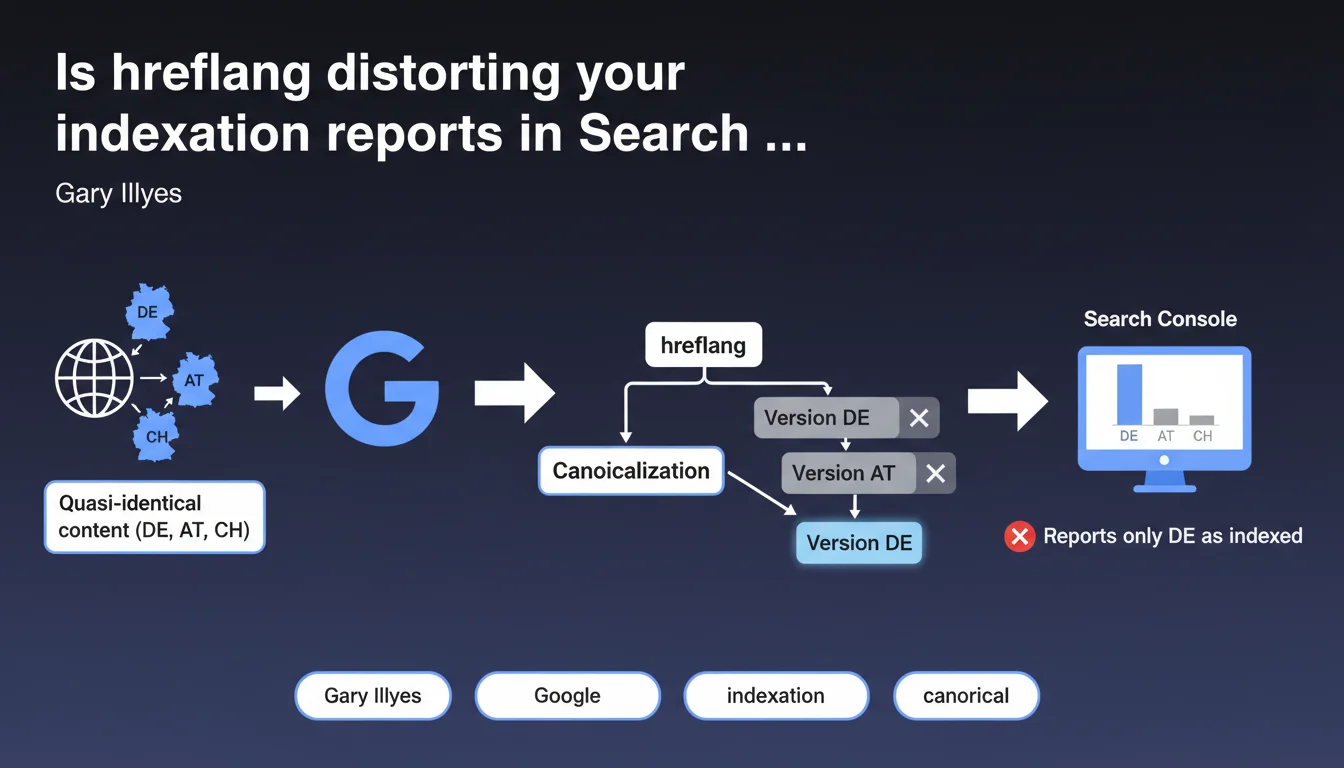
Google often canonicalizes multiple quasi-identical regional versions (German DE/AT/CH for example) toward a single URL. Search Console reporting then uses this unique canonical, which masks the other versions and wrongly suggests they're no longer indexed when they technically still are.
What you need to understand
Why does Google canonicalize regional versions that are supposed to be distinct?
When multiple URLs offer quasi-identical content in the same language (German for DE, AT, CH for example), Google treats them as duplicates. Rather than indexing all variants, it chooses one as the canonical version and consolidates signals there.
The problem? This canonicalization happens even when hreflang is correctly implemented. Google sometimes ignores your annotations if the content is too similar.
How does Search Console report these canonicalized pages?
Search Console displays only the canonical version chosen by Google. The other regional URLs disappear from indexation reports, performance data, and coverage.
Concretely, you see your /de/ page indexed, but /de-at/ and /de-ch/ don't appear anywhere — even though they're technically crawled and eligible. This is a reporting black hole.
What are the practical consequences of this confusion?
You might panic thinking your regional variants have been deindexed or penalized. In reality, they're simply hidden from reporting because Google treats them as duplicates of the canonical.
Another risk: you might over-optimize or unnecessarily modify these pages thinking they have an indexation problem.
- Google canonicalizes regional versions with too-similar content even if hreflang is present
- Search Console only reports the canonical chosen by Google, not all variants
- The other URLs aren't deindexed — they're just invisible in reports
- This confusion can lead to incorrect diagnostics and unnecessary SEO actions
SEO Expert opinion
Is this statement consistent with real-world observations?
Yes, and it's frustrating. We regularly observe multilingual sites with perfectly configured hreflang where Google completely ignores the annotations and canonicalizes to a single version. The content is often too close for Google to consider the regional distinction meaningful.
The major problem? Google doesn't warn you. No alerts in Search Console. You discover canonicalization by analyzing server logs or testing the URL Inspection Tool on each variant — and there, surprise, Google tells you a different canonical than the one you declared.
What nuances should be added to this claim?
Gary Illyes remains vague about what exactly triggers this canonicalization. He talks about "quasi-identical" content — but what similarity threshold does Google apply? 90%? 95%? No concrete data. [To verify] on your own sites with content at different differentiation levels.
Another point: this statement implies hreflang is respected except when content is too similar. Let's be honest — that amounts to saying hreflang only works when content is sufficiently distinct, which severely limits its usefulness for legitimate regional variants.
In what cases does this rule not apply?
If your regional variants have genuinely differentiated content — local adaptations, currencies, cultural references, region-specific customer testimonials — Google should respect your hreflang annotations and not arbitrarily canonicalize.
But watch out — this is where it gets tricky: even with visible differences, if the HTML structure and main body text remain identical at 85-90%, Google may still decide it's duplicate. You really need to make a strong effort to differentiate.
Practical impact and recommendations
How do you verify if Google is canonicalizing your regional variants?
Use the URL Inspection Tool in Search Console on each regional variant. Look at the "Canonical URL selected by Google" line. If it points to a different version than the one declared in your hreflang, you're affected.
Supplement with a site:yourdomain.com/de-at/ search in Google. If results are empty or only show the /de/ version, it's confirmed: canonicalization underway.
What concrete steps should you take to avoid this problem?
The only reliable solution: genuinely differentiate content between your regional variants. Not just changing two words — you need unique sections, local examples, adapted calls-to-action, region-specific customer testimonials.
If content must remain identical (for legal reasons or standardized products, for example), accept the canonicalization. Focus your SEO efforts on the canonical version and use hreflang only for geographic distribution of search results.
- Audit all regional variants with the URL Inspection Tool to identify unwanted canonicalizations
- Analyze content similarity rate between variants (tools like Copyscape, Siteliner)
- Differentiate each variant's content with unique local sections (minimum 20-30% distinct content)
- Regularly monitor server logs to verify Googlebot crawls all versions
- Don't rely solely on Search Console — cross-check with site: and URL Inspection Tool
- If canonicalization is unavoidable, focus SEO on the canonical version and accept that others serve only for regional distribution
❓ Frequently Asked Questions
Hreflang empêche-t-il vraiment la canonicalisation entre variantes régionales ?
Comment savoir quelle variante Google a choisi comme canonique ?
Mes variantes régionales disparues de Search Console sont-elles désindexées ?
Quel niveau de différenciation de contenu faut-il pour éviter la canonicalisation ?
Faut-il abandonner hreflang si mes contenus régionaux sont trop similaires ?
🎥 From the same video 17
Other SEO insights extracted from this same Google Search Central video · published on 22/06/2023
🎥 Watch the full video on YouTube →
💬 Comments (0)
Be the first to comment.