
Official statement
Other statements from this video 17 ▾
- □ Pourquoi votre site n'apparaît-il pas dans Google : indexation ou ranking ?
- □ Pourquoi Google pousse-t-il Search Console pour diagnostiquer l'indexation ?
- □ L'URL Inspection Tool de Search Console remplace-t-il vraiment le test d'indexation manuel ?
- □ Le rapport d'indexation de la Search Console suffit-il vraiment à diagnostiquer vos problèmes d'indexation ?
- □ Faut-il vraiment chercher à indexer 100% de ses pages ?
- □ Pourquoi Google indexe-t-il toujours la page d'accueil en premier sur un nouveau site ?
- □ Pourquoi votre homepage n'apparaît-elle toujours pas dans l'index Google ?
- □ Votre site est-il vraiment absent de l'index Google ou juste victime de la canonicalisation ?
- □ Hreflang fausse-t-il vos rapports d'indexation dans Search Console ?
- □ Pourquoi vos pages 'site en construction' ne seront jamais indexées par Google ?
- □ Pourquoi certaines pages s'indexent en quelques secondes et d'autres jamais ?
- □ Google peut-il encore indexer l'intégralité du web ?
- □ Google applique-t-il vraiment un quota d'indexation par site ?
- □ Faut-il supprimer l'ancien contenu pour améliorer l'indexation du nouveau ?
- □ Faut-il vraiment utiliser la fonction 'Demander une indexation' de la Search Console ?
- □ L'opérateur site: est-il vraiment fiable pour mesurer l'indexation de votre site ?
- □ Comment exploiter vraiment l'opérateur site: au-delà de la simple vérification d'indexation ?
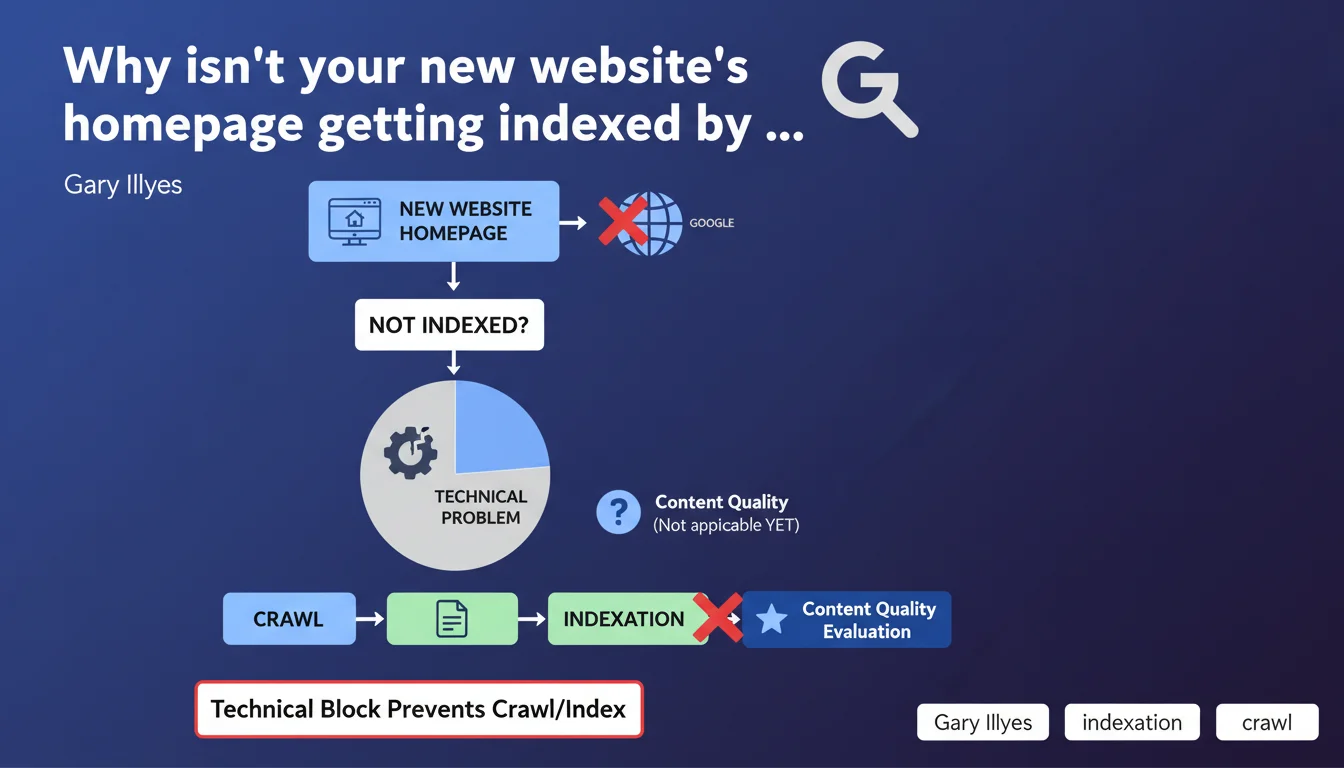
When a new website's homepage fails to index, it's almost always a technical issue, not a content quality problem. Google cannot evaluate content quality before crawling pages — so if nothing is indexing, look for a technical block (robots.txt, noindex, server errors, redirects...).
What you need to understand
What does Gary Illyes' statement really mean?
Gary Illyes lays down a simple principle: the indexation of a new site's homepage has nothing to do with content quality. If Google can't index your homepage, it's because it can't access it, read it, or process it — period.
In practical terms? The quality evaluation process happens after crawling and indexation, not before. Google doesn't decide to ignore your homepage because it's mediocre. If it's not indexing, there's a technical obstacle preventing Googlebot from doing its job.
Why is this distinction so important?
Because it reframes your diagnostic approach. Too many new site owners try to improve their content when their homepage won't index, when the problem is elsewhere. They waste time on copywriting or design when they should be inspecting their robots.txt file, meta tags, server configuration, or redirects.
This statement tells you: stop asking existential questions about your content quality. Open Search Console, check your server logs, track down the block.
What are the most common technical blocks?
Most of the time, you'll find the same culprits:
- Misconfigured robots.txt blocking access to the root or critical resources
- Meta noindex tag left in place after development phase
- HTTP Header X-Robots-Tag: noindex returned by the server
- Redirect loops or poorly managed redirect chains
- Server 5xx errors or repeated timeouts preventing crawl
- Canonical pointing to another URL creating ambiguity
- Content blocked by a firewall, CDN, or overly restrictive bot protection system
SEO Expert opinion
Is this statement consistent with real-world observations?
Yes, completely. From hundreds of new sites I've audited, homepage non-indexation is almost always technical. The exceptions — where Google refuses to index for qualitative reasons — involve near-empty pages, obvious spam, or sites clearly violating guidelines. But those aren't "legitimate new sites".
What's interesting is that Gary Illyes doesn't say "always," he says "almost always." This nuance leaves room for edge cases: identically duplicated sites, extreme thin content, or domains with a heavy spam history. But honestly? If you launch a clean site and it won't index, look for a technical bug — not an editorial problem.
What nuances should you add to this principle?
First point: this rule applies to new sites. On an established site, homepage non-indexation can have other causes — an algorithmic or manual penalty, for example. But for a brand new domain with no history, the question doesn't even come up: Google has no reason to penalize a site it has never seen.
Second point: Gary is talking about the homepage, but the principle extends to the first pages discovered. If nothing is indexing on a new site — neither homepage nor internal pages — that's a generalized technical block. If the homepage indexes but other pages don't, then you can start investigating other angles (architecture, internal linking, quality).
When doesn't this rule apply?
There are a few rare but real exceptions:
- Domains with a dark past: if you buy a domain name that was used for spam or phishing, Google can treat it with extreme suspicion — or even blacklist it.
- Cloned or scraper sites detected on first crawl: if your content is a complete copy of another site, Google may choose not to index anything.
- Near-empty or Googlebot-inaccessible pages: if your homepage contains only unrendered JavaScript, or is blank server-side, Google can't evaluate much — but again, that's technical.
In summary: [To verify] if you think your new site isn't indexing for qualitative reasons. In 99% of cases, that's a misdiagnosis.
Practical impact and recommendations
What should you do concretely if your homepage won't index?
First step: open Search Console and run a URL inspection test on your homepage. It will immediately tell you if Google can access the page, if it's indexable, and if there's an obvious problem (noindex, robots.txt, server error).
If the test reveals a block, fix it — then request manual indexation. If the test shows the page is indexable but isn't appearing in the index, wait 48-72 hours and run the test again. Google can take a bit of time to process new URLs.
What mistakes should you absolutely avoid?
- Leaving a meta noindex tag in production after a staging environment
- Blocking access to /assets/, /wp-content/, or /cdn/ in robots.txt — this prevents Google from loading critical CSS/JS
- Configuring a canonical to another URL by mistake (e.g., to a dev environment)
- Serving 403 or 401 codes to Googlebot while the page is accessible to visitors (firewall or CDN issue)
- Creating redirect loops between www and non-www, or between HTTP and HTTPS
- Ignoring errors in server logs: repeated timeouts, 500s, 503s
- Relying solely on XML sitemap — if Googlebot can't crawl your homepage, the sitemap is useless
How do you verify your site is compliant and ready to be indexed?
Check these points in order:
- Test your homepage with the Search Console URL inspection tool — this is the source of truth
- Review your robots.txt file (yoursite.com/robots.txt): make sure it doesn't block the root or critical resources
- Check your HTML source code: no meta noindex tag, correct canonical, no X-Robots-Tag in HTTP response
- Analyze server logs to see if Googlebot is attempting to crawl and receiving errors
- Test loading speed: if the page takes 10 seconds to respond, Googlebot may timeout
- Verify that content is visible server-side (not only in client-side JavaScript)
In summary: non-indexation of a new site's homepage is a technical problem, not a quality issue. Don't waste time rewriting your content — track down the block using Search Console diagnostic tools and server logs. Once the problem is identified and fixed, indexation typically follows within 48-72 hours.
These checks may seem straightforward on paper, but server configurations, CDN/firewall interactions, and architectural subtleties can make diagnosis complex at times. If you hit a case that resists your fixes, or if you want a complete audit to prevent these blocks from launch day, engaging a specialized SEO agency can save you valuable time and secure your visibility from the start.
❓ Frequently Asked Questions
Combien de temps faut-il attendre avant de s'inquiéter si la homepage ne s'indexe pas ?
Le sitemap XML peut-il forcer l'indexation d'une homepage bloquée techniquement ?
Un nouveau site avec un contenu léger peut-il ne pas s'indexer pour des raisons qualitatives ?
Faut-il soumettre manuellement la homepage via la Search Console ?
Un domaine neuf avec un historique spam peut-il être refusé à l'indexation ?
🎥 From the same video 17
Other SEO insights extracted from this same Google Search Central video · published on 22/06/2023
🎥 Watch the full video on YouTube →
💬 Comments (0)
Be the first to comment.