
Official statement
Other statements from this video 14 ▾
- 5:33 Can you really control which image appears in Google's text search results?
- 7:30 Why do your Search Console reports keep contradicting each other?
- 8:40 Should you really upload your disavow list only on the current domain?
- 10:06 Is Google really ranking your internal pages above your category pages—and should you be worried?
- 11:21 Why does the public URL test fail so frequently in Search Console?
- 15:15 Do 'Crawled – not indexed' pages really harm your entire website's visibility?
- 16:27 Why is Google treating your e-commerce category pages as duplicate content?
- 18:55 Does Google really interpret the intention behind your searches better than you think?
- 21:21 Do simple URLs really impact your Google rankings?
- 22:22 Can Google ignore your JavaScript if you place a noindex tag in the head?
- 24:24 Are iframes in your <head> really killing your SEO?
- 26:06 How can you accurately verify redirect behavior for Googlebot?
- 28:06 Can a misconfigured 301 redirect actually block your pages from being indexed?
- 30:28 How can you control the date displayed in Google search results?
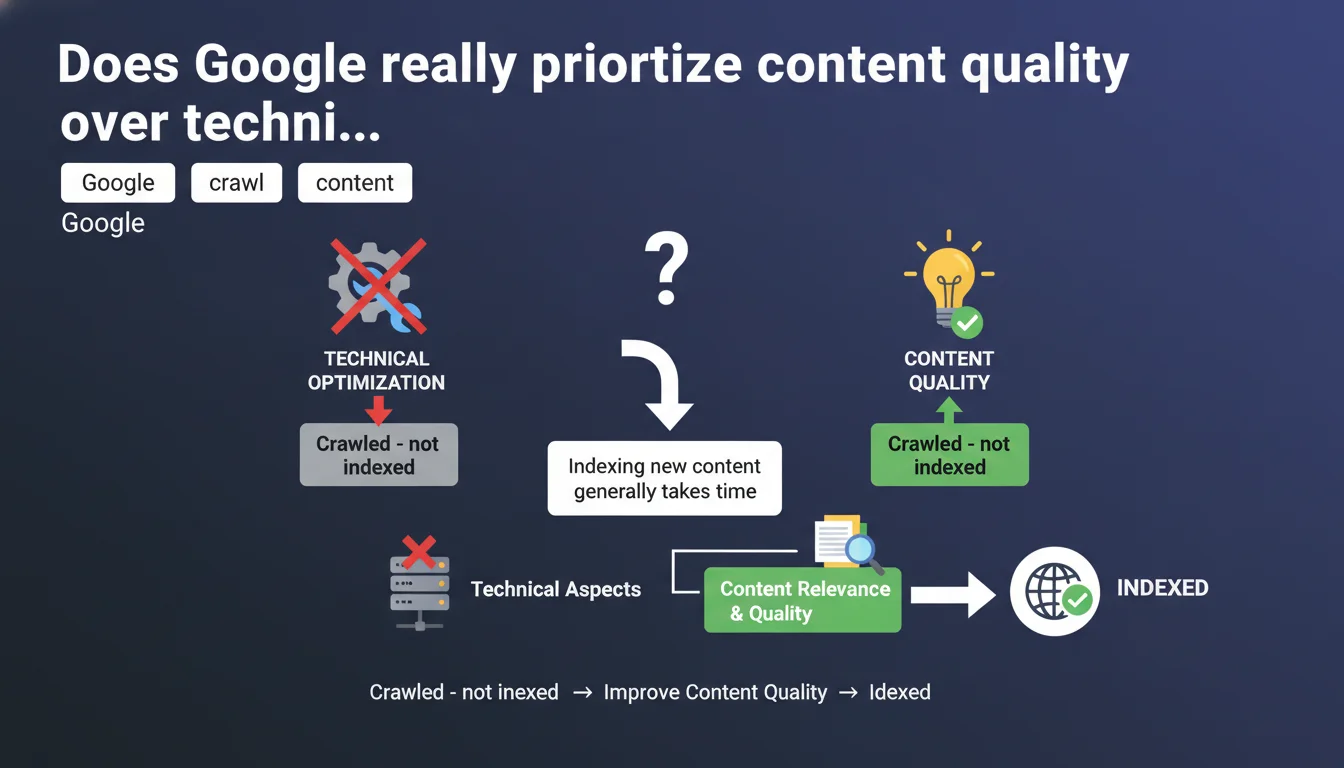
Google states that indexing new content takes time and that the 'Crawled - not indexed' status is more of a relevance and editorial quality issue than a technical problem. The focus should therefore be on improving the content itself rather than making technical adjustments to crawl or sitemap.
What you need to understand
What does the 'Crawled - not indexed' status really mean?
This status appears in Search Console when Googlebot has visited a URL without integrating it into the index. The page is known, analyzed, but deemed non-priority or insufficiently distinctive to deserve a place in search results.
Unlike other indexation statuses, this one doesn't indicate a technical roadblock — no robots.txt, no noindex tag, no server error. The crawl proceeded normally. The problem lies elsewhere.
Why does Google emphasize the notion of time?
Indexing is not instantaneous, even for quality content. Google must evaluate relevance, compare with existing content, allocate resources. New content can remain pending for several days, even weeks, before being indexed — especially on sites with low authority or a history of mediocre content.
This statement reminds us that we must be patient before diagnosing a structural problem. Many practitioners panic as soon as a page remains unindexed 48 hours after publication, when that's perfectly normal in most cases.
How does quality take precedence over technique here?
Google clearly directs the diagnosis: if your pages are crawled but not indexed, your first instinct should not be to fiddle with the XML sitemap or add canonical tags. You need to question editorial value: does this content offer something unique? Does it answer a clear search intent?
This prioritization is consistent with Google's quality guidelines — the algorithm prioritizes perceived relevance above all. Technically perfect content without substance will remain outside the index.
- The 'Crawled - not indexed' status is not a technical bug in the majority of cases
- Indexing takes time, especially on new or low-authority sites
- Editorial quality and relevance are the first levers to pull
- Google encourages thinking about content before infrastructure
SEO Expert opinion
Is this statement consistent with real-world observations?
Yes and no. On established sites with good crawl frequency, quality new content often indexes within a few hours. The delay mentioned by Google is observed mainly on new sites, low-authority sites, or those with weak content history.
Where it gets tricky: many 'Crawled - not indexed' cases persist despite decent editorial quality. We see unique pages, well-structured, with original angles, remain blocked for months. In these situations, technical actions — internal linking adjustments, removal of zombie content, consolidation of similar pages — often unblock indexing. [To verify]: Google likely simplifies to prevent webmasters from scattering their efforts, but reality is more nuanced.
What nuances should be added to this recommendation?
First, "improving quality" remains vague. Google provides no objective criteria — length? depth? demonstrated expertise? This imprecision leaves practitioners in the dark. Content "quality" for Google isn't always what an industry expert would consider quality.
Second, completely ignoring technical aspects is risky. If your site is massively generating crawled but unindexed URLs — thousands of product pages with generic descriptions, poorly managed filter facets — the problem isn't just editorial. It's also a matter of architecture and crawl budget. Consolidating, noindexing, canonicalizing becomes essential.
In what cases does this rule not really apply?
On large e-commerce sites, selective indexing is often intentional by Google to avoid saturating its index with nearly identical pages. Improving the quality of 10,000 similar product sheets won't change anything — you need to work on differentiation, internal linking, and sometimes accept that not all pages will ever be indexed.
Same goes for news sites: an article published at 6 PM can be crawled at 6:05 PM and indexed at 6:10 PM if the site has good authority and frequent crawl. The "time" mentioned by Google doesn't apply uniformly — it depends heavily on the site's profile.
Practical impact and recommendations
What should you do concretely about this status?
First step: wait. If the page was published less than two weeks ago, don't panic. Check that it's crawlable, that it appears in your sitemap, and let Google do its work.
If the status persists beyond three weeks, move to editorial analysis: does this page provide unique value? Is it better documented than existing competitor content already indexed? Does it answer a specific search intent?
Next, strengthen internal linking to this page from already well-indexed and authoritative pages. Google follows links — if your new content is orphaned or relegated to three clicks from the homepage, its indexing will be delayed.
What mistakes should you avoid in this context?
Don't fall into the technical over-optimization trap: frantically adding canonicals, multiplying indexing requests via Search Console, modifying the sitemap every hour. It won't help and can even degrade the signal you send to Google.
Also avoid publishing masses of mediocre content to "test." Google learns from your site's history — if you have a pattern of weak content regularly crawled but not indexed, the algorithm will be more selective on your future publications.
How do you verify your content deserves indexing?
Compare your page with the top 10 Google results for your target query. Ask yourself honestly: does my content provide something different, more complete, better structured? If the answer is no, Google has no reason to index it.
Use semantic analysis tools to verify topic coverage: do you address expected sub-topics? Do you answer related questions your users are asking?
- Verify that the page is technically crawlable (no noindex, robots.txt OK)
- Wait a minimum of 2 weeks before diagnosing a problem
- Analyze editorial value: uniqueness, depth, relevance
- Strengthen internal linking from already indexed pages
- Compare with competitor content already in SERPs
- If high rate of crawled-not indexed pages: audit overall architecture
- Avoid repeated indexing requests or compulsive technical modifications
❓ Frequently Asked Questions
Combien de temps faut-il attendre avant de considérer qu'une page crawlée ne sera jamais indexée ?
Faut-il supprimer les pages en statut 'Crawlé - non indexé' ?
Le statut 'Crawlé - non indexé' affecte-t-il le crawl budget ?
Demander l'indexation manuelle via la Search Console aide-t-il vraiment ?
Un bon maillage interne peut-il suffire à débloquer l'indexation ?
🎥 From the same video 14
Other SEO insights extracted from this same Google Search Central video · published on 05/03/2026
🎥 Watch the full video on YouTube →
💬 Comments (0)
Be the first to comment.