
Official statement
Other statements from this video 13 ▾
- □ Does content quality really impact every single Google ranking system?
- □ Does Google really prioritize high-quality pages when deciding what to crawl?
- □ Is Googlebot really that dumb, or is Google hiding something about how crawling actually works?
- □ Does page quality really determine how deeply Google crawls your website?
- □ Is Google really penalizing entire sections of your site based on quality patterns?
- □ Does moving low-quality UGC content really unlock your site's crawl potential?
- □ Does update frequency really affect how often Google crawls your pages?
- □ Does Google really filter certain topics during crawling and indexing?
- □ Can Google really crawl a page without indexing it if the content doesn't make sense?
- □ Is duplicate content really safe for your SEO?
- □ Can affiliate links coexist with a high-quality SEO strategy?
- □ Should you really have humans review your machine-translated content before publishing?
- □ Why does Google rely on links from 'normal websites' to evaluate your site's authority?
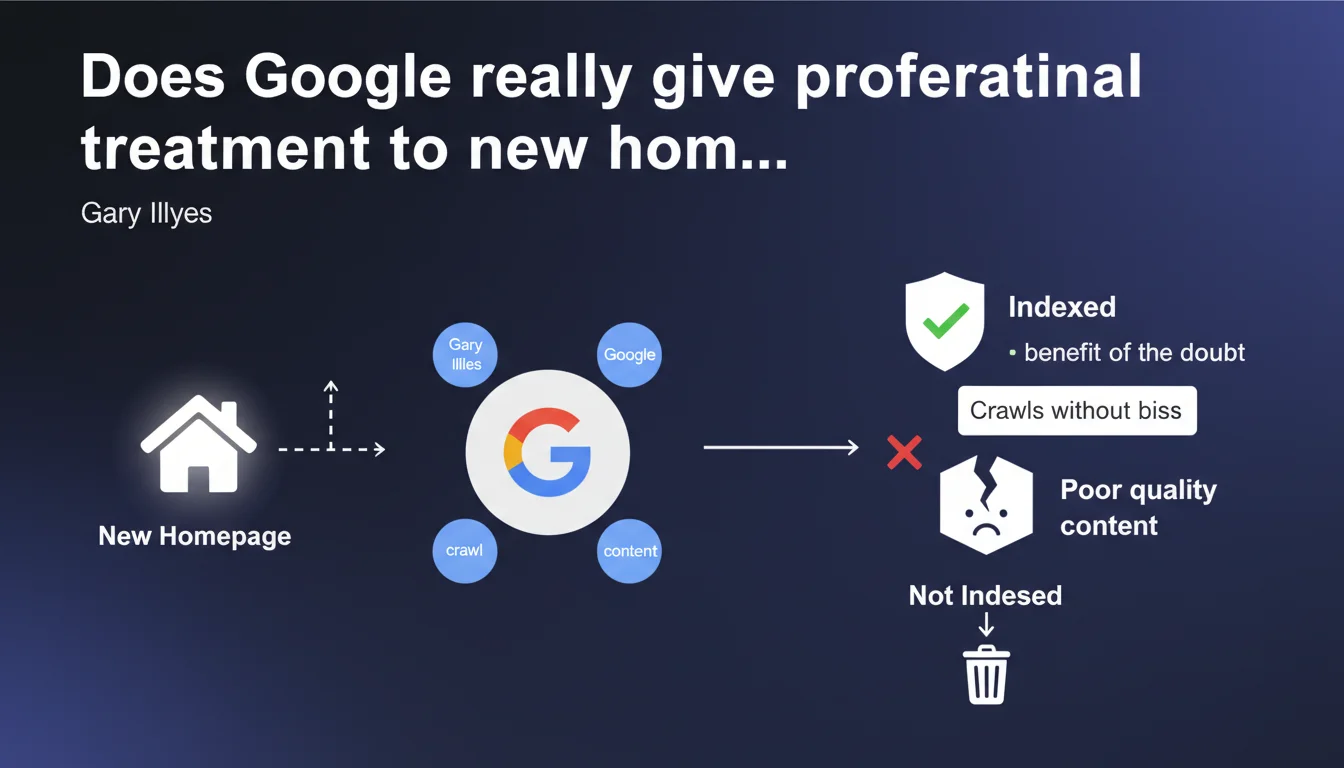
Gary Illyes claims that Google crawls homepages of new sites without prior bias and gives them the benefit of the doubt for indexation. Only very poor quality content would block this initial indexing. A statement that raises questions about what Google truly considers "very poor quality."
What you need to understand
What does "giving the benefit of the doubt" really mean in practice?
Google admits here that it cannot evaluate the quality of a new site before crawling it. The homepage therefore benefits from an initial neutral treatment — no preventive filters prevent it from entering the index.
This approach contrasts with other scenarios where Google applies predictions based on external signals (expired domain resold, detected site network, suspicious patterns). For a completely new homepage, these signals don't exist yet.
What qualifies as "very poor quality" content according to Google?
The wording remains vague. One might assume it refers to empty pages, obvious spam, massive scraping, or auto-generated content without value. But the exact threshold is not defined. [To be verified]
History shows that Google regularly indexes mediocre pages — the real sorting happens afterward, through algorithmic updates. Initial indexation is therefore no guarantee of quality.
Does this statement apply only to homepages?
Yes, and this is a crucial point. Illyes specifically discusses homepages of new sites. Internal pages, on the other hand, depend on crawl budget, link depth, and the site's perceived quality.
A new site with a quickly indexed homepage can very well see its secondary pages ignored for weeks if the structure is weak or if the content doesn't justify thorough crawling.
- Google crawls new homepages without prior algorithmic bias
- Initial indexation does not guarantee favorable ranking
- Only openly spammy content would block indexation — the bar is low
- This rule does not automatically extend to internal pages
- The real quality test occurs after indexation, during algorithmic evaluations
SEO Expert opinion
Is this statement consistent with real-world observations?
Partially. In practice, we do observe that most new homepages are crawled and indexed within a few days — even for very modest sites. Nothing surprising here.
However, the claim that there is "no bias or prior predictions" deserves some nuance. Google analyzes the domain name (WHOIS history, similarity with penalized domains), the first backlinks pointing to the site, and can very well apply a filter if negative signals appear from the start.
What limitations should be placed on this statement?
The "benefit of the doubt" does not mean fair treatment. A new site without authority, without backlinks, without history will remain low in rankings even if technically indexed. Indexation is only a first administrative step, not a quality validation.
Furthermore, the notion of "very poor quality" remains a subjective and opaque criterion. Google provides no concrete metrics — a site deemed acceptable today can be demoted tomorrow if a filter triggers. [To be verified]
In which cases does this rule not apply?
If the site is launched on a domain with a toxic history (spam, previous manual penalty), the benefit of the doubt may be forfeited. If the site belongs to a site network detected by Google, crawling can be delayed or filtered.
Finally, a site without any discoverability signals — zero backlinks, not declared in Search Console, missing sitemap — can remain invisible for several weeks, even if technically Google could crawl it.
Practical impact and recommendations
What should you concretely do to maximize this window of goodwill?
Since Google crawls the homepage without prejudice, you might as well optimize this first impression. The homepage content must be clear, structured, and immediately signal the site's theme. No generic placeholders, no "site under construction."
Declare the site in Search Console from day one and submit the XML sitemap to speed up the process. Even if Google eventually discovers the site naturally, why wait?
What mistakes should you avoid to not waste this benefit of the doubt?
Don't launch a site with an empty or nearly empty homepage. Google can index the page, but if it contains only a few lines of generic text, the algorithm will classify it as low-quality content on the first evaluation.
Also avoid launching a site with dozens of poor quality internal pages — even if the homepage passes, aggregated site signals can quickly trigger a global quality filter.
How can you verify that your site is truly benefiting from this neutral treatment?
Monitor indexation in Search Console. If the homepage doesn't appear in the index within 7 to 10 days, it's either a technical issue (robots.txt, accidental noindex) or a negative signal detected by Google.
Use site:yourdomain.com in Google to confirm indexation. If the page appears but doesn't rank on any keywords, even branded ones, it's an indicator that the benefit of the doubt doesn't extend to ranking.
- Create a homepage with substantial and structured content before launch
- Declare the site in Search Console and submit the sitemap on day one
- Verify the absence of blocking directives (robots.txt, noindex tag)
- Add a few initial backlinks from legitimate sources to accelerate discovery
- Monitor indexation within 7 days — if nothing appears, diagnose quickly
- Don't rely solely on indexation: produce relevant content quickly to validate perceived quality
❓ Frequently Asked Questions
Est-ce que Google crawle toutes les nouvelles homepages automatiquement ?
Une homepage indexée rapidement garantit-elle un bon classement ?
Qu'est-ce qui bloque réellement l'indexation d'une nouvelle homepage ?
Les pages internes bénéficient-elles aussi de ce traitement neutre ?
Faut-il attendre avant de soumettre un nouveau site à Google ?
🎥 From the same video 13
Other SEO insights extracted from this same Google Search Central video · published on 19/09/2023
🎥 Watch the full video on YouTube →
💬 Comments (0)
Be the first to comment.