
Official statement
Other statements from this video 16 ▾
- □ Are Google Search Essentials Really Enough to Rank Well in Google?
- □ Is user-centric content really the ranking factor Google claims it to be?
- □ Is Trust Really the True Central Pillar of E-E-A-T According to Google?
- □ Has first-hand experience become a non-negotiable ranking factor for Google?
- □ Is creator expertise really the game-changing ranking factor Google claims it is?
- □ Is thematic authority really enough to position yourself as a reference source in Google's eyes?
- □ Does Google really penalize you for not specifying timezone information in your structured data dates?
- □ Should you really update your article's publication date every time you make changes?
- □ Should you really remove all secondary dates from a page to boost your SEO performance?
- □ Should you remove logos and watermarks from your images to boost SEO performance?
- □ Does Google News really consider all websites automatically, or are there hidden criteria you need to know about?
- □ Why does Google News require complete transparency about author identity?
- □ Does Google really penalize websites when ads dominate editorial content?
- □ Are pop-ups and ads really killing your SEO rankings?
- □ Do you really need to tag ALL your outbound links with rel=sponsored or rel=ugc?
- □ Is your paywall triggering Google's cloaking detection without you knowing it?
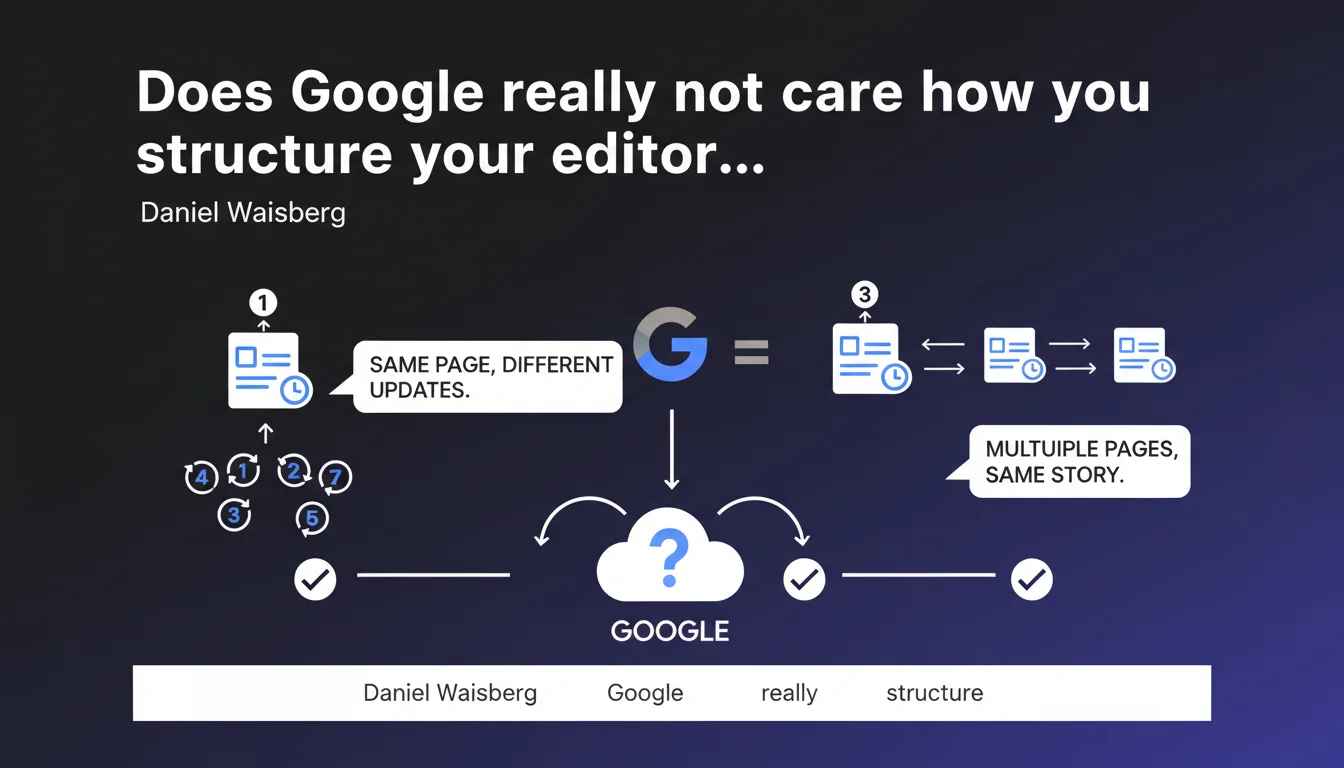
Google claims to have no preference between a single page updated regularly and multiple distinct pages to cover evolving news. This claimed neutrality leaves the door open to varied editorial strategies, but raises questions about the indirect signals each approach sends to the search engine.
What you need to understand
Why does Google bother clarifying this point?
This statement responds to recurring confusion in the press and media: should you create a new URL with each development in a story, or consolidate all updates on a single pivot page? Some sites multiply articles, others practice live blogging on a single continuously updated URL.
Google indicates that neither method benefits from an inherent algorithmic advantage. The absence of technical preference doesn't mean both approaches produce the same results in terms of visibility, traffic, or indexation.
What criteria actually influence ranking?
Google isn't saying structure has no impact—only that it doesn't enforce a model. In reality, each editorial choice sends different signals: a single page enriched continuously can signal continuous freshness, while multiple distinct pages multiply entry points and ranking opportunities for specific queries.
Behavioral metrics, content quality, thematic consistency, and user experience remain the real levers. Google's statement doesn't exempt you from thinking strategically about editorial architecture.
How do you interpret this neutrality in the context of evolving news?
This position reflects a logic where Google prioritizes content relevance and search intent over pure technical mechanics. A single page can be perceived as an evolving reference resource, ideal for generic queries. Multiple pages promote granularity and indexing of specific details.
- Stated neutrality: Google neither penalizes nor favors a specific editorial format for recurring news
- Strategic freedom: Publishers can choose based on their editorial constraints and traffic goals
- Indirect signals: Even without technical preference, each approach influences crawl, indexation, and user behavior differently
- Important context: This statement concerns continuous news, not all content types
SEO Expert opinion
Is this statement consistent with real-world practices?
Yes and no. On paper, Google indeed has no technical directive imposing a format. But in practice, sites that multiply URLs on the same event sometimes end up with undetected cannibalization issues overlooked by the editorial team. Conversely, a single page updated continuously can lose visibility if it doesn't send the right freshness signals—particularly through clear timestamps and structured markup. [To verify] The claim of total neutrality deserves nuance based on verticals and actual search behaviors.
Observations show that major news sites dominating SERPs on breaking news use vastly varied strategies—some create a new page with each significant development, others consolidate everything on a single URL updated every hour. The common thread? Solid technical infrastructure and the ability to trigger rapid reindexing.
What nuances should you apply to leverage this freedom?
Google isn't saying "do whatever you want without consequence." It's saying "we don't impose rigid rules." The distinction matters. A single page requires rigorous modification date management, schema.org tags (LiveBlogPosting notably), and internal architecture that signals each update as a distinct event in the content flow.
On the other hand, multiplying URLs requires mastering internal linking, avoiding duplicate title and meta description, and ensuring each page provides real incremental value. Let's be honest: many sites create 10 nearly identical articles on the same event just to capture quick traffic, without real editorial differentiation. That's a dilution risk.
In what cases does this neutrality become a trap?
When a site interprets "no preference" as "no optimization needed." A poorly structured single page, without clear timestamp or semantic markup, can be ignored by Google Discover or lose ranking against competitors who create dedicated pages with titles optimized for each query angle. Concretely? A sporting event, for example, can generate highly varied searches: "match result," "player X injury," "coach reaction." A single page won't capture all these intents as effectively as multiple targeted content pieces.
Practical impact and recommendations
What should you do concretely based on your editorial model?
If you opt for a single updated page, ensure each major modification is detectable by Google. This requires updating the dateModified tag in schema.org, visible timestamps for users, and ideally a versioning or internal sectioning system that structures content into identifiable blocks.
If you prefer creating multiple pages, ensure each new URL provides unprecedented information or a different angle. Avoid near-identical titles and redundant content risking cannibalization. Implement coherent internal linking between pages to signal editorial continuity.
What errors should you avoid to not dilute your visibility?
Classic mistake: publishing 5 successive articles with titles like "Breaking: event X," "Update: event X," "News: event X." Google can index multiple versions, but users see only one URL in results—often not your preferred one. Result: algorithmic confusion and loss of control over displayed messaging.
Another trap: maintaining a single page without ever explicitly signaling updates. Google may not recrawl fast enough, or consider the content hasn't changed enough to resurface in news. Without clear freshness signals, a page can stagnate even if objectively current.
How do you verify your structure is optimal?
Analyze your positions in Google Discover and Google News: a well-optimized single page should appear regularly with updated snippets. If not, your freshness signals may not be strong enough. With multiple pages, monitor cannibalization in Search Console: if multiple URLs compete for the same queries with low CTR, you have a structure problem.
- Implement appropriate schema.org (Article, NewsArticle, or LiveBlogPosting as needed)
- Systematically update the dateModified tag with each significant modification
- Use distinct titles and meta descriptions if creating multiple pages on the same event
- Structure content with clear h2/h3 headings to facilitate crawling and featured snippet extraction
- Monitor cannibalization metrics in Search Console and adjust if necessary
- Test reindexing speed via the Indexing API or URL inspection tool
❓ Frequently Asked Questions
Faut-il créer une nouvelle URL à chaque mise à jour d'une actualité ?
Une page unique mise à jour est-elle moins bien indexée qu'une nouvelle page ?
Comment éviter la cannibalisation si je crée plusieurs pages sur le même événement ?
Le schema.org LiveBlogPosting est-il obligatoire pour une page unique ?
Google favorise-t-il les sites qui publient plus d'URLs sur un événement ?
🎥 From the same video 16
Other SEO insights extracted from this same Google Search Central video · published on 15/05/2023
🎥 Watch the full video on YouTube →
💬 Comments (0)
Be the first to comment.