
Official statement
Other statements from this video 16 ▾
- □ Are Google Search Essentials Really Enough to Rank Well in Google?
- □ Is user-centric content really the ranking factor Google claims it to be?
- □ Is Trust Really the True Central Pillar of E-E-A-T According to Google?
- □ Has first-hand experience become a non-negotiable ranking factor for Google?
- □ Is creator expertise really the game-changing ranking factor Google claims it is?
- □ Does Google really penalize you for not specifying timezone information in your structured data dates?
- □ Should you really update your article's publication date every time you make changes?
- □ Should you really remove all secondary dates from a page to boost your SEO performance?
- □ Does Google really not care how you structure your editorial approach to breaking news?
- □ Should you remove logos and watermarks from your images to boost SEO performance?
- □ Does Google News really consider all websites automatically, or are there hidden criteria you need to know about?
- □ Why does Google News require complete transparency about author identity?
- □ Does Google really penalize websites when ads dominate editorial content?
- □ Are pop-ups and ads really killing your SEO rankings?
- □ Do you really need to tag ALL your outbound links with rel=sponsored or rel=ugc?
- □ Is your paywall triggering Google's cloaking detection without you knowing it?
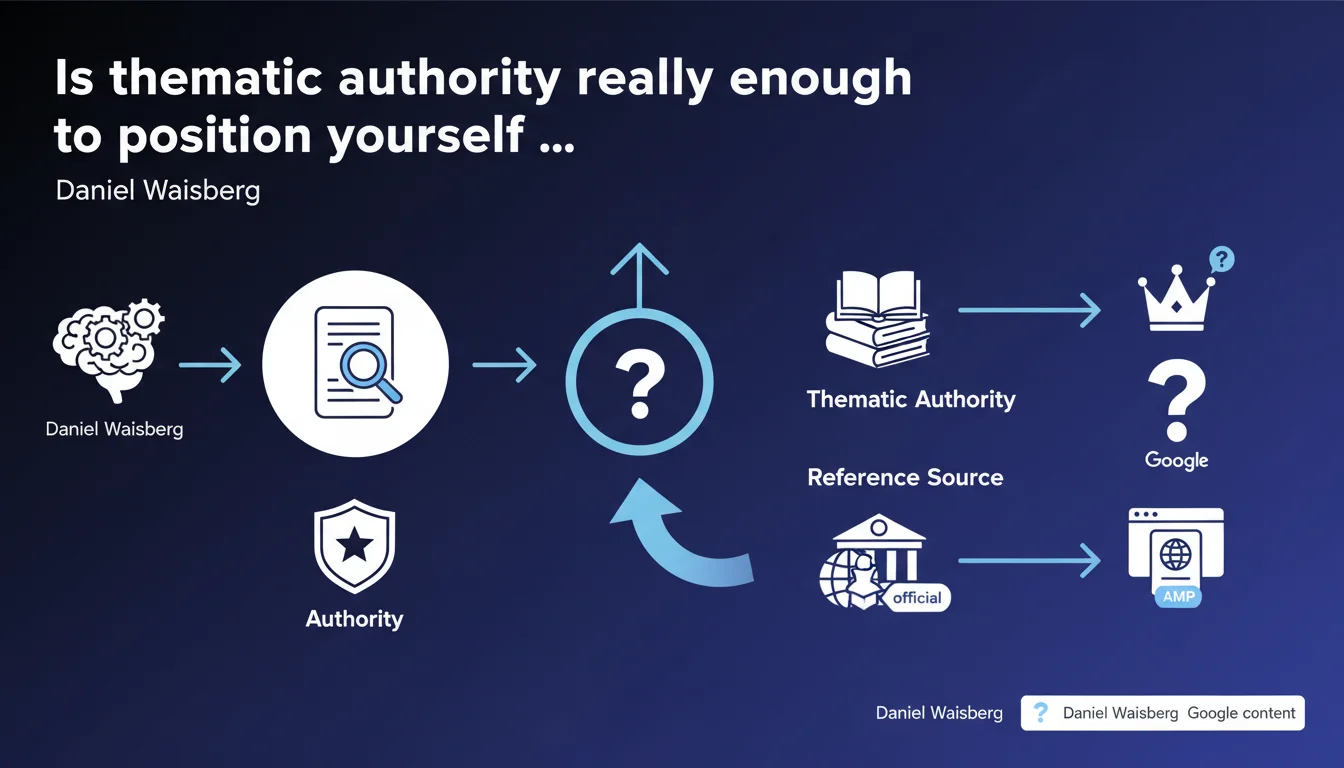
Google defines authority as the recognition of a creator or website as an indispensable source on a given topic. The passport example illustrates obvious institutional authority, but the concept remains unclear for competitive subjects. In practice, being perceived as an authority goes beyond backlinks — even though Google remains vague about the precise criteria.
What you need to understand
What's the difference between authority and mere expertise?
Google distinguishes here between authority (being recognized as a reference source) and expertise (mastering a subject). An expert can have solid skills without being perceived as THE reference by their ecosystem.
The passport example is revealing: the government website isn't necessarily the best designed or most comprehensive, but it holds institutional authority by nature. For non-institutional subjects, this recognition is acquired differently — and that's where it gets complicated.
How does Google actually measure this authority?
The statement remains deliberately vague about the technical signals used. We can assume that backlinks from recognized sites, brand mentions, co-occurrences with authoritative entities play a role.
But Google doesn't specify how it weighs these signals or how it distinguishes between two sources with comparable link profiles. It's a gray area that leaves room for interpretation.
- Authority doesn't come down to PageRank — even though links remain a strong indicator of recognition
- Google favors sources that build consensus in their domain, not just those that accumulate traffic
- On YMYL topics, institutional or professional authority takes priority over traditional editorial authority
- The notion of authority varies depending on the search query context — a source can be authoritative on one sub-topic and not on another
Why is Google emphasizing this concept so much right now?
Because generative AI and synthetic content have blurred the lines. Anyone can produce technically correct text without having the editorial legitimacy to back it up.
By emphasizing recognized authority, Google is trying to redirect creators toward building lasting reputation rather than optimizing isolated technical signals.
SEO Expert opinion
Does this definition of authority match what we observe in practice?
Yes and no. On YMYL queries (health, finance, legal), we indeed observe that Google favors institutional sources or those recognized by their peers. A government site, a professional association, an established media outlet will have a structural advantage.
But on typical commercial or informational queries, the authority measured by Google remains correlated with quality backlinks — whatever they say. A site with a solid and diverse link profile often wins against a technically better site but one that's less cited. [To verify]: the exact balance between link signals and behavioral signals in authority calculation remains opaque.
What contradictions does this statement raise?
Google talks about recognition as an indispensable source, but its algorithms continue to promote sites that accumulate traffic without necessarily being recognized by their peers. Well-optimized SEO content farms still capture positions — proof that algorithmic authority doesn't always match editorial authority.
Another point: the passport example is misleading. It's a case where authority is obvious and indisputable. But on "best CRM for SMBs" or "natural treatment for hypertension," who holds the authority? Google provides no objective criteria for determining this.
Can you build authority artificially?
Technically, yes — through strategic acquisition of contextual backlinks, editorial partnerships, press relations, targeted guest blogging. But this approach quickly hits its limits if it's not backed by real legitimacy.
Google is getting better at detecting artificial link profiles and authority manipulation attempts. The challenge today is to build authentic recognition — which takes time and requires a real editorial strategy, not just link building.
Practical impact and recommendations
What should you do concretely to build authority?
First, identify the thematic scope on which you want to be recognized. Wanting to be an authority on "digital marketing" is unrealistic for 99% of sites. Better to aim for "marketing automation for B2B e-commerce" and become THE reference in that niche.
Next, accumulate signals of recognition: citations in studies, conference speaking, publications in industry media, collaborations with recognized figures. These elements create a footprint that reinforces the authority perceived by Google and by users.
- Publish original content that generates editorial citations and natural links
- Establish partnerships with recognized players in your sector (co-publications, joint studies)
- Get mentions from third-party sources that themselves have authority
- Build consistent presence on the channels where your audience and peers are active
- Sign your content with identifiable authors who have demonstrable legitimacy
- Avoid artificial link-building tactics that create an inconsistent link profile
What mistakes undermine a site's authority?
Publishing on too many different topics dilutes thematic authority. A site that covers SEO, cooking, and finance at once is an authority on nothing. Google evaluates editorial coherence over time.
Another trap: buying backlinks from sites unrelated to your topic. This creates a suspicious link profile that can weaken your authority rather than strengthen it. Better 10 contextually relevant links than 100 generic ones.
How can you verify that your site is gaining authority?
Track the evolution of your backlink profile: proportion of links from recognized sites in your sector, diversity of referring domains, context of anchors. A site that's gaining authority naturally attracts more editorial links.
Also observe your positions on competitive informational queries. If you're advancing against established players without changing your technical implementation, it means Google is recognizing your growing authority.
❓ Frequently Asked Questions
L'autorité est-elle plus importante que la qualité du contenu pour le SEO ?
Peut-on avoir de l'autorité sur un site récent ?
Les backlinks restent-ils le principal signal d'autorité ?
Comment Google distingue-t-il autorité et popularité ?
L'autorité d'un site se transfère-t-elle à tous ses contenus ?
🎥 From the same video 16
Other SEO insights extracted from this same Google Search Central video · published on 15/05/2023
🎥 Watch the full video on YouTube →
💬 Comments (0)
Be the first to comment.