
Official statement
Other statements from this video 14 ▾
- □ Does Google really use just one algorithm to rank websites?
- □ Why is Google now officially differentiating between ranking systems and updates?
- □ Do you really need to overhaul your entire site after every Google update?
- □ Is Google finally consolidating the documentation of its ranking systems in one place?
- □ Should you really wait for a Google system to impact your traffic before taking action?
- □ Is Google really rolling out more updates or just communicating about them better?
- □ Does Google really limit search results to just two pages per domain?
- □ Is HTTPS losing its grip as a Google ranking factor?
- □ Should you ditch the technical SEO checklist and focus solely on user experience instead?
- □ Is Page Experience optimization becoming impossible by focusing on individual signals?
- □ Are Google's technical guidelines really as binary and verifiable as they claim?
- □ Does word count really matter for Google rankings?
- □ Should you really display an author on every single page of your website?
- □ Is authentic content for a real audience truly the SEO game-changer Google claims it is?
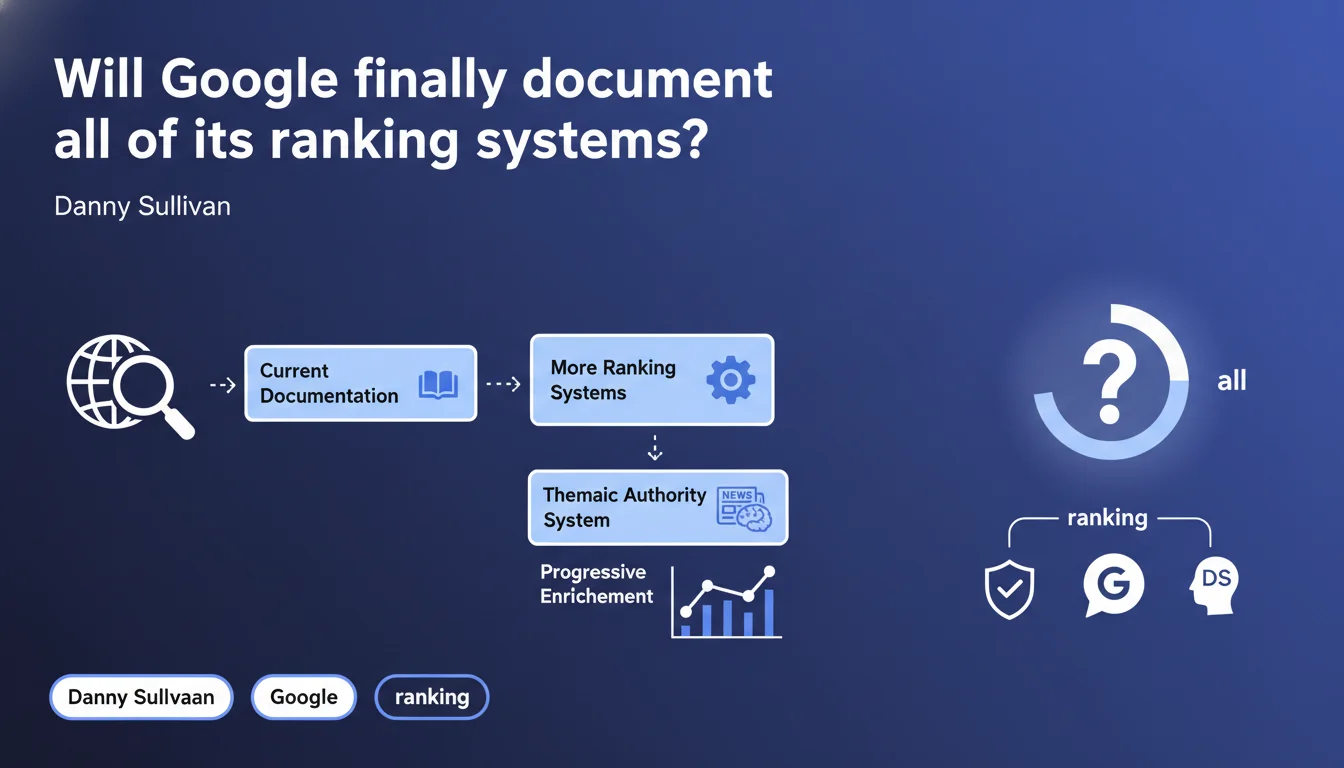
Google announces it will progressively enhance its official documentation by revealing more ranking systems — like the recent thematic authority system shared by the news team. A transparency move that could finally lift the veil on certain previously opaque mechanisms, provided the promised granularity delivers.
What you need to understand
What does this announcement of increased granularity actually mean in concrete terms?
Until now, Google documented its main ranking systems (Helpful Content, Core Updates, SpamBrain…) but remained vague about other mechanisms. Danny Sullivan's announcement suggests we'll finally gain access to technical details on secondary or specialized systems.
The cited example — the thematic authority system shared by the news team — illustrates this desire for transparency. Problem: we still don't know how frequently these publications will occur, or which systems will be involved.
Why this evolution now?
Google is facing mounting pressure from regulators (European DMA, US antitrust) and SEO professionals demanding more algorithmic transparency. Documenting systems is becoming less of a choice and more of a necessity.
The question remains whether this approach reflects a genuine commitment or is merely a communication exercise to appease critics. The coming months will tell.
What information can we expect to obtain?
In the best case: precise descriptions of evaluated signals, approximate thresholds, concrete examples of well/poorly ranked sites. In the worst case: marketing jargon without actionable substance.
The thematic authority example is revealing — we now know a system exists, but details remain thin. The promised « granularity » will need to go far beyond these cosmetic announcements.
- Google promises richer documentation on its secondary ranking systems
- The thematic authority system (news) serves as an example of this new approach
- No timeline or list of affected systems has been communicated
- This increased transparency likely responds to mounting regulatory pressure
- The actual quality of this documentation remains to be proven
SEO Expert opinion
Is this statement consistent with observed practices?
On paper, yes. Google has indeed begun documenting certain systems it kept under wraps before. The thematic authority system is a good example — previously, we deduced its existence through observation, now it's official.
But let's be honest: the gap between « documenting a system » and « providing actionable information » is enormous. Google excels at the art of saying things while revealing almost nothing. [To verify]: will this promised granularity truly go beyond the usual generalities?
What risks does this announcement carry?
First, the risk of overinterpretation. Each new documentation will trigger a wave of analyses, benchmarks, miracle SEO recipes — when the documented system may be just one signal among a hundred others.
Second, Google can document systems that are already obsolete or marginal to create an illusion of transparency without revealing anything strategic. It's the classic risk of « informational smoke screen ».
What strategy should you adopt in the face of these future publications?
First rule: systematically cross-reference what Google documents with what you observe in the field. If a system is documented but no A/B testing confirms its impact, remain skeptical.
Second rule: don't rush to optimize every newly revealed system. Focus on the fundamentals (content, UX, technical) — they will always remain a priority, regardless of documentation granularity.
Practical impact and recommendations
What should you do concretely in the short term?
For now, nothing radical. This announcement is more about strategic monitoring than immediate action. Set up a system for tracking Google's official publications (Search Central Blog, Danny Sullivan on X).
When a new system is documented, take time to break down the documentation: which signals are mentioned? What types of sites are affected? Are there concrete examples or only generic discourse?
How to prepare your site for these future revelations?
The best preparation remains to solidify the fundamentals. A site that respects the basics (clean architecture, quality content, positive UX signals) will naturally be better equipped, regardless of the documented system.
Build a database of your current performance (traffic, rankings, conversion rates by query type). That way, when Google reveals a new system, you can measure its real impact on your metrics.
- Set up monitoring of official Google publications (Search Central, Danny Sullivan)
- Don't modify your SEO strategy until a newly documented system proves its impact
- Systematically cross-reference official documentation with your field observations
- Strengthen the technical and editorial fundamentals of your site
- Document your current performance to measure future changes
- Avoid over-optimization: don't chase every new signal revealed
❓ Frequently Asked Questions
Quand Google va-t-il publier ces nouvelles documentations de systèmes ?
Le système d'autorité thématique concerne-t-il tous les sites ou seulement Google Actualités ?
Faut-il modifier sa stratégie SEO suite à cette annonce ?
Google va-t-il documenter ses principaux algorithmes de ranking ?
Comment savoir si un système documenté a vraiment du poids dans le classement ?
🎥 From the same video 14
Other SEO insights extracted from this same Google Search Central video · published on 22/08/2023
🎥 Watch the full video on YouTube →
💬 Comments (0)
Be the first to comment.