
Official statement
Other statements from this video 14 ▾
- □ Does Google really use just one algorithm to rank websites?
- □ Why is Google now officially differentiating between ranking systems and updates?
- □ Do you really need to overhaul your entire site after every Google update?
- □ Is Google finally consolidating the documentation of its ranking systems in one place?
- □ Should you really wait for a Google system to impact your traffic before taking action?
- □ Is Google really rolling out more updates or just communicating about them better?
- □ Will Google finally document all of its ranking systems?
- □ Does Google really limit search results to just two pages per domain?
- □ Is HTTPS losing its grip as a Google ranking factor?
- □ Is Page Experience optimization becoming impossible by focusing on individual signals?
- □ Are Google's technical guidelines really as binary and verifiable as they claim?
- □ Does word count really matter for Google rankings?
- □ Should you really display an author on every single page of your website?
- □ Is authentic content for a real audience truly the SEO game-changer Google claims it is?
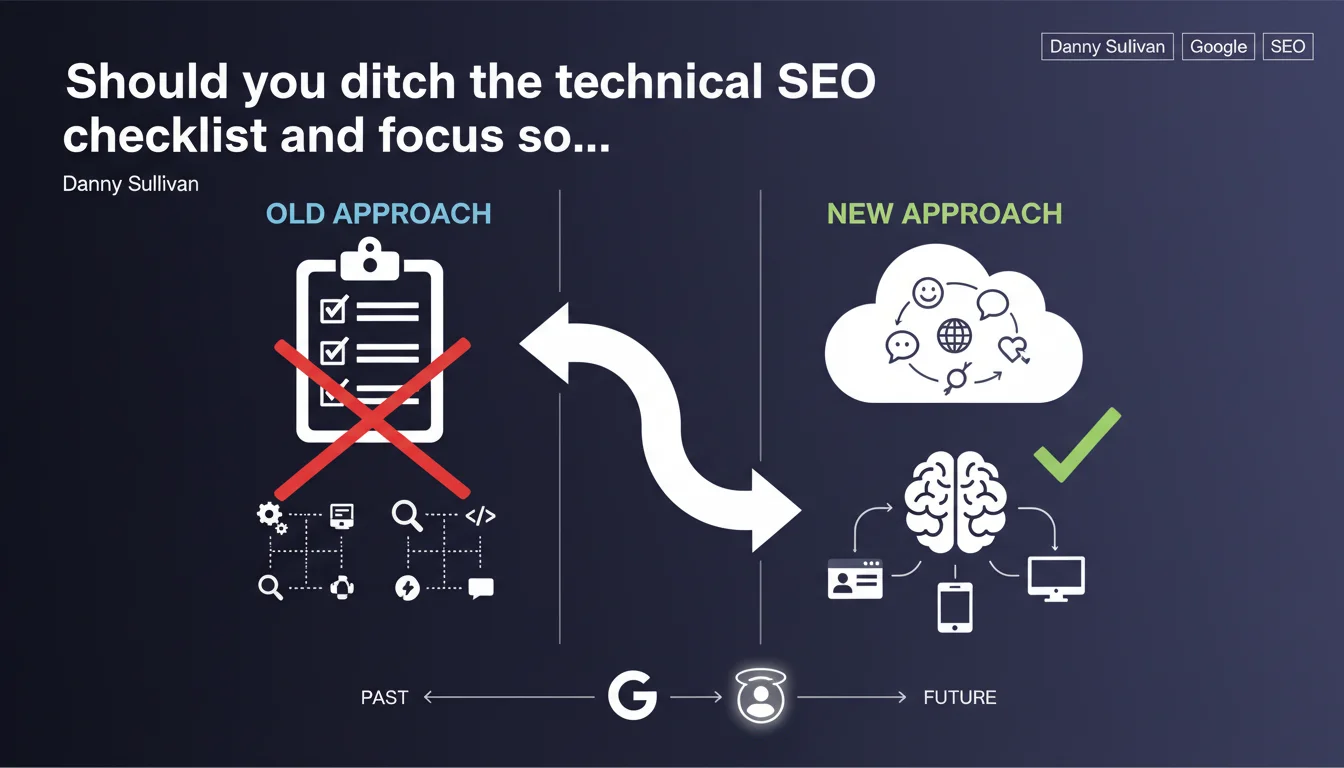
Google claims to be shifting from a logic of isolated technical signals to a holistic approach centered on overall mindset and user experience. Rather than checking off SEO boxes, you should adopt a comprehensive vision. A statement that raises more questions than it answers.
What you need to understand
What exactly does this "holistic approach" mean?
Danny Sullivan evokes a paradigm shift: Google would no longer be satisfied with analyzing isolated signals (meta descriptions, backlinks, loading speed) but would seek to understand the overall intent behind a site. The idea is to move from an "SEO checklist" logic to a philosophy centered on the end user.
Concretely? The algorithm would evaluate whether your site is built to answer a real need or simply to manipulate search results. A page with all technical signals in the green but a disappointing experience would be penalized — and conversely, rich content with some technical imperfections could outperform.
Does this vision replace the known technical criteria?
No. This is where Google's discourse becomes deliberately vague. Sullivan doesn't say that technical signals no longer matter, but that they're no longer sufficient on their own. Core Web Vitals, HTTPS, mobile-first remain basic prerequisites.
The underlying message: stop looking for the magic formula or the miracle signal that will skyrocket your rankings. Google wants you to think "user" before thinking "algorithm." Except that in practice, the algorithm remains a black box that reacts… to signals.
Why is Google communicating about this change now?
Two probable reasons. First, limit excesses: too many sites over-optimize technical details without caring about actual experience. Second, prepare the ground for algorithmic updates that increasingly integrate machine learning and behavioral analysis — difficult to explain in terms of binary signals.
- Shift from isolated signal logic to global evaluation of experience
- Technical criteria remain necessary but are no longer sufficient
- Google wants to discourage purely technical "gaming" practices
- Machine learning now allows analysis of complex behavioral patterns
SEO Expert opinion
Is this statement consistent with practices observed in the field?
Yes and no. [To be verified] because Google provides no concrete metrics to measure this "mindset." In the field, we indeed observe that technically perfect but content-poor sites stagnate. Conversely, sites with technical imperfections but real added value hold their ground.
But — and this is a big but — SEO audits continue to reveal that correcting specific technical signals (crawl budget, canonicals, structured data) generates measurable gains. So this "holistic approach" doesn't replace technique: it adds to it. Google plays on ambiguity to avoid giving a recipe.
What nuances should be applied to this idealized vision?
First nuance: not all sectors are equal. In e-commerce or news, technical signals and freshness weigh heavily. In long-form informational content publishing, experience and depth matter more. Google generalizes a trend that applies very variably depending on verticals.
Second nuance: this statement also serves to discourage over-optimization. Google knows that some SEOs spend more time analyzing microscopic details than producing valuable content. This is a political message as much as a technical one.
What are the risks if you apply this philosophy literally?
The main risk: falling into artistic vagueness. "Thinking user" is a noble concept but operationally vague. Without KPIs, without measurable signals, how do you drive an SEO strategy? You risk justifying any decision with "it's good for the user" without ever validating or refuting it.
Another risk: relaxing technical effort under the pretense that "mindset matters more." Google's crawlers remain machines that follow rules. If your site isn't technically exploitable, your good intentions will be worthless.
Practical impact and recommendations
What should you concretely do after this statement?
Continue to optimize the technical fundamentals — it's non-negotiable. But instead of treating each signal in isolation, ask yourself: does this optimization really improve experience, or am I just checking a box?
For example: optimizing Core Web Vitals only to turn green without improving perceived speed makes no sense in this logic. However, reducing perceived loading time (smart lazy loading, skeleton screens) addresses both the technical signal and real experience.
What mistakes should you avoid in this new approach?
Mistake number one: opposing technique and experience. They're two sides of the same coin. A fast, well-structured, accessible site is also a good user experience. Never sacrifice technique under the guise of prioritizing "the human side."
Mistake number two: believing there's a new mysterious signal to optimize. Google reveals nothing new here — it reframes an already existing trend. Don't launch into risky projects to "prove your mindset." Focus on measurable and actionable improvements.
How do you verify that your strategy aligns with this vision?
Ask yourself three questions for each SEO initiative:
- Does this optimization solve a real problem encountered by users?
- Can I measure the impact on engagement, bounce rate, time spent?
- Does this action improve both technical signals AND perceived experience?
- Am I building for my audience or trying to trick the algorithm?
If you honestly answer these questions, you're already on the right track. But let's be honest: translating these principles into concrete actions, prioritizing initiatives, measuring results — that's advanced SEO strategy work.
❓ Frequently Asked Questions
Dois-je arrêter de suivre mes signaux techniques habituels ?
Comment Google mesure-t-il cet « état d'esprit » ?
Cette approche holistique favorise-t-elle les gros sites ?
Faut-il revoir entièrement ma stratégie SEO actuelle ?
Cette déclaration annonce-t-elle une mise à jour algorithmique majeure ?
🎥 From the same video 14
Other SEO insights extracted from this same Google Search Central video · published on 22/08/2023
🎥 Watch the full video on YouTube →
💬 Comments (0)
Be the first to comment.