
Official statement
Other statements from this video 14 ▾
- □ Google utilise-t-il vraiment un seul algorithme pour classer les sites ?
- □ Pourquoi Google distingue-t-il désormais systèmes de classement et mises à jour ?
- □ Faut-il vraiment tout refaire après chaque mise à jour Google ?
- □ Google centralise-t-il enfin la documentation de ses systèmes de classement ?
- □ Faut-il vraiment attendre qu'un système Google impacte votre trafic avant d'agir ?
- □ Google multiplie-t-il vraiment les mises à jour ou communique-t-il simplement mieux ?
- □ Google va-t-il enfin documenter tous ses systèmes de classement ?
- □ Le HTTPS est-il en train de perdre son poids dans l'algorithme de Google ?
- □ Faut-il abandonner la checklist technique et miser uniquement sur l'expérience utilisateur ?
- □ La Page Experience est-elle devenue trop complexe pour être optimisée signal par signal ?
- □ Les directives techniques de Google sont-elles vraiment binaires et vérifiables ?
- □ Le nombre de mots est-il vraiment sans importance pour le classement Google ?
- □ Faut-il vraiment afficher un auteur sur toutes vos pages web ?
- □ Le contenu authentique pour audience réelle est-il vraiment la clé du SEO ?
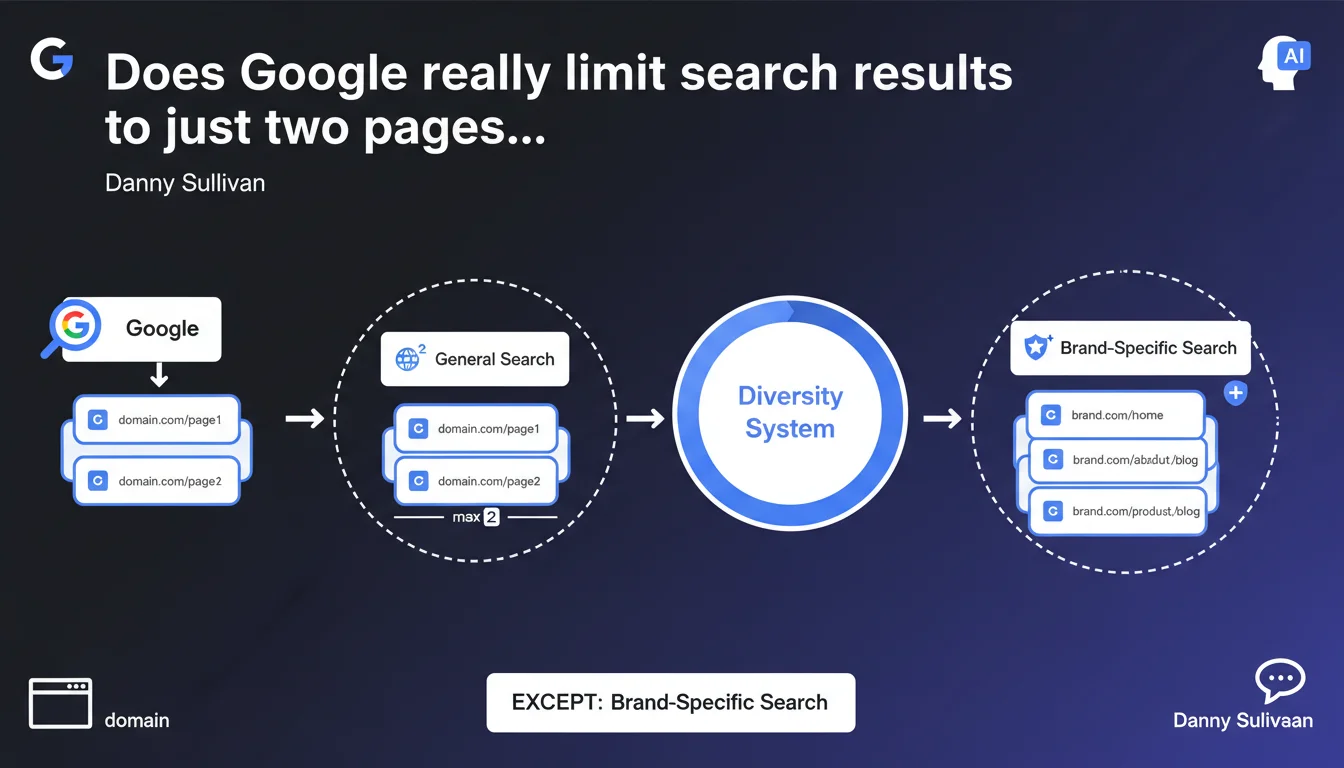
Google confirms that a diversity system generally limits to a maximum of two pages from the same website in the top search results. This rule loosens for brand-specific searches where multiple results from the same domain can appear. In practice, this filter directly impacts the visibility of sites that over-optimize too many pages for the same queries.
What you need to understand
What exactly is the site diversity system?
Google applies an automatic filter that prevents a single domain from monopolizing search results. In practice, when you run a typical informational or transactional query, you'll generally see only a maximum of two pages from the same website on the first page of results.
This system aims to provide a variety of sources to users. The idea: prevent a single player from totally dominating a SERP, even if they have exhaustive content on the topic.
Does this rule apply to all types of searches?
No, and that's where things get tricky. Google clarifies that this limitation loosens for brand searches. If someone types "Nike running shoes" or "Apple iPhone 15", the search engine can legitimately display 4, 5 or even more pages from the official site.
The problem? The boundary between "brand search" and "generic search" remains fuzzy. A query like "best CRM" would trigger the two-result limit, but "best CRM Salesforce" could already be considered brand-oriented.
Does this filter only concern the root domain or subdomains too?
Google generally considers subdomains as part of the same site for this diversity system. If you have blog.example.com and shop.example.com, both count toward the quota of maximum two results.
A few exceptions exist — highly differentiated subdomains can sometimes be treated separately, but that's not the norm. Don't count on it to bypass the system.
- Maximum two pages per domain in standard results
- Loosening for brand-specific searches
- Subdomains generally count in the same quota
- Objective: ensure diversity of sources for the user
- Direct impact on multi-page optimization strategies
SEO Expert opinion
Does this rule actually match what we observe in the field?
Overall, yes. On the majority of informational and commercial queries, we do observe this limitation to two results per domain. Repeated tests confirm this behavior over many years.
But — and this is important — exceptions are more frequent than one might think. Major authority sites (Wikipedia, Amazon, large media outlets) regularly exceed this limit on certain queries. [To verify]: Google has never explicitly stated the precise criteria that allow these exceptions.
Is the notion of "brand search" sufficiently clear?
Honestly? No. Google remains deliberately vague about what exactly constitutes a "brand-specific search". Is it enough to have a brand name in the query? Does the intent need to be clearly oriented toward that particular site?
In practice, we observe that even partially branded queries can trigger the filter relaxation. "CRM Salesforce pricing" will likely display more than two pages from Salesforce. But the boundary remains murky.
Can you bypass this system or exploit it strategically?
Bypass it? Hardly. Attempts to use multiple domains for the same commercial entity generally don't work — Google detects relationships between sites and can apply the diversity filter to the entire group.
Exploit it strategically? Yes, but not how you might think. Rather than creating 20 pages optimized for the same query, focus your efforts on a maximum of two pages per search intent. Identify your best assets and invest in those.
Practical impact and recommendations
How should you adapt your content strategy given this limitation?
First reflex: audit your existing pages to identify cannibalization cases. If you have multiple URLs targeting the same search intent, you're probably wasting potential. Google will choose two pages, you need to make sure they're the right ones.
Prioritize an intelligent consolidation approach. Rather than 5 average articles on "how to choose a CRM", create 1 or 2 truly comprehensive resources that deserve their place in the two available slots.
Should you rethink your site architecture and internal linking?
Absolutely. Your internal linking should clearly signal to Google which pages are your priorities for each topic. If you have two legitimately different pages that deserve to rank on variants of the same query, internal linking should reflect this hierarchy.
Also consider silo structure. If Google can only display two pages from your site, you might as well have those two pages cover complementary angles rather than redundant ones. A transactional page + an informational page, for example.
What common mistakes must you absolutely avoid?
Don't fall into the trap of multiplying nearly identical landing pages. This old-school strategy no longer works — you won't gain more visibility with 10 similar pages than with 2 truly solid pages.
Another frequent mistake: neglecting brand searches. If your brand is starting to gain recognition, optimize your ability to dominate SERPs on these queries. It's one of the rare cases where you can legitimately target more than two positions.
- Identify and resolve cannibalization cases between your pages
- Consolidate redundant content into stronger pillar resources
- Adjust internal linking to signal your priorities to Google
- Develop a strategy of complementary content rather than repetitive
- Specifically optimize for brand queries if applicable
- Regularly monitor your multiple positions on the same queries
- Avoid creating satellite domains to bypass the system
❓ Frequently Asked Questions
Les sous-domaines comptent-ils dans la limite de deux résultats par site ?
Peut-on avoir plus de deux résultats pour les recherches de marque ?
Comment éviter la cannibalisation entre mes pages avec cette règle ?
Cette limitation s'applique-t-elle aussi aux featured snippets et autres enrichissements ?
Créer des sites satellites permet-il de contourner cette règle ?
🎥 From the same video 14
Other SEO insights extracted from this same Google Search Central video · published on 22/08/2023
🎥 Watch the full video on YouTube →
💬 Comments (0)
Be the first to comment.