
Official statement
Other statements from this video 14 ▾
- □ Google utilise-t-il vraiment un seul algorithme pour classer les sites ?
- □ Pourquoi Google distingue-t-il désormais systèmes de classement et mises à jour ?
- □ Faut-il vraiment tout refaire après chaque mise à jour Google ?
- □ Google centralise-t-il enfin la documentation de ses systèmes de classement ?
- □ Google multiplie-t-il vraiment les mises à jour ou communique-t-il simplement mieux ?
- □ Google va-t-il enfin documenter tous ses systèmes de classement ?
- □ Google limite-t-il vraiment à deux pages par domaine dans ses résultats de recherche ?
- □ Le HTTPS est-il en train de perdre son poids dans l'algorithme de Google ?
- □ Faut-il abandonner la checklist technique et miser uniquement sur l'expérience utilisateur ?
- □ La Page Experience est-elle devenue trop complexe pour être optimisée signal par signal ?
- □ Les directives techniques de Google sont-elles vraiment binaires et vérifiables ?
- □ Le nombre de mots est-il vraiment sans importance pour le classement Google ?
- □ Faut-il vraiment afficher un auteur sur toutes vos pages web ?
- □ Le contenu authentique pour audience réelle est-il vraiment la clé du SEO ?
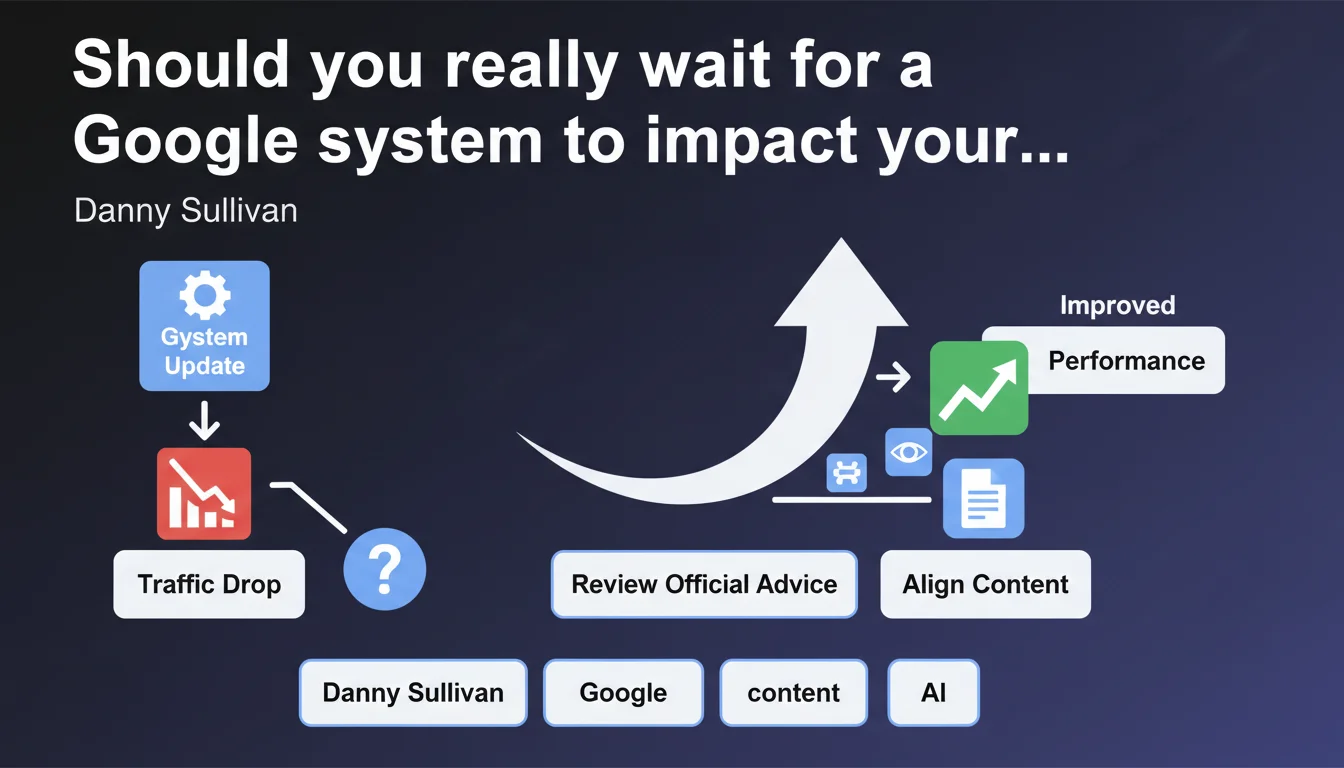
Google advises only intervening on your site after observing a traffic drop following the deployment of a system. This reactive approach assumes you actively monitor your metrics and can precisely identify which system penalized you — which in reality is not always straightforward.
What you need to understand
What does this Google recommendation concretely mean?
Danny Sullivan invites site publishers to adopt a wait-and-see strategy. Rather than panicking at every update announcement, the idea is to monitor your metrics and only intervene if you observe real negative impact.
This stance is based on the principle that a well-designed site, aligned with Google's quality expectations, has nothing to fear from updates. If your traffic drops, it means your content no longer matches the criteria of the deployed system.
Why does Google insist on this reactive approach?
The goal is to avoid unnecessary over-optimization. Too many sites change their strategy at every announcement, often without reason. Google wants to calm this Pavlovian reflex that generates noise and counterproductive adjustments.
By limiting interventions to cases of proven impact, Google also hopes to reduce misunderstandings: a traffic drop is not systematically linked to an algorithmic update. Correlation is not causation.
What are the prerequisites for applying this advice?
This approach works if you have a robust monitoring system. You must be able to quickly identify a drop in rankings, organic traffic, or conversions, and correlate it with Google's update calendar.
Without this data, you're flying blind. You risk missing a weak signal or, conversely, attributing a drop to Google when it comes from a technical issue or seasonality.
- Actively monitor your KPIs (rankings, traffic, CTR) via reliable tools
- Identify the timing of the drop to correlate it with official announcements
- Consult official advice associated with the system in question (Helpful Content, Core Update, etc.)
- Don't confuse correlation and causation — a technical bug may coincide with an update
- Act strategically based on identified signals, not randomly
SEO Expert opinion
Is this statement coherent with real-world reality?
In theory, yes. In practice, it's more nuanced. The reactive approach assumes Google documents each system clearly and its evaluation criteria. Yet "official advice" often remains vague — we talk about "helpful content," "quality," without defining precisely what that means.
Result: even following recommendations, you're sometimes in interpretation territory. [To be verified] in the field, some sites compliant with guidelines still experience unexplained drops. The granularity of systems isn't always stable.
In what cases does this rule not apply?
If your site operates in an ultra-competitive sector (finance, health, e-commerce), waiting for impact before acting can be too late. Your competitors optimize proactively, and you lose ground before even seeing the drop.
Likewise, certain early warning signs — such as progressive CTR degradation or rising bounce rates — can herald future impact. Waiting for the sharp drop amounts to letting a correctable situation deteriorate.
What nuance should we add to this approach?
The idea is not to freeze everything while waiting for a signal from Google. A well-managed site evolves continuously: new content, technical optimizations, UX improvements. This continuous evolution naturally puts you in a better position facing updates.
The trap is falling into systematic urgency logic. You see a Core Update announcement, you panic, you modify 50 pages — and you don't even know if you were affected. This sterile agitation is what Google wants to avoid.
Practical impact and recommendations
What should you concretely do after a traffic drop?
First, confirm that the drop is indeed linked to an update. Check your server logs, load time, 404 errors, indexation. A technical bug can mimic an algorithmic penalty.
Next, identify the impacted pages. All URLs don't lose traffic uniformly. Focus on those that dropped and analyze what they have in common: content depth, structure, internal links, EEAT signals.
Consult the official advice for the system in question. If it's Helpful Content, review your pages to verify they provide real added value. If it's a Core Update, look at overall site quality, trust signals, thematic authority.
What mistakes should you avoid in this process?
Don't modify your entire site at once. Proceed in waves, measure impact, iterate. A massive overhaul can worsen the situation if you don't correctly identify the problem.
Also avoid over-interpreting Google's statements. Danny Sullivan talks about "reviewing advice," not rewriting all your content. Often, a targeted adjustment is enough — semantic enrichment, better header structure, strengthened internal linking.
How do you verify your site aligns with Google's expectations?
Run your pages through the EEAT criteria (Expertise, Experience, Authoritativeness, Trustworthiness). Who writes? What credibility? What sources? What transparency about author and organization?
Test the real usefulness of content: do your pages answer a genuine question? Do they provide something you don't find elsewhere? Would a human read them willingly, not just for SEO?
- Set up daily monitoring of rankings and organic traffic
- Correlate drops with official Google update calendar
- Isolate impacted pages and analyze commonalities
- Verify technical aspects (indexation, speed, server errors) before concluding penalty
- Consult official guidelines for the identified system (Helpful Content, Core Update, etc.)
- Test targeted adjustments on a sample of pages before generalizing
- Measure impact of each modification over sufficient period (4 to 8 weeks)
- Don't modify entire site at once — proceed through iterations
❓ Frequently Asked Questions
Dois-je attendre une baisse de trafic avant d'optimiser mon site ?
Comment savoir si ma baisse de trafic est liée à une mise à jour Google ?
Que signifie 'réviser les conseils officiels associés' concrètement ?
Combien de temps faut-il attendre après une modification pour mesurer l'impact ?
Peut-on récupérer complètement après une baisse liée à un système Google ?
🎥 From the same video 14
Other SEO insights extracted from this same Google Search Central video · published on 22/08/2023
🎥 Watch the full video on YouTube →
💬 Comments (0)
Be the first to comment.