
Official statement
Other statements from this video 14 ▾
- □ Google utilise-t-il vraiment un seul algorithme pour classer les sites ?
- □ Faut-il vraiment tout refaire après chaque mise à jour Google ?
- □ Google centralise-t-il enfin la documentation de ses systèmes de classement ?
- □ Faut-il vraiment attendre qu'un système Google impacte votre trafic avant d'agir ?
- □ Google multiplie-t-il vraiment les mises à jour ou communique-t-il simplement mieux ?
- □ Google va-t-il enfin documenter tous ses systèmes de classement ?
- □ Google limite-t-il vraiment à deux pages par domaine dans ses résultats de recherche ?
- □ Le HTTPS est-il en train de perdre son poids dans l'algorithme de Google ?
- □ Faut-il abandonner la checklist technique et miser uniquement sur l'expérience utilisateur ?
- □ La Page Experience est-elle devenue trop complexe pour être optimisée signal par signal ?
- □ Les directives techniques de Google sont-elles vraiment binaires et vérifiables ?
- □ Le nombre de mots est-il vraiment sans importance pour le classement Google ?
- □ Faut-il vraiment afficher un auteur sur toutes vos pages web ?
- □ Le contenu authentique pour audience réelle est-il vraiment la clé du SEO ?
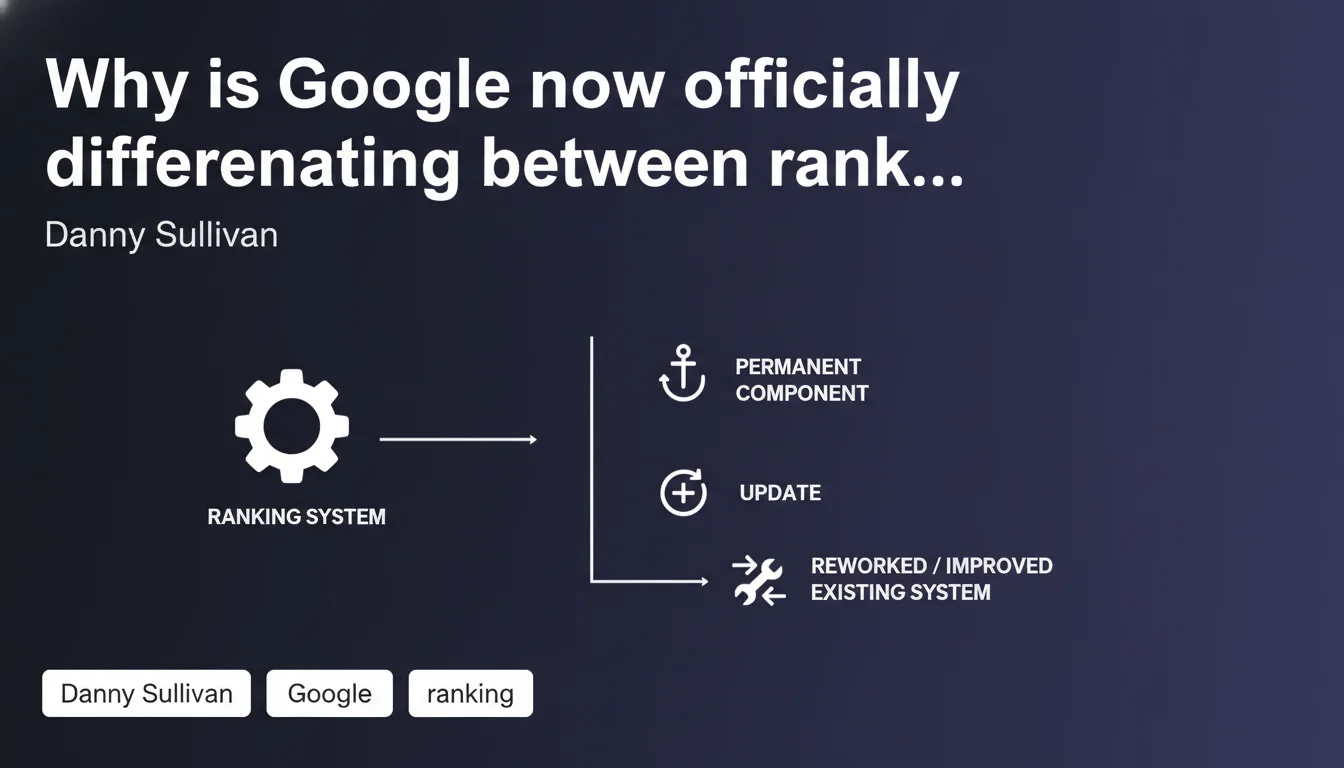
Google is formalizing a semantic distinction between "ranking systems" (permanent components of the algorithm) and "updates" (punctual improvements to an existing system). This clarification aims to avoid confusion in official communications, but remains largely cosmetic for SEO practitioners who already observe this nuance in the field.
What you need to understand
Was this distinction really necessary?
Until now, Google used the terms "update" and "system" interchangeably to designate changes to its algorithm. The Helpful Content Update became the Helpful Content System, without anyone really knowing if it was a fundamental change or just a vocabulary shift.
Danny Sullivan is therefore formalizing what was implicit: a ranking system is a permanent brick of the algorithm (PageRank, semantic analysis, E-E-A-T signals…), while an update means that a system has been reworked or improved.
Which systems does Google consider "permanent"?
Google maintains an official page listing its active ranking systems: Helpful Content System, Product Reviews System, Page Experience Signals, and more. These systems operate continuously, unlike the old punctual "updates" like Panda or Penguin that were deployed manually.
When Google announces an "update", it now means that one of these systems has been recalibrated, refined, or extended. For example, a "Helpful Content Update" indicates that the system's criteria have been adjusted, not that a new filter has been created.
Does this change anything for our SEO monitoring?
Not really. Most seasoned SEO professionals were already making this distinction intuitively. We knew that a "Core Update" retouched multiple systems simultaneously, while a "Product Reviews Update" targeted a specific mechanism.
The main benefit of this clarification? It makes Google's official communication more predictable. When they talk about a "system", we know it runs continuously. When they announce an "update", we know there's been a modification significant enough to be reported.
- System = permanent component of the algorithm, active continuously
- Update = improvement or recalibration of an existing system
- This distinction clarifies Google's communication, but doesn't fundamentally change our SEO approach
- "Core Updates" affect multiple systems simultaneously, which is why their impact is broader and less predictable
SEO Expert opinion
Is this statement consistent with observed practices?
Yes, but with a time lag. Google started renaming certain "updates" to "systems" several months ago — Helpful Content Update became Helpful Content System, for example. This declaration simply formalizes a practice already underway.
The problem? Google made this transition without prior explanations, leaving the SEO community to speculate on what it concretely meant. This clarification therefore arrives late, but it has the merit of existing.
What nuances should we add?
First nuance: not all systems are equally documented. Google officially lists certain systems (Helpful Content, Product Reviews, Page Experience…), but remains vague about other critical algorithm components. [To verify]: what actual share of the algorithm is covered by this official list? We don't know.
Second nuance: the boundary between "system" and "update" remains blurry in some cases. "Core Updates" are not technically a system, but global adjustments affecting multiple systems simultaneously. Google never details which ones — which limits the practical usefulness of this distinction.
Third nuance: some historical systems (Panda, Penguin) have been integrated into the main algorithm and now run in real time. They no longer subject to announced "updates", but can be adjusted silently. So even with this distinction, we don't always know what's changing.
In what cases does this rule not apply?
Google rarely announces minor adjustments to a system. If the Helpful Content System is slightly refined without massive impact, no official communication will be made. The "system vs update" distinction therefore applies only to changes deemed significant by Google.
Another limitation: bugs and rollbacks. When Google deploys an update that causes undesired side effects, it can cancel or correct quietly. These corrections are never described as "updates", even though they effectively modify the behavior of a system.
Practical impact and recommendations
What should we do concretely?
First thing: adjust your SEO monitoring. When Google announces an "update" to a system, focus your analysis on that system's specific criteria. If it's a Helpful Content Update, check editorial quality, content depth, and displayed expertise. If it's a Product Reviews Update, scrutinize your product pages and comparisons.
Second action: stop panicking unnecessarily. A "system" active continuously shouldn't cause sudden fluctuations, unless you've just published content or massively modified your site. If you see position variations, first look for a recently announced "update" before suspecting a permanent system.
Third point: regularly consult the official list of ranking systems maintained by Google. It evolves — some systems become obsolete, others appear. It's a good gauge of Google's current priorities.
What mistakes should we avoid?
Mistake #1: believing that a "permanent" system means it never changes. A system can be active continuously AND regularly adjusted. That's precisely why Google announces "updates" to existing systems.
Mistake #2: ignoring undocumented systems. Google officially lists a handful of systems, but the algorithm accounts for many others (internal link analysis, duplicate content detection, freshness consideration…). This declaration covers only a visible part of the iceberg.
Mistake #3: over-optimizing for a single system. If you focus your entire strategy on the Helpful Content System while neglecting technical signals (Core Web Vitals, mobile-friendliness) or authority (backlinks, E-E-A-T), you remain vulnerable to the other systems running in parallel.
How can I verify my site is compliant?
First step: map your pages by ranking system. Identify which pages are likely evaluated by the Helpful Content System (blog articles, guides), which fall under the Product Reviews System (product sheets, comparisons), etc. This allows you to prioritize your efforts.
Second step: audit each page type according to the documented criteria of the corresponding system. Google publishes official guidelines for certain systems (particularly Helpful Content and Product Reviews). Use them as your reference framework.
Third step: monitor fluctuations after each announced update. If your traffic drops after a Helpful Content Update, that's a clear signal that certain pages don't meet the system's criteria. Analyze which ones, compare with competitor pages that are rising, and adjust.
- Update your SEO monitoring calendar by integrating the systems/updates distinction
- Consult Google's official list of active ranking systems
- Map your pages according to the systems that likely evaluate them
- Audit each content type according to the documented criteria of the relevant system
- Monitor official announcements of updates via Google Search Central
- Analyze traffic fluctuations after each update to identify weaknesses
❓ Frequently Asked Questions
Un système de classement peut-il être désactivé par Google ?
Les Core Updates sont-elles des mises à jour ou des systèmes ?
Google annonce-t-il toutes les mises à jour de systèmes ?
Comment savoir quel système a impacté mon site après une baisse de trafic ?
Cette distinction change-t-elle la fréquence des mises à jour ?
🎥 From the same video 14
Other SEO insights extracted from this same Google Search Central video · published on 22/08/2023
🎥 Watch the full video on YouTube →
💬 Comments (0)
Be the first to comment.