
Official statement
Other statements from this video 14 ▾
- □ Google utilise-t-il vraiment un seul algorithme pour classer les sites ?
- □ Pourquoi Google distingue-t-il désormais systèmes de classement et mises à jour ?
- □ Faut-il vraiment tout refaire après chaque mise à jour Google ?
- □ Faut-il vraiment attendre qu'un système Google impacte votre trafic avant d'agir ?
- □ Google multiplie-t-il vraiment les mises à jour ou communique-t-il simplement mieux ?
- □ Google va-t-il enfin documenter tous ses systèmes de classement ?
- □ Google limite-t-il vraiment à deux pages par domaine dans ses résultats de recherche ?
- □ Le HTTPS est-il en train de perdre son poids dans l'algorithme de Google ?
- □ Faut-il abandonner la checklist technique et miser uniquement sur l'expérience utilisateur ?
- □ La Page Experience est-elle devenue trop complexe pour être optimisée signal par signal ?
- □ Les directives techniques de Google sont-elles vraiment binaires et vérifiables ?
- □ Le nombre de mots est-il vraiment sans importance pour le classement Google ?
- □ Faut-il vraiment afficher un auteur sur toutes vos pages web ?
- □ Le contenu authentique pour audience réelle est-il vraiment la clé du SEO ?
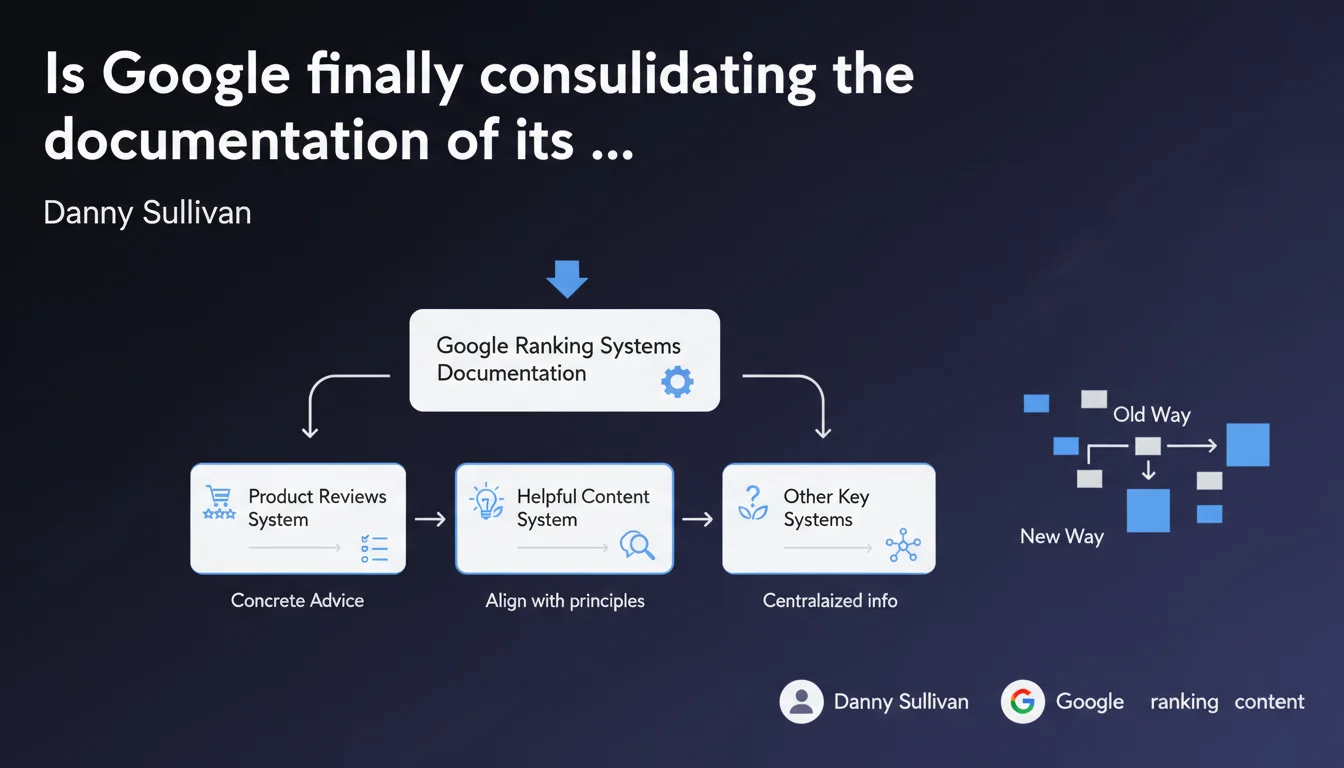
Google is creating dedicated pages to explain each major ranking system (product reviews, helpful content, etc.). Each page provides practical advice on what the system evaluates and how to adapt your content accordingly. The stated goal: greater transparency for website creators.
What you need to understand
Why is Google centralizing the documentation of its ranking systems?
Until recently, understanding Google's ranking systems felt like solving a scattered puzzle across official blogs, YouTube videos, and cryptic tweets. Each update — Helpful Content, Product Reviews, Core Updates — sparked its own set of conflicting interpretations.
This initiative aims to structure the information into dedicated pages, accessible directly from Google Search Central. Each system now has its own documentation, with explicit criteria and concrete recommendations. The idea: reduce gray areas and help creators align their content more easily.
What exactly do these official pages contain?
Each page details the system's functionality, its evaluation criteria, and the signals it prioritizes. For instance, the Product Reviews Update page explains what distinguishes a high-quality product review from superficial content.
You'll also find actionable advice: what types of content to favor, what pitfalls to avoid, how to structure information. The format stays general — Google won't hand over its algorithms — but the level of detail is improving.
Who is this documentation aimed at?
Primarily content creators and publishers, not necessarily technical SEO specialists. Google is trying to speak directly to those producing the pages, avoiding overly technical jargon.
For SEO practitioners, this is an official reference to benchmark against real-world observations. These pages let you test hypotheses and verify whether what Google says matches what you actually see in the SERPs.
- Centralized documentation for each major ranking system
- Concrete advice on what each algorithm values
- Greater transparency to facilitate creator alignment
- Accessible format for both publishers and SEO professionals
- Official reference to compare against real-world data
SEO Expert opinion
Is this transparency really anything new?
Let's be honest: Google has been communicating about its systems for years. The difference here is the centralization. Instead of scattering information across 15 blog posts, everything is grouped into one coherent hub.
But the substance? It often remains fairly generic. Standard advice like "create quality content" or "provide real added value" doesn't revolutionize practice. What's missing are quantifiable thresholds: word count, depth of analysis, text-to-image ratio. [Worth verifying]: is following these recommendations alone enough to recover from a Helpful Content penalty?
Do real-world observations confirm these claims?
Partly. On the Product Reviews Update, the stated criteria (actual testing, detailed comparisons, visual proof) clearly align with pages that gain rankings. There's a clear correlation.
However, with the Helpful Content System, it's murkier. Some sites apply the official advice to the letter and see no improvement. Others with lighter content perform better thanks to secondary signals — domain authority, backlinks, CTR. The system alone doesn't explain everything.
What limitations should you keep in mind?
These pages remain communications-oriented. Google will never detail precise weightings, activation thresholds, or interactions between systems. It's a compass, not a GPS.
Second limitation: timing. These documentations evolve at Google's pace — sometimes lagging behind actual changes. A system can shift in the SERPs before the official page is updated. Always test before generalizing.
Practical impact and recommendations
What should you concretely do with these resources?
Start by mapping the systems that impact your niche. If you manage an e-commerce site with product pages, the Product Reviews page is top priority. If you publish informational guides, focus on Helpful Content.
Next, conduct an audit: compare your current content against the stated criteria. Identify gaps: missing visual proof, no real testing, overly surface-level content. Prioritize high-traffic pages.
How do I verify my site is compliant?
Build an internal scoring system based on official criteria. For example with Product Reviews: original photos present (yes/no), actual product testing (yes/no), comparisons with alternatives (yes/no), technical measurements (yes/no). Score each page.
Then cross-reference with performance data: which pages score high AND perform well? Which score high but stagnate? This reveals whether Google's criteria are sufficient or if other signals matter.
What mistakes should you absolutely avoid?
Don't turn these guidelines into a rigid template. Google values diversity and originality. If all your articles follow the same mechanical structure (intro + 5 sections + conclusion), it screams SEO-by-formula.
Another trap: overlooking unmentioned signals. Google barely discusses backlinks in these pages, yet they remain critical. Same for speed, mobile-first, E-E-A-T. These systems add to the others; they don't replace them.
- Identify systems that matter most for your niche
- Audit existing content against official criteria
- Create an internal scoring system to measure compliance
- Prioritize high-traffic pages
- Cross-reference scores with actual performance
- Avoid overly mechanical and repetitive structures
- Don't neglect other ranking signals (links, technical, UX)
- Test and iterate rather than blindly apply guidelines
❓ Frequently Asked Questions
Ces pages remplacent-elles les guidelines générales de Google ?
Google met-il à jour ces pages à chaque évolution des systèmes ?
Peut-on se fier uniquement à ces conseils pour optimiser son site ?
Les critères énoncés sont-ils exhaustifs ?
Comment savoir si mon contenu est pénalisé par un système en particulier ?
🎥 From the same video 14
Other SEO insights extracted from this same Google Search Central video · published on 22/08/2023
🎥 Watch the full video on YouTube →
💬 Comments (0)
Be the first to comment.