
Official statement
Other statements from this video 14 ▾
- □ Does Google really use just one algorithm to rank websites?
- □ Why is Google now officially differentiating between ranking systems and updates?
- □ Do you really need to overhaul your entire site after every Google update?
- □ Is Google finally consolidating the documentation of its ranking systems in one place?
- □ Should you really wait for a Google system to impact your traffic before taking action?
- □ Is Google really rolling out more updates or just communicating about them better?
- □ Will Google finally document all of its ranking systems?
- □ Does Google really limit search results to just two pages per domain?
- □ Should you ditch the technical SEO checklist and focus solely on user experience instead?
- □ Is Page Experience optimization becoming impossible by focusing on individual signals?
- □ Are Google's technical guidelines really as binary and verifiable as they claim?
- □ Does word count really matter for Google rankings?
- □ Should you really display an author on every single page of your website?
- □ Is authentic content for a real audience truly the SEO game-changer Google claims it is?
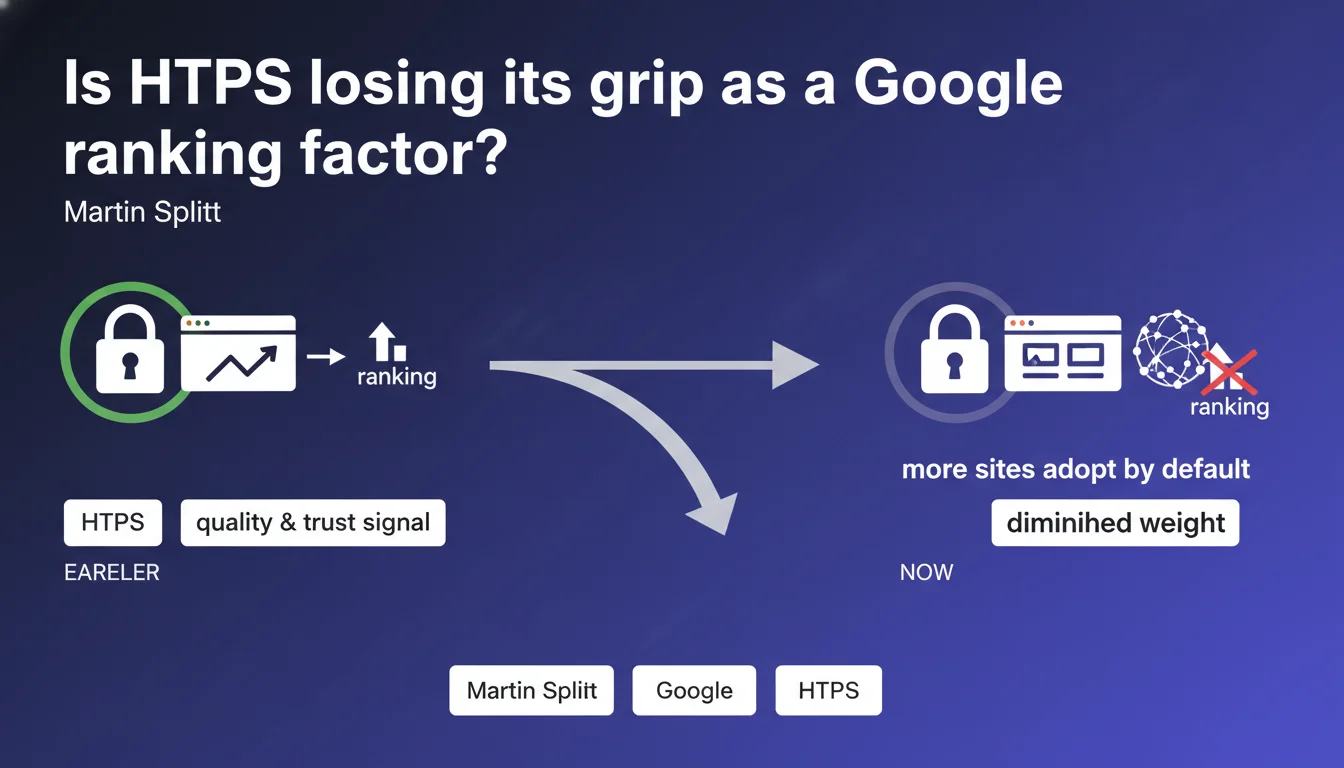
Martin Splitt confirms that HTTPS carries less weight as a ranking signal than it used to. Why? Because it's become universally adopted: when everyone implements it by default, it no longer differentiates well-maintained sites from others. The implication: Google has had to rebalance its criteria elsewhere.
What you need to understand
Why is Google reducing the weight of HTTPS in its algorithm?
Since its introduction as a ranking factor in 2014, HTTPS has functioned as a trust marker. A site running HTTPS signaled an effort to secure user data — therefore, by extension, a certain level of seriousness.
Except that — and this is where it gets tricky — virtually every website is now switching to HTTPS by default. Hosting providers offer free SSL certificates (Let's Encrypt), CMSs activate it automatically, and browsers display aggressive warnings for any HTTP site. Result: the signal becomes binary and universal. It no longer distinguishes anything.
What does this change concretely for SEO?
Google adjusts the weight of its signals based on their ability to discriminate quality. If 95% of sites have HTTPS, the algorithm can no longer use it to set apart two equivalent pages. It becomes a hygiene criterion, not a competitive advantage.
This doesn't mean HTTPS disappears from the equation — it remains a factor in user experience (padlock display, trust) and probably a binary criterion (present or absent). But its relative boosting power erodes mechanically.
What other signals have experienced the same fate?
This dilution phenomenon isn't new. Google has already experienced it with other criteria: mobile compatibility (mobile-friendly) lost its differentiating weight when almost all sites became responsive. Same dynamic.
- HTTPS becomes a minimum prerequisite, not a differentiation lever
- Google rebalances its criteria toward less universal and more qualitative signals
- The absence of HTTPS probably remains penalizing, but its presence no longer boosts as much
- This logic applies to all technical signals that become generalized (AMP, Core Web Vitals eventually?)
SEO Expert opinion
Is this statement consistent with real-world observations?
Yes, absolutely. For several years now, we've observed that switching a site from HTTP to HTTPS no longer generates the same ranking gains it did in 2015-2016. A/B tests show near-neutral impacts on SERPs for sites already well-optimized otherwise.
What Splitt confirms here is a mechanism that all practitioners have suspected: a generalized signal mechanically loses its differentiating power. This is a logic of standard algorithmic adjustment, not a strategic reversal by Google.
What nuances should be added to this statement?
First point: Google isn't saying HTTPS no longer matters at all. It's saying its relative weight has decreased. Critical distinction. A pure HTTP site still suffers disadvantages (browser warnings, user mistrust, risk of indirect penalty).
Second point: this statement lacks sectoral granularity. [To be verified] — does this dilution apply uniformly across all sectors? Probably not. In e-commerce or finance, HTTPS remains a critical trust signal, even if it no longer boosts rankings. User perception and conversion rate, meanwhile, remain impacted.
What does this statement reveal about Google's strategy?
It reveals a logic of continuous adaptation: Google never freezes its criteria. As soon as a signal becomes trivial, it loses its predictive value. The algorithm then migrates toward finer indicators — probably toward behavioral signals, content quality, Core Web Vitals in specific contexts.
Let's be honest: this communication is also Google's way of saying "stop asking us if HTTPS still boosts rankings." The implicit answer: it depends, but overall less than before.
Practical impact and recommendations
Should you still migrate to HTTPS if you haven't already?
Yes, without hesitation. Even if the pure SEO boost is diluted, the absence of HTTPS puts you at a structural disadvantage: dissuasive browser warnings, inability to use certain modern APIs (geolocation, push notifications), risk of blocking by corporate proxies, approximate GDPR compliance.
HTTPS is no longer a lever for SEO differentiation, but it remains a condition of entry to the game. It's like asking if a car needs wheels: technically yes, even if that doesn't make it faster than others.
What strategic adjustments should you make?
Stop counting on HTTPS as a competitive ranking factor. Redirect your efforts toward criteria that still retain differentiating power: editorial quality, depth of subject coverage, E-E-A-T signals, advanced user experience (smooth navigation, loading time optimized beyond Core Web Vitals thresholds).
Concretely? If you're torn between fine-tuning your HTTPS (upgrading from TLS 1.2 to 1.3, optimizing certificate chain) or investing in expert quality content, choose content. The SEO return on investment is no longer comparable.
- Ensure your HTTPS is active, correctly configured (301 redirects HTTP → HTTPS), and declared in Search Console
- Verify the absence of mixed content errors that would degrade user experience
- Stop relying on HTTPS alone to gain positions — it no longer compensates for structural weaknesses
- Reallocate your SEO budget toward high-impact differentiating levers: content, UX, contextualized Core Web Vitals
- Monitor emerging signals Google values (contextual freshness, structured entities, topical authority)
❓ Frequently Asked Questions
Le HTTPS a-t-il encore un impact sur le SEO en 2025 ?
Dois-je quand même migrer mon site HTTP vers HTTPS ?
Pourquoi Google réduit-il le poids du HTTPS comme signal de classement ?
Quels signaux SEO ont encore un réel pouvoir différenciateur aujourd'hui ?
Le HTTPS est-il devenu totalement inutile pour le SEO ?
🎥 From the same video 14
Other SEO insights extracted from this same Google Search Central video · published on 22/08/2023
🎥 Watch the full video on YouTube →
💬 Comments (0)
Be the first to comment.