
Official statement
Other statements from this video 14 ▾
- □ Google utilise-t-il vraiment un seul algorithme pour classer les sites ?
- □ Pourquoi Google distingue-t-il désormais systèmes de classement et mises à jour ?
- □ Faut-il vraiment tout refaire après chaque mise à jour Google ?
- □ Google centralise-t-il enfin la documentation de ses systèmes de classement ?
- □ Faut-il vraiment attendre qu'un système Google impacte votre trafic avant d'agir ?
- □ Google multiplie-t-il vraiment les mises à jour ou communique-t-il simplement mieux ?
- □ Google va-t-il enfin documenter tous ses systèmes de classement ?
- □ Google limite-t-il vraiment à deux pages par domaine dans ses résultats de recherche ?
- □ Le HTTPS est-il en train de perdre son poids dans l'algorithme de Google ?
- □ Faut-il abandonner la checklist technique et miser uniquement sur l'expérience utilisateur ?
- □ Les directives techniques de Google sont-elles vraiment binaires et vérifiables ?
- □ Le nombre de mots est-il vraiment sans importance pour le classement Google ?
- □ Faut-il vraiment afficher un auteur sur toutes vos pages web ?
- □ Le contenu authentique pour audience réelle est-il vraiment la clé du SEO ?
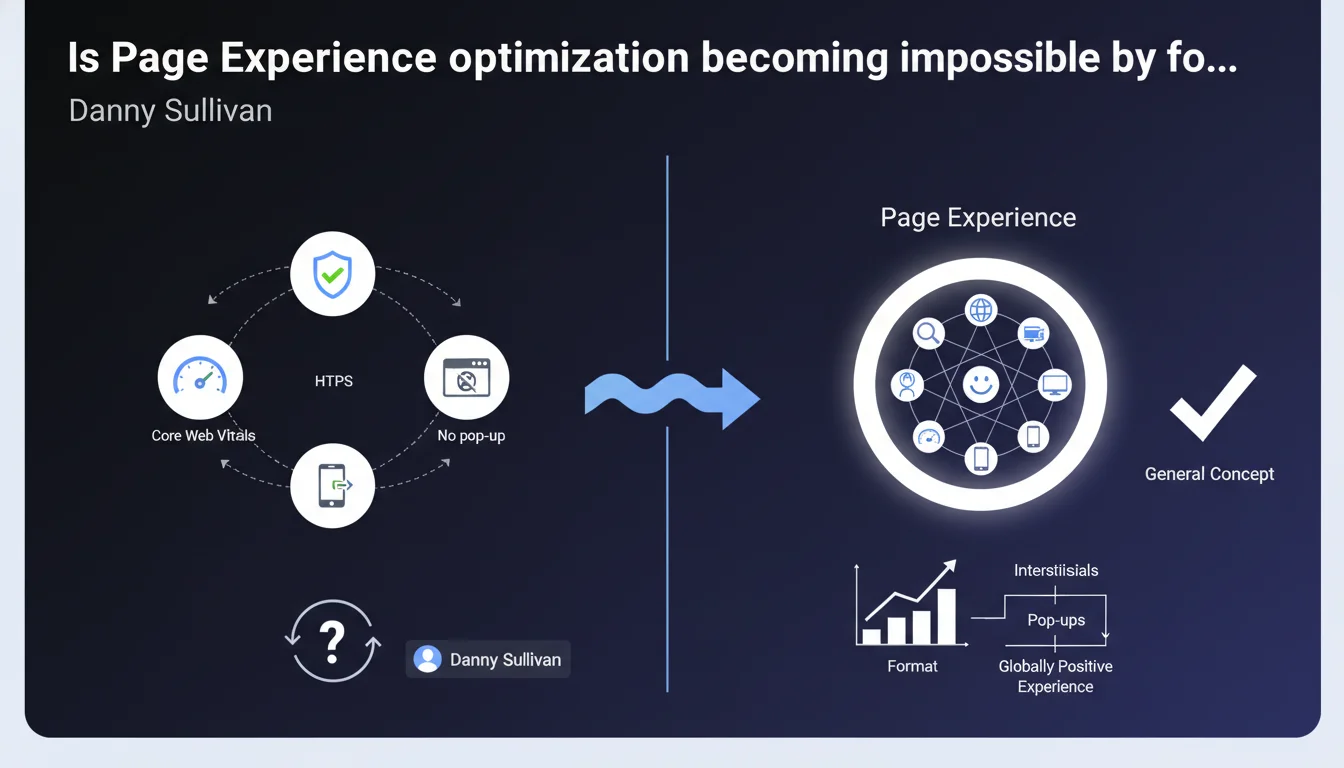
Google no longer considers Page Experience as a specific ranking system but as a holistic concept. Optimizing Core Web Vitals or HTTPS in isolation is no longer enough — you need a global approach including interstitials, pop-ups, page format and all elements that impact user experience. The message: stop checking boxes, think real experience.
What you need to understand
What exactly is changing with this statement?
For a long time, Page Experience was presented as an identifiable ranking system, with measurable signals: Core Web Vitals, HTTPS, absence of intrusive interstitials. SEOs could check boxes and optimize each metric separately.
Now Google claims it's a general concept — not an isolated algorithm. Concretely? You can have excellent Core Web Vitals and HTTPS, but if your page is loaded with aggressive pop-ups or your layout breaks the mobile experience, you won't have good overall Page Experience.
Why is Google changing its approach?
Because the checklist approach created abuses. Sites were optimizing technical metrics while keeping dark patterns, invasive interstitials or catastrophic layouts. The score was good, the real experience was disastrous.
Google wants to push toward a holistic vision: user experience isn't the sum of isolated signals, it's a global perception. If a single element breaks everything, other metrics don't compensate.
What signals remain individually measurable?
Core Web Vitals remain official and measurable metrics. HTTPS too. But Google insists: these signals are no longer isolated levers you optimize independently to gain ranking.
They're part of a larger set — and that set includes less quantifiable elements: layout quality, interstitial usage, presence of intrusive ads, device-appropriate format. Some of these criteria are subjective or evaluated by human raters, not by automated algorithms.
- Page Experience is no longer a distinct ranking system but a general concept
- Optimizing Core Web Vitals alone guarantees nothing if overall experience is poor
- Google wants to break the "checklist" approach in favor of a holistic vision
- Some experience criteria are evaluated qualitatively, not only through automated metrics
- Interstitials, pop-ups, page format, unstable layout matter as much as Core Web Vitals
SEO Expert opinion
Is this statement consistent with what we observe in the field?
Yes and no. In the field, we do see that sites with excellent Core Web Vitals can underperform if mobile experience is catastrophic — invasive pop-ups, broken layouts, ads pushing content. On that, Google is consistent.
But — and here's where it gets tricky — the vague definition of "general concept" is problematic. What is a "globally positive" experience? What specific thresholds, what precise criteria? [To verify]: Google provides no numbered evaluation grid for this "holistic approach".
What nuances should be added to this discourse?
First nuance: saying Page Experience is "no longer a specific system" doesn't mean Core Web Vitals lost their weight. They remain confirmed ranking signals. What changes is they're no longer sufficient alone.
Second nuance: this holistic approach gives Google enormous interpretive leeway. Without precise measurable criteria, it's hard to know if a particular interstitial will be penalized or tolerated. We remain in the dark — which suits Google, far less the SEOs who want clear rules.
In what cases doesn't this rule apply?
Let's be honest: for ultra-competitive queries where all players have equivalent page experiences, this "general concept" probably won't make the difference. Content, authority, backlinks will remain decisive.
Conversely, on verticals where sites have catastrophic experiences — discount e-commerce with aggressive pop-ups, recipe sites drowning in ads — this holistic approach can become a key differentiator. If you deliver truly good experience, you can gain ground.
Practical impact and recommendations
What should you do concretely to align with this vision?
Stop treating Core Web Vitals as an isolated checklist. Audit your page experience holistically: go through your site with a fine-tooth comb on mobile, identify all friction points — interstitials, pop-ups, intrusive ads, layout shifts not captured by CLS.
Test your site like an average user. If your first interaction is a newsletter pop-up hiding content, then a poorly executed cookie banner, then an ad pushing text — you have a problem, even if your Core Web Vitals are green.
What mistakes should you avoid in this holistic approach?
Mistake number one: believing that optimizing Core Web Vitals alone is enough. Google is clear — it's only part of the equation.
Mistake number two: removing all interstitials and pop-ups on principle. Some are tolerated (legal cookie banner, age gate), others aren't (forced newsletter before content access). Nuance matters.
Mistake number three: neglecting page format. A perfect desktop site can be unreadable on mobile if text is too small, buttons too close, content poorly adapted. Google evaluates experience by device — be irreproachable everywhere.
How can you verify your site respects this global approach?
- Audit Core Web Vitals via PageSpeed Insights, Search Console — but don't stop there
- Test real mobile experience: load your key pages on smartphone, note every friction point
- Identify all interstitials and pop-ups — verify they respect Google guidelines (no main content masking, easy closing)
- Check layout stability beyond CLS: some visual shifts aren't captured by the metric but break experience
- Analyze content-to-ad ratio — too much intrusive ads can degrade overall experience even if metrics are OK
- Compare your experience to your direct competitors — if you're behind, it's a differentiation lever
- Use real user testing (A/B testing, heatmaps) to identify friction points not detected by automated metrics
❓ Frequently Asked Questions
Les Core Web Vitals restent-ils un signal de ranking après cette déclaration ?
Comment mesurer une Page Experience 'globalement positive' si ce n'est plus un système spécifique ?
Peut-on encore utiliser des pop-ups sans risquer de pénalité Page Experience ?
Si mes concurrents ont de mauvais Core Web Vitals mais aucun interstitiel, qui gagne ?
Cette déclaration signifie-t-elle qu'optimiser les Core Web Vitals est devenu inutile ?
🎥 From the same video 14
Other SEO insights extracted from this same Google Search Central video · published on 22/08/2023
🎥 Watch the full video on YouTube →
💬 Comments (0)
Be the first to comment.