
Official statement
Other statements from this video 14 ▾
- □ Does Google really use just one algorithm to rank websites?
- □ Why is Google now officially differentiating between ranking systems and updates?
- □ Do you really need to overhaul your entire site after every Google update?
- □ Is Google finally consolidating the documentation of its ranking systems in one place?
- □ Should you really wait for a Google system to impact your traffic before taking action?
- □ Is Google really rolling out more updates or just communicating about them better?
- □ Will Google finally document all of its ranking systems?
- □ Does Google really limit search results to just two pages per domain?
- □ Is HTTPS losing its grip as a Google ranking factor?
- □ Should you ditch the technical SEO checklist and focus solely on user experience instead?
- □ Is Page Experience optimization becoming impossible by focusing on individual signals?
- □ Are Google's technical guidelines really as binary and verifiable as they claim?
- □ Does word count really matter for Google rankings?
- □ Should you really display an author on every single page of your website?
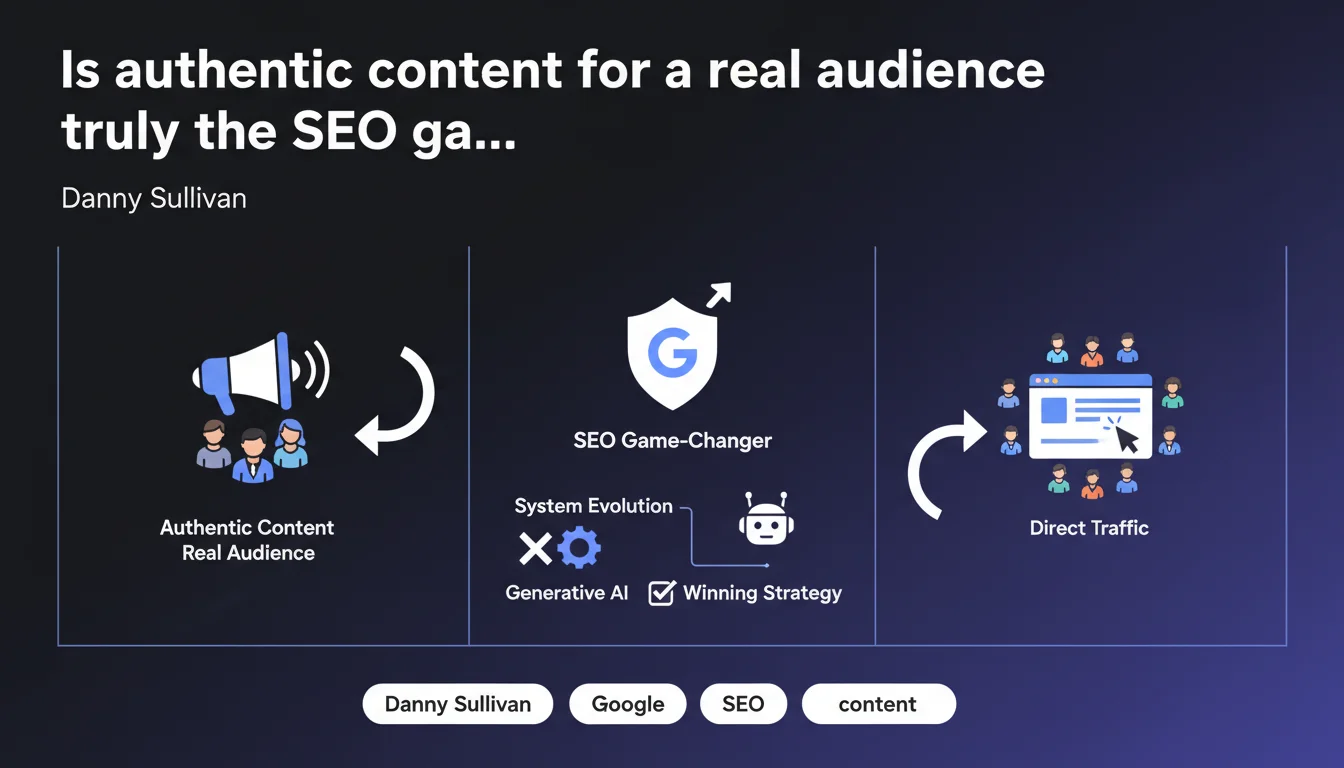
Google asserts that creating authentic content for a real audience you genuinely know—people who would visit your site directly—represents the most sustainable SEO strategy. This approach would outperform technical optimization tactics in the face of algorithmic shifts and the rise of generative AI. The advice seems aimed at content farming practices, yet remains deliberately vague about what « authenticity » actually means in concrete terms.
What you need to understand
What does « authentic content for a real audience » actually mean in practice?
Google contrasts two approaches here: creating for search engines versus creating for identified humans. The underlying idea? Your content should serve the needs of users who would visit your site even without Google—a direct, loyal, engaged audience.
Let's be honest: this formulation is vague. What makes content « authentic » in Google's eyes? The official stance deliberately avoids providing measurable criteria. We assume it means genuine expertise, lived experience, original added value—but nothing quantifiable.
Why is Google emphasizing this approach now?
The explosion of AI-generated content changes everything. Sites can now produce massive amounts of grammatically correct but superficial content. Google is trying to reframe the discussion: it's not the tool that matters (AI or human), it's the intention and final quality.
This statement also continues the thread of Helpful Content Updates. The underlying message? Stop creating content just because Semrush tells you a keyword has search volume. Create because you have something useful to say to someone specific.
Does this recommendation actually change SEO strategy?
Not really. It's an elegant reformulation of already-known principles: E-E-A-T, User Intent, contextual relevance. What changes is the emphasis: Google now centers direct audience at the core, not the journey through organic search.
Concretely, this means that direct engagement signals (branded traffic, return rate, time spent, navigation depth) could weigh more heavily in the algorithmic equation. But—and this is where it gets sticky—Google never explicitly confirms which signals are actually used.
- Create for an identified audience you know and who knows you
- Prioritize genuine added value over pure technical optimization
- Anticipate algorithmic evolution by betting on loyalty rather than volatile acquisition
- Generative AI isn't forbidden, but must serve a user-centric strategy
- Direct audience signals likely become more important (without official confirmation)
SEO Expert opinion
Is this statement consistent with what we observe in practice?
Yes and no. Sites with strong branded traffic and loyal audiences genuinely do resist Core Updates better—this is documented by numerous case studies. But claiming it's THE single key? That's excessive oversimplification.
Purely SEO-optimized sites with no real direct audience continue to rank excellently on commercial or informational queries with high volume. « Authentic content » guarantees nothing if the technical foundation is flawed, if backlinks are lacking, or if intent isn't matched correctly.
What nuances should be added to this advice?
Google deliberately conflates two things: creation intent and measurable result quality. You can create with the purest intentions and produce mediocre content. Conversely, a freelance writer who knows nothing about your audience can produce something excellent with a good brief.
Another critical nuance: not every sector lends itself to this direct-audience logic. An e-commerce site selling generic products (batteries, ink cartridges, spare parts) doesn't have a « real audience coming directly ». The user is searching for a product, not a brand. Yet these sites still need SEO.
[To verify]: Google provides no metrics to measure content « authenticity ». This absence of objective criteria leaves the door open to all interpretations—and to algorithmic arbitrariness.
In what cases doesn't this rule really apply?
On purely transactional or short-tail informational queries, authenticity matters little. The user searches « iPhone 16 price » or « convert PDF to Word »—they have no brand loyalty. They want a fast, reliable, functional answer.
Same for ultra-specialized niches where the global total audience is tiny. You can't build a « direct audience » of 50 people and expect viable business. You depend entirely on long-tail SEO—and that's perfectly legitimate.
Practical impact and recommendations
What should you concretely do to align your strategy with this recommendation?
Start by precisely identifying your target audience. Not a vague marketing persona, but real segments with specific needs, questions, vocabulary. Analyze your Analytics: who returns? Who engages? Who converts? They are your real audience.
Next, create content that answers their unmet questions elsewhere. Not « keyword-optimized content », but answers you'd give a customer on the phone. If your content adds nothing a competitor hasn't already said, it has no reason to exist.
What mistakes should you avoid when applying this advice?
Classic mistake: confusing « authentic » with « personal » or « spontaneous ». Authentic content remains structured, technically optimized, strategic. Authenticity concerns intention and value, not writing style.
Another trap: abandoning keywords under the guise of authenticity. Google remains a language-based search engine. Match intent AND the vocabulary of your audience—that's precisely what smart authenticity is.
Finally, don't neglect promotion and distribution. Invisible authentic content serves no purpose. Build direct channels (newsletter, social media, community) so your audience « comes directly » as Google recommends.
How do you measure whether your content truly meets this requirement?
Monitor branded traffic: how many visitors search your brand + keyword? This signals an audience that already knows you. Analyze return rate: a returning user signals perceived value.
Look at engagement metrics (time spent, scroll depth, pages per session)—not for Google, but to validate that your content genuinely engages. If no one reads past the first paragraph, your « authenticity » isn't convincing anyone.
Finally, measure the share of direct and referral traffic versus pure SEO. A healthy site has diversified sources. If 95% of your traffic comes from Google, you don't have a direct audience—you have algorithmic dependency.
- Precisely document who comprises your real audience (analytics, CRM, customer feedback)
- Audit your existing content: remove anything that adds no unique value
- Build an editorial calendar based on real customer questions, not Semrush volumes
- Develop direct acquisition channels (newsletter, social, community) to reduce SEO dependency
- Train your writers in subject matter expertise, not just web writing techniques
- Measure real engagement (time spent, returns, branded search), not just rankings and traffic
- Optimize technically: authentic content on a slow or poorly-structured site remains invisible
- Integrate generative AI as an assistance tool, never as your sole production source
❓ Frequently Asked Questions
Le contenu généré par IA est-il compatible avec cette recommandation d'authenticité ?
Comment définir concrètement une « audience réelle » pour mon site ?
Cette approche fonctionne-t-elle pour les sites purement affiliés ou e-commerce générique ?
Faut-il abandonner l'optimisation mot-clé pour privilégier l'authenticité ?
Comment Google mesure-t-il concrètement l'authenticité d'un contenu ?
🎥 From the same video 14
Other SEO insights extracted from this same Google Search Central video · published on 22/08/2023
🎥 Watch the full video on YouTube →
💬 Comments (0)
Be the first to comment.