
Official statement
Other statements from this video 14 ▾
- □ Does Google really use just one algorithm to rank websites?
- □ Why is Google now officially differentiating between ranking systems and updates?
- □ Do you really need to overhaul your entire site after every Google update?
- □ Is Google finally consolidating the documentation of its ranking systems in one place?
- □ Should you really wait for a Google system to impact your traffic before taking action?
- □ Will Google finally document all of its ranking systems?
- □ Does Google really limit search results to just two pages per domain?
- □ Is HTTPS losing its grip as a Google ranking factor?
- □ Should you ditch the technical SEO checklist and focus solely on user experience instead?
- □ Is Page Experience optimization becoming impossible by focusing on individual signals?
- □ Are Google's technical guidelines really as binary and verifiable as they claim?
- □ Does word count really matter for Google rankings?
- □ Should you really display an author on every single page of your website?
- □ Is authentic content for a real audience truly the SEO game-changer Google claims it is?
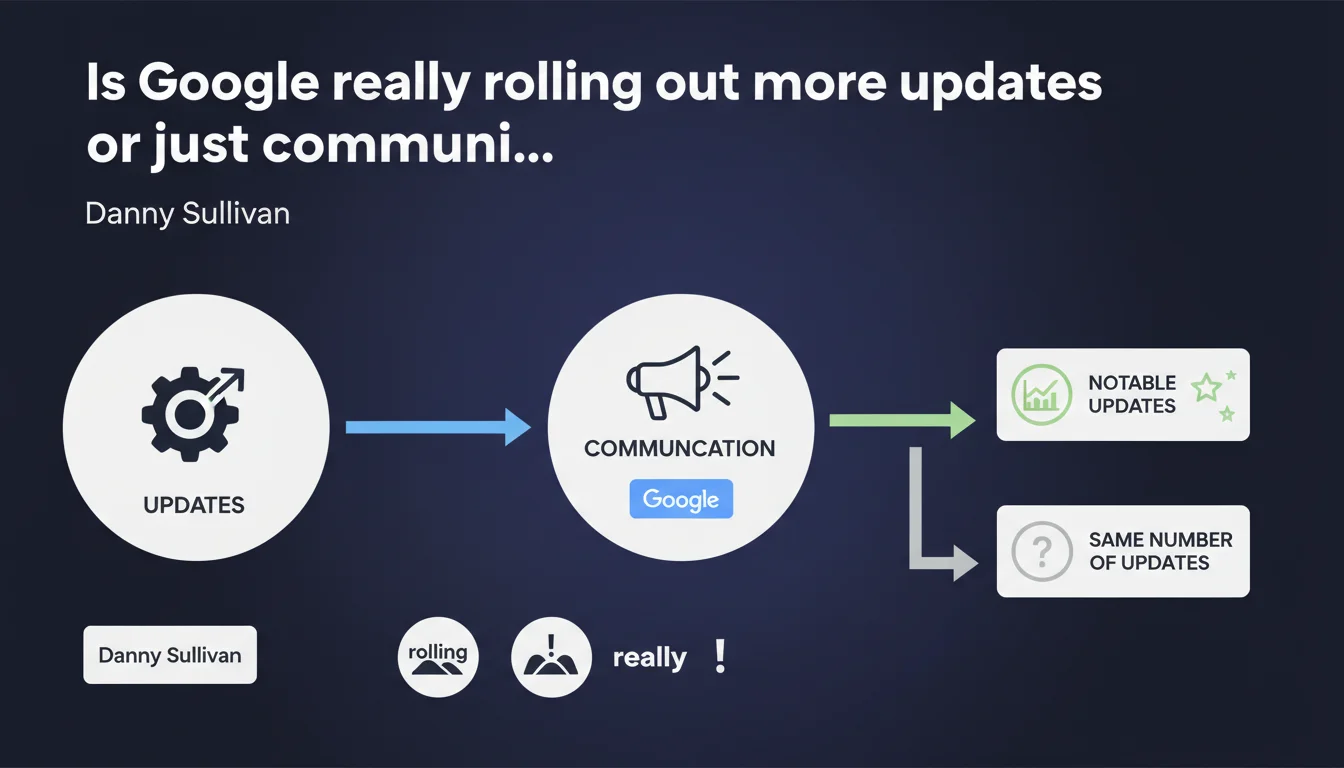
Google claims that the number of algorithm updates hasn't increased, but the company now communicates more about those that deserve webmasters' attention. Only 'notable' updates are subject to public announcements. This clarification aims to calm the perception of accelerating algorithmic changes.
What you need to understand
Why does Google insist on this distinction between volume and communication?
The dominant impression among SEOs is that Google is rolling out more updates than before. Danny Sullivan attempts to correct this perception: the actual volume of modifications hasn't exploded, but transparency has changed.
In the past, Google modified its algorithm silently. Today, the company publicly announces major updates — those that cause significant fluctuations in the SERPs. This targeted communication creates an optical effect: it feels like more is happening.
What makes an update 'notable' according to Google?
Google doesn't communicate about all of its algorithmic modifications. An update becomes notable when it warrants webmasters to adjust their strategy.
Concretely? Core Updates, major spam-fighting deployments, or structural changes like Helpful Content Updates. Daily micro-adjustments, meanwhile, stay under the radar. This selectivity avoids overwhelming professionals with a constant stream of announcements.
What should you take away from this statement?
- The number of updates hasn't increased, it's the communication that has evolved
- Google announces only updates that require action from webmasters
- Daily fluctuations still exist but are not subject to public announcements
- This increased transparency aims to reduce uncertainty rather than amplify it
SEO Expert opinion
Does this statement match real-world observations?
Let's be honest: the perception of acceleration isn't entirely unfounded. SERP volatility data shows more frequent fluctuations in recent years, regardless of official announcements.
Either Google is downplaying the true scope of changes, or tracking tools have become more sensitive and detect variations we were previously unaware of. [To verify]: the claim that volume hasn't increased lacks concrete metrics to be objectively validated.
Why is Google communicating now when it stayed silent before?
The communication strategy shift comes after years of criticism over algorithmic opacity. Unannounced updates triggered panic and speculation in the SEO community.
By announcing major changes, Google regains control of the narrative. Rather than letting professionals interpret mysterious fluctuations, the company frames what deserves attention itself. It's also a way to reduce support tickets and public complaints — an announced update generates less confusion than an unexplained variation.
Does this transparency have practical limitations?
The problem remains that Google chooses what it announces. Some major updates detected by tracking tools have never been officially confirmed.
Furthermore, even when Google communicates, details remain vague. You know a Core Update is being deployed, but not which specific signals have been re-evaluated. For practitioners, this partial transparency remains frustrating: you know the change exists without having the tools to analyze it finely.
Practical impact and recommendations
Should you follow Google's announcements religiously?
No. Focus on officially announced updates — these are the ones that justify in-depth analysis and potentially strategic adjustments.
Daily fluctuations are part of the background noise. They generally don't require immediate action unless your monitoring tools detect a sudden and sustained drop in your key positions.
How do you distinguish a real update from mere volatility?
Cross-reference multiple sources: Google Search Status Dashboard, official accounts (@searchliaison), volatility tools (SEMrush Sensor, Moz MozCast, RankRanger). If multiple signals converge and Google confirms, it's a real update.
If your positions fluctuate but no announcement is made and volatility indices remain stable, it's probably normal algorithmic noise or an adjustment specific to your niche.
What do you do concretely when a notable update is announced?
- Wait for the deployment to finish (usually 1-2 weeks) before analyzing real impact
- Compare your positions before/after on a representative sample of keywords
- Identify pages that gained or lost traffic and look for common patterns
- Consult official guidelines updated by Google following the announcement
- Avoid immediate reactive corrections — let the algorithm stabilize before acting
- Document your observations to compare with next updates of the same type
❓ Frequently Asked Questions
Google déploie-t-il vraiment moins de mises à jour qu'avant ?
Dois-je m'inquiéter de chaque fluctuation de mes positions ?
Comment savoir si une mise à jour me concerne ?
Google communique-t-il sur toutes ses mises à jour ?
Où suivre les annonces officielles de mises à jour ?
🎥 From the same video 14
Other SEO insights extracted from this same Google Search Central video · published on 22/08/2023
🎥 Watch the full video on YouTube →
💬 Comments (0)
Be the first to comment.