
Official statement
Other statements from this video 14 ▾
- □ Does Google really use just one algorithm to rank websites?
- □ Why is Google now officially differentiating between ranking systems and updates?
- □ Do you really need to overhaul your entire site after every Google update?
- □ Is Google finally consolidating the documentation of its ranking systems in one place?
- □ Should you really wait for a Google system to impact your traffic before taking action?
- □ Is Google really rolling out more updates or just communicating about them better?
- □ Will Google finally document all of its ranking systems?
- □ Does Google really limit search results to just two pages per domain?
- □ Is HTTPS losing its grip as a Google ranking factor?
- □ Should you ditch the technical SEO checklist and focus solely on user experience instead?
- □ Is Page Experience optimization becoming impossible by focusing on individual signals?
- □ Are Google's technical guidelines really as binary and verifiable as they claim?
- □ Does word count really matter for Google rankings?
- □ Is authentic content for a real audience truly the SEO game-changer Google claims it is?
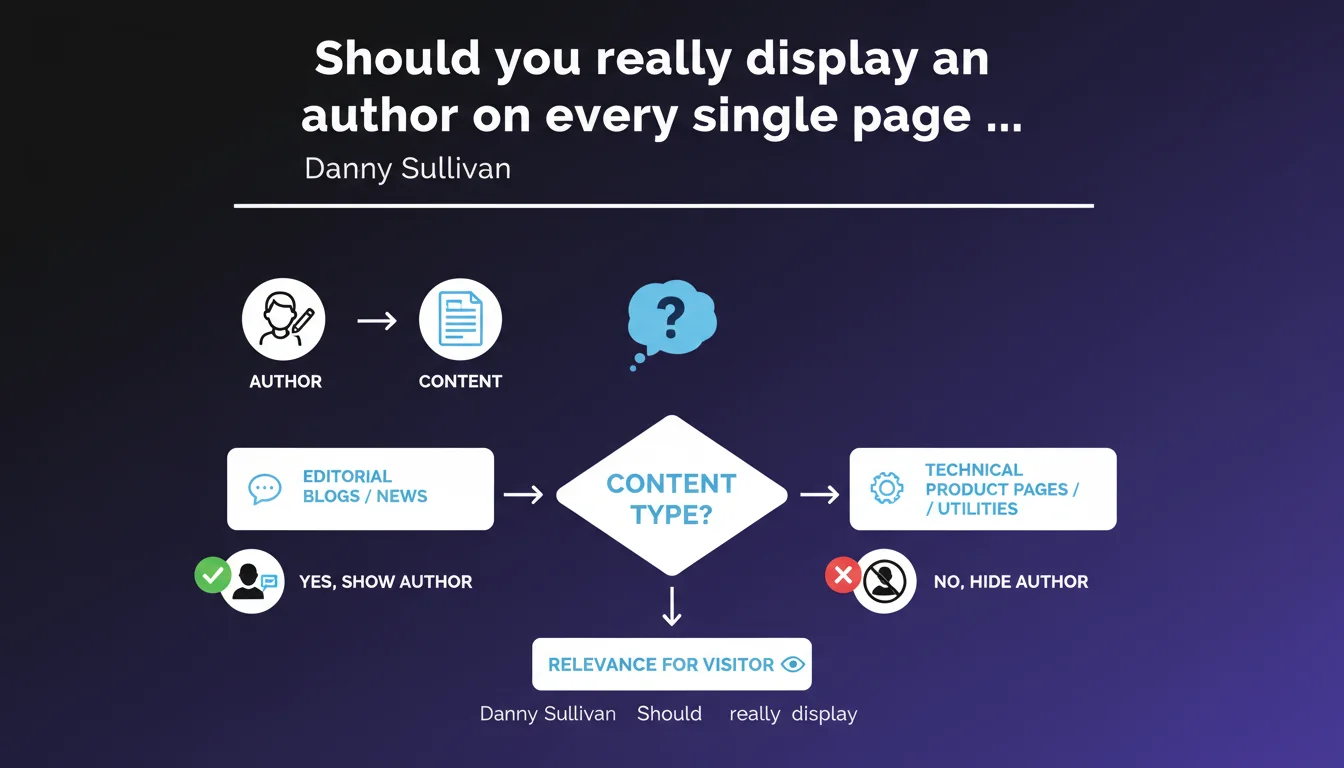
Google confirms that authorship only makes sense where visitors expect to find an author. On a product page or technical specification sheet, displaying an author name adds nothing — neither for the user nor for SEO. Authorship remains relevant for editorial content: blog articles, guides, analyses.
What you need to understand
This statement from Danny Sullivan settles a debate that has plagued SEO for years: should you systematically display an author on every page of a website?
The answer is no. And that's refreshing.
Why does Google bother clarifying this point?
Because since the introduction of E-E-A-T (Experience, Expertise, Authoritativeness, Trustworthiness) in the Quality Rater Guidelines, many sites panicked and slapped author signatures everywhere. Including places where it makes absolutely no sense.
Google is reminding us here that authorship is not a universal ranking signal. It's a contextual trust indicator. On a technical product page, nobody cares who wrote it — they're looking for specs, price, availability. Forcing a byline on that type of page is just informational noise.
Where does authorship actually make sense?
Where content relies on individual expertise: blog articles, how-to guides, trend analysis, expert opinions. In short, everything that falls under editorial content.
In these cases, displaying an identifiable author with a bio, credentials, and publication history strengthens credibility. And Google values that — not through algorithmic magic, but because it improves user trust.
What does this concretely change for SEO?
It simplifies your life. You no longer need to rack your brain figuring out whether your terms and conditions page should mention an author. It doesn't need one. Neither does your contact page or your standard e-commerce product cards.
Focus authorship where it delivers real perceived value to the visitor. And structure it correctly with schema.org/Person or schema.org/Author markup so search engines can connect content from the same author.
- Authorship is not a universal ranking criterion
- It's relevant for editorial content (articles, guides, analyses)
- It serves no purpose on product pages, terms of service, technical pages
- An identifiable and credible author strengthens E-E-A-T where expected
- schema.org/Author markup helps Google understand the author's identity
SEO Expert opinion
Is this statement consistent with what we observe in the field?
Yes, and it's actually one of the rare cases where Google says exactly what the data confirms.
Sites that rank well in health, finance, legal — all YMYL domains — display identifiable authors on their articles. But their product pages, technical FAQs, forms? No signatures. And it doesn't cause them any visibility problems.
On the other hand, sites that added generic bylines to every page — like "Written by the editorial team" — gained nothing. Worse: in some cases, it dilutes credibility when the displayed author has no verifiable profile.
What nuance should be added to this rule?
Danny Sullivan talks about "pages where it makes sense for the visitor." Let's be honest: that's vague. And that's where the SEO practitioner's judgment comes into play.
Take a borderline case: a product comparison page. Technically, it's a "product" page. But if it's a comparison written with real analysis, personal opinion, on-the-ground testing — then yes, authorship makes sense. Because the visitor wants to know who is recommending what.
Another example: glossary or definition pages. If it's a plain definition, no author needed. If it's a long explanatory article with examples and expert interpretation, authorship becomes relevant.
Should I remove authorship from pages where it's already in place?
No. Unless it's clearly artificial or misleading.
If your product pages display a generic author with no verifiable profile, you can remove it without concern. But if you have product sheets written by experts — like a sommelier describing a wine, a mechanic commenting on an auto part — keep the authorship. It makes sense.
However, if you've slapped "SEO Claims Team" on every page without distinction, that's noise. And it serves no purpose. [To verify]: Google has never confirmed that generic authors ("editorial team") are penalized, but the lack of individual credibility is a weak signal for E-E-A-T.
Practical impact and recommendations
What should I do concretely on my site?
Start with an audit of your pages. List all those that display an author. Ask yourself: does this page fall under editorial content, or is it a functional/technical page?
For each page, ask: "Would a visitor expect to see an author here?" If the answer is no, remove the byline.
What mistakes should I absolutely avoid?
Don't create fake authors for show. If you don't have an identifiable writer, don't invent "Marie Dupont, SEO specialist" with a stock photo and zero online presence. Google won't directly penalize you, but users will smell the scam.
Another classic mistake: displaying a different author on each page with no coherence. If you have 500 articles written by 50 phantom authors, you're not strengthening your E-E-A-T — you're diluting it. Better to consolidate content under a few credible authors with solid profiles.
How do I verify my authorship is properly configured?
Three simple checkpoints:
- Verify your editorial pages display a visible author with a link to their bio
- Ensure schema.org/Author markup is in place on these pages (test with Google's JSON-LD validator)
- Check that each author has an accessible profile with credentials and publication history
- Remove bylines from product pages, terms of service, technical pages where they add nothing
- If you're unsure about a page, ask: "Would I want to know who wrote this?"
Authorship is a powerful E-E-A-T lever — but only where it answers a user expectation. Don't force it everywhere. Concentrate it on editorial content with identifiable, credible authors.
If your site mixes editorial content and product pages, proper authorship implementation can become a technical headache. Between schema.org markup, profile consistency, and page audits, it's a project that takes time and real expertise. Many specialized SEO agencies offer support on this type of optimization — and honestly, when you see how many sites bungle the basics of structured data, it's often an investment that pays for itself.
❓ Frequently Asked Questions
Est-ce que l'absence d'auteur sur une page éditoriale peut nuire au référencement ?
Faut-il créer des profils auteurs même si je suis le seul rédacteur du site ?
Le markup schema.org/Author est-il obligatoire pour que Google reconnaisse l'auteur ?
Peut-on utiliser un auteur générique type 'Équipe éditoriale' ?
Dois-je supprimer l'authorship de mes fiches produits existantes ?
🎥 From the same video 14
Other SEO insights extracted from this same Google Search Central video · published on 22/08/2023
🎥 Watch the full video on YouTube →
💬 Comments (0)
Be the first to comment.