
Official statement
Other statements from this video 14 ▾
- □ Does Google really use just one algorithm to rank websites?
- □ Why is Google now officially differentiating between ranking systems and updates?
- □ Do you really need to overhaul your entire site after every Google update?
- □ Is Google finally consolidating the documentation of its ranking systems in one place?
- □ Should you really wait for a Google system to impact your traffic before taking action?
- □ Is Google really rolling out more updates or just communicating about them better?
- □ Will Google finally document all of its ranking systems?
- □ Does Google really limit search results to just two pages per domain?
- □ Is HTTPS losing its grip as a Google ranking factor?
- □ Should you ditch the technical SEO checklist and focus solely on user experience instead?
- □ Is Page Experience optimization becoming impossible by focusing on individual signals?
- □ Are Google's technical guidelines really as binary and verifiable as they claim?
- □ Should you really display an author on every single page of your website?
- □ Is authentic content for a real audience truly the SEO game-changer Google claims it is?
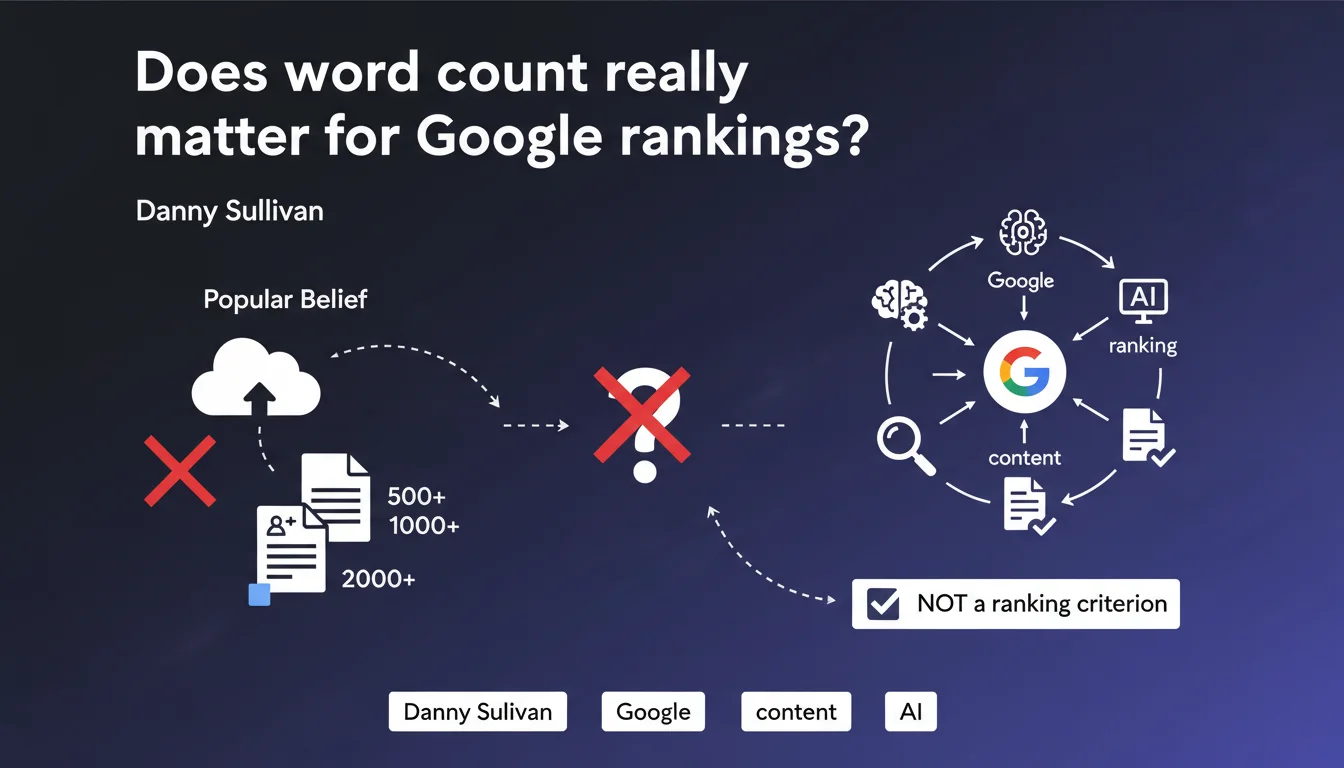
Google states that the word count of content is not a ranking criterion. Neither a minimum nor maximum is required — only relevance to answer search intent matters. This position ends myths about "X word minimum" content but doesn't settle the question of necessary depth.
What you need to understand
Why does Google insist there's no word count threshold?
Because word counter obsession is one of the most persistent SEO myths. How many times have you heard "you need at least 1000 words to rank"? Google is trying to kill this belief from the start.
The search engine doesn't count words. It evaluates whether your page answers better than others what the user is looking for. A 300-word article can rank perfectly if that's exactly what's needed to answer the query.
Does this mean we can publish any length?
Technically, yes. Practically, no. Google doesn't set a threshold, but the nature of the query imposes one implicitly.
Searching "backlink definition" requires 150 words. Searching "e-commerce link building strategy" demands 2000. It's not Google requiring it — it's the subject complexity and editorial competition.
What's the difference between volume and content depth?
Volume is simple: counting words. Depth is smart: covering all expected aspects for a given query.
A 5000-word article going in circles is worth less than an 800-word piece that perfectly structures information. Google favors the second — the one that answers, not the one that just fills space.
- No minimum or maximum threshold is applied by Google's algorithm
- Word count is not a direct ranking factor
- Relevance and answer completeness outweigh length
- Natural length varies for each query based on its complexity
- Well-ranking competitors give clues about expected depth
SEO Expert opinion
Is this statement consistent with what we observe in practice?
Yes and no. Technically, Google is right: there's no "min_words: 1000" parameter in the algorithm. But let's look at the field.
Take a competitive YMYL query — "best mortgage rates". The top 10 results all range between 2500 and 4000 words. Coincidence? No. These topics require depth to cover expected angles and demonstrate expertise.
Length isn't the cause of ranking — it's an indirect consequence. To properly treat a complex topic, you need volume. It's mechanical.
Where does this rule not apply in practice?
On competitive, complex informational queries. Publishing 400 words against exhaustive 3000-word guides is shooting yourself in the foot.
Why? Because Google measures satisfaction rate via user behavior. If all your visitors go back to search for more information elsewhere, you lose. And they will return to search if your content is skeletal.
[To verify]: Google claims no threshold, but its Quality Raters Guidelines explicitly mention the notion of "substantial content". What defines "substantial" if not, indirectly, a certain volume?
What are the real criteria behind this facade?
Google evaluates whether you answer all facets of the intent. This comes through structure, semantic coverage, freshness, and authority.
Short content can excel if the intent is simple. But on broad topics, you must cover sub-questions — and that inherently takes space. Volume then becomes a proxy for completeness, without being the direct cause.
Practical impact and recommendations
What should you actually do with this information?
Stop writing to hit a word quota. Start with user intent and ask yourself: what exactly does this person want to know?
Analyze the top 10 results. Not to copy their length — to identify the angles covered. If they all cover 8 aspects of the topic and you only treat 3, you'll lose. Regardless of word count.
Adapt length to format: a quick definition, an exhaustive guide, a detailed comparison — each calls for different treatment. Be as long as necessary, as short as possible.
What mistakes should you avoid absolutely?
Don't pad to fill space. Blocks of 3000 words with 80% redundancy are worse than 500 dense words. Google detects fluff through user signals.
Avoid the opposite extreme too: publishing 200 words on a topic that deserves 2000, under the pretext that "Google has no threshold". You'll be buried by competitors who understand that properly treating this topic requires space.
- Analyze search intent before setting a target length
- Study well-ranking content to identify expected depth
- Structure your content around user questions, not a word quota
- Test with varied-length content and measure actual engagement
- Avoid unnecessary padding — prioritize information density
- For complex queries, accept that completeness requires volume
❓ Frequently Asked Questions
Google privilégie-t-il les contenus longs dans ses résultats ?
Existe-t-il un nombre de mots idéal pour le SEO ?
Un contenu court peut-il vraiment bien se classer ?
Comment savoir si mon contenu est assez complet sans compter les mots ?
Dois-je supprimer mes contenus courts existants ?
🎥 From the same video 14
Other SEO insights extracted from this same Google Search Central video · published on 22/08/2023
🎥 Watch the full video on YouTube →
💬 Comments (0)
Be the first to comment.