
Official statement
Other statements from this video 14 ▾
- □ Why is Google now officially differentiating between ranking systems and updates?
- □ Do you really need to overhaul your entire site after every Google update?
- □ Is Google finally consolidating the documentation of its ranking systems in one place?
- □ Should you really wait for a Google system to impact your traffic before taking action?
- □ Is Google really rolling out more updates or just communicating about them better?
- □ Will Google finally document all of its ranking systems?
- □ Does Google really limit search results to just two pages per domain?
- □ Is HTTPS losing its grip as a Google ranking factor?
- □ Should you ditch the technical SEO checklist and focus solely on user experience instead?
- □ Is Page Experience optimization becoming impossible by focusing on individual signals?
- □ Are Google's technical guidelines really as binary and verifiable as they claim?
- □ Does word count really matter for Google rankings?
- □ Should you really display an author on every single page of your website?
- □ Is authentic content for a real audience truly the SEO game-changer Google claims it is?
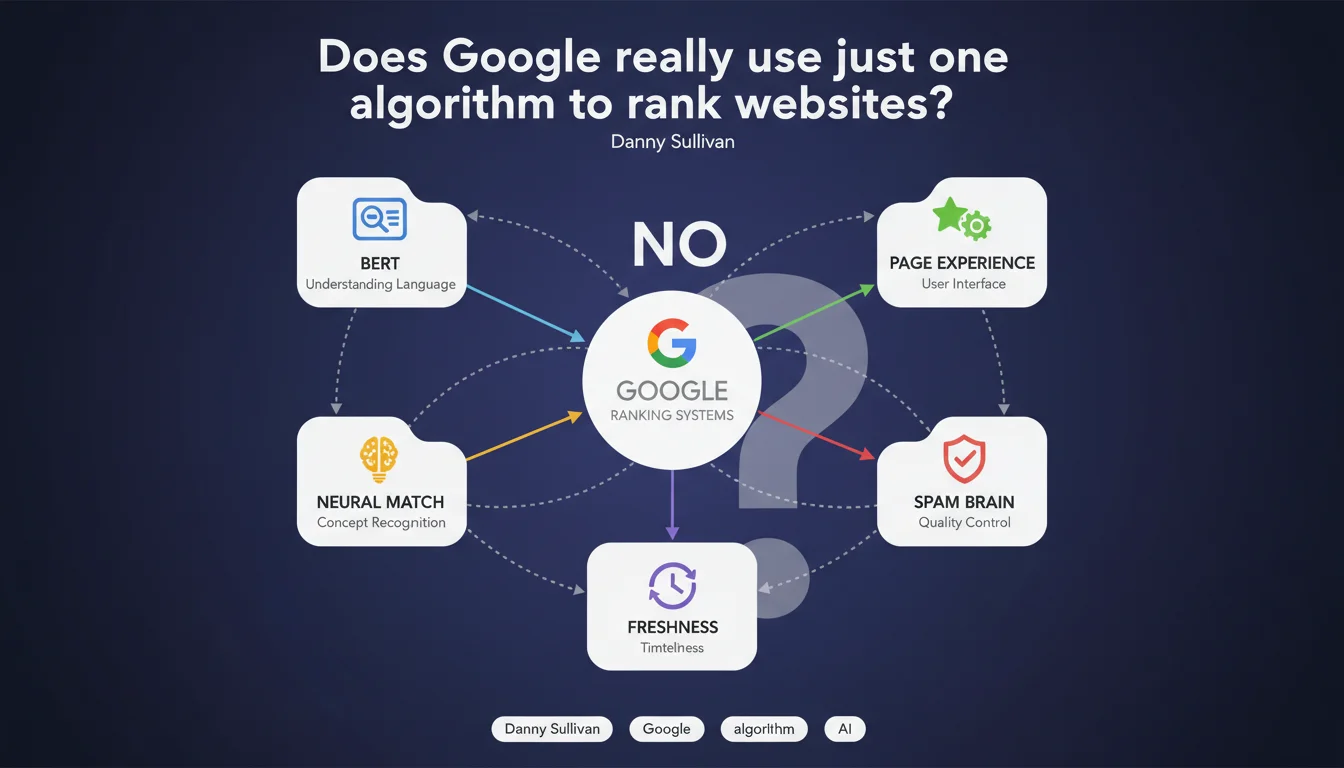
Google officially confirms that there is no single "ranking algorithm," but rather a multitude of distinct systems that work in parallel. Each system evaluates specific criteria (content, links, user experience, etc.) and their interaction determines the final ranking. This clarification challenges the simplistic idea of a single "Google algorithm" that you could "game."
What you need to understand
Why does Google insist on this distinction between algorithm and systems?
Terminology matters. When we talk about a "Google algorithm," we imagine a single, centralized mechanism. The reality is far more fragmented: Google deploys dozens of independent ranking systems, each analyzing a different facet of a page or website.
Some systems evaluate content freshness, others scrutinize location signals, backlink quality, author expertise, or language relevance. Their interaction — and not just their simple addition — determines the final ranking.
What's the practical impact of this multi-system architecture?
If you optimize for a single criterion — say, stuffing your pages with keywords — you'll only satisfy one system among dozens. Other systems can penalize you if your content lacks expertise signals, quality links, or engagement signals.
This is why single-criterion tactics (keyword stuffing, link farms, content duplication) fail. They ignore the fact that ranking is a weighted synthesis of multiple simultaneous evaluations.
What are the main ranking systems documented by Google?
- BERT and MUM: semantic and contextual understanding of queries
- Helpful Content System: detection of content created for users vs. for search engines
- Page Experience: speed, visual stability, interactivity (Core Web Vitals)
- Link Analysis: evaluation of backlink quality and relevance
- Local Search Systems: geographic and proximity signals
- Product Reviews Update: detection of authentic vs. generic reviews
- Spam Systems: filtering of manipulative techniques
SEO Expert opinion
Is this statement consistent with real-world observations?
Yes, and it explains why two sites with similar link profiles can have radically different rankings. Each site activates different combinations of systems. An e-commerce site with excellent Core Web Vitals but content poor in expertise will be penalized by the Helpful Content System despite its speed.
We also observe that certain updates impact very specific segments: the Product Reviews Update affects review sites, Local Search updates impact Google Business Profile listings. This confirms the existence of specialized systems that only activate in certain contexts.
What nuances should we consider?
[To verify] Google remains deliberately vague about the exact weighting of each system. We don't know if the link system accounts for 20% or 50% of the final ranking. This opacity is strategic: revealing exact weights would facilitate manipulation.
Another gray area: interdependence between systems. Google says they "work together," but doesn't specify whether certain systems have veto power. For example, if a site is detected as spam by Spam Systems, is it permanently excluded even if it performs well on other criteria?
In what cases does this rule not apply?
Navigation queries — when a user types "Facebook" or "Gmail" — likely bypass the majority of systems. The intent is so clear that Google can simply match the brand name.
Similarly, YMYL queries (Your Money Your Life) likely activate reinforced expertise verification systems. A health site will be scrutinized with criteria that Google doesn't apply to a cooking blog.
Practical impact and recommendations
What should you do concretely following this announcement?
Abandon the idea of a "silver bullet" optimization. There is no single magic lever that will boost your ranking. You must simultaneously satisfy multiple systems: expert content, impeccable technical experience, natural link profile, engagement signals, etc.
Audit your site from the angle of each known system. Ask yourself: "Does my site activate this system positively or negatively?" A site can have excellent backlinks but generic content that negatively triggers the Helpful Content System.
What mistakes should you absolutely avoid?
Don't over-optimize a single criterion at the expense of others. I've seen sites obsessed with Core Web Vitals sacrifice content richness to gain 200ms of loading speed. Result: they lost ranking because the impoverished content triggered other filtering systems.
Also avoid believing that a system is "dormant" because Google hasn't communicated about it recently. Spam systems, for example, run constantly — their silence doesn't mean they're inactive.
How can you verify that your site positively activates the main systems?
- Analyze your content: does it answer a clear user intent or is it created to capture generic traffic?
- Audit your Core Web Vitals on a representative sample of pages (not just the homepage)
- Verify the quality and topical relevance of your backlinks — avoid off-topic links
- If you publish product reviews, ensure they contain firsthand elements (actual testing, original photos, detailed comparisons)
- For local sites, optimize your Google Business Profile listing and ensure NAP consistency (Name, Address, Phone)
- Eliminate any spam technique identified by Google: cloaking, keyword stuffing, low-quality PBNs
❓ Frequently Asked Questions
Combien de systèmes de classement Google utilise-t-il exactement ?
Les systèmes de classement ont-ils tous le même poids dans le classement final ?
Un site peut-il être bien classé s'il performe mal sur un système mais excellemment sur les autres ?
Faut-il optimiser son site pour chaque système documenté par Google ?
Cette déclaration change-t-elle fondamentalement la manière de faire du SEO ?
🎥 From the same video 14
Other SEO insights extracted from this same Google Search Central video · published on 22/08/2023
🎥 Watch the full video on YouTube →
💬 Comments (0)
Be the first to comment.