
Official statement
Other statements from this video 14 ▾
- □ Does Google really use just one algorithm to rank websites?
- □ Why is Google now officially differentiating between ranking systems and updates?
- □ Is Google finally consolidating the documentation of its ranking systems in one place?
- □ Should you really wait for a Google system to impact your traffic before taking action?
- □ Is Google really rolling out more updates or just communicating about them better?
- □ Will Google finally document all of its ranking systems?
- □ Does Google really limit search results to just two pages per domain?
- □ Is HTTPS losing its grip as a Google ranking factor?
- □ Should you ditch the technical SEO checklist and focus solely on user experience instead?
- □ Is Page Experience optimization becoming impossible by focusing on individual signals?
- □ Are Google's technical guidelines really as binary and verifiable as they claim?
- □ Does word count really matter for Google rankings?
- □ Should you really display an author on every single page of your website?
- □ Is authentic content for a real audience truly the SEO game-changer Google claims it is?
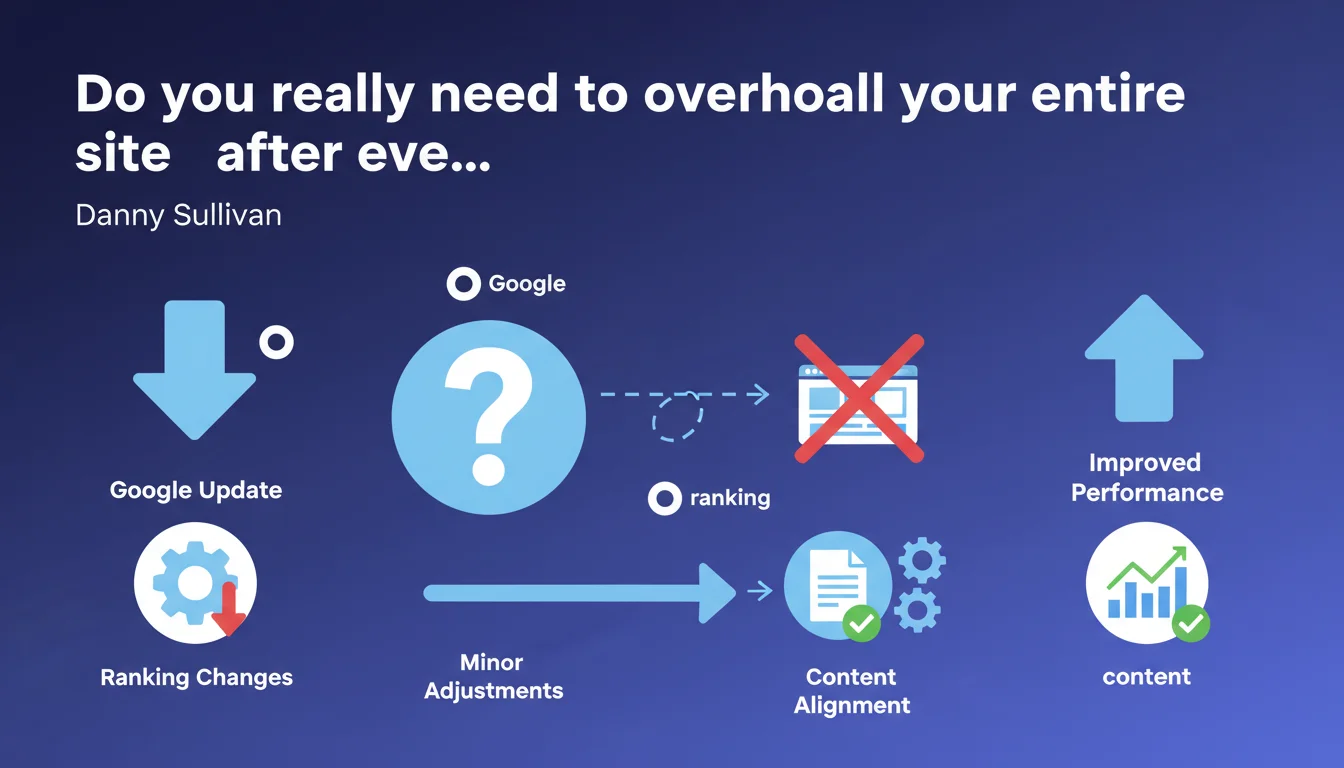
Google claims that updates don't require a complete redesign if your content already respects its fundamental principles. Only minor adjustments would be necessary. The question remains: what does Google specifically mean by "minor adjustments" and "aligned content"?
What you need to understand
What is Google really saying in this statement?
Danny Sullivan sets a reassuring framework: when an algorithmic update arrives, there's no need to panic and rebuild everything from the ground up. If your content was already respecting Google's quality principles, the adjustments needed would be limited.
The message clearly aims to counter the recurring anxiety among publishers who, with each Core Update, consider massive overhauls. Google insists: consistency trumps impulsive reaction.
What does Google mean by "aligned content"?
This is where the discourse becomes murkier. Google speaks of its principles, without detailing precisely which ones or how to measure this alignment. We assume it refers to E-E-A-T, content relevance, and user experience.
The problem? These criteria remain subjective and evolving. What was "aligned" six months ago may no longer be today if the algorithm's expectations have refined.
Why this statement now?
Updates have multiplied in recent years, creating a climate of permanent uncertainty among publishers. This communication aims to soothe, to reposition Google as a stable partner rather than an unpredictable arbiter.
Let's be honest: it's also a way to deflect responsibility from the algorithm. If you drop after an update, it's because your content wasn't truly good from the start — not because the algo changed its rules.
- Main message: no systematic overhaul needed after each update
- Implicit condition: your content must already meet Google's standards (without precise definition)
- Subtext: if you lose traffic, it's probably because your foundation was weak
- Political angle: stabilize perception of the algorithm and reduce publisher anxiety
SEO Expert opinion
Does this statement match ground reality?
Partially. It's true that sites with a solid editorial foundation — recognized expertise, original content, coherent internal linking — weather updates better. But "minor adjustments"? [To be verified]
In practice, even well-established sites can see their traffic fluctuate by 20 to 40% following a Core Update, with no clear explanation. Calling this "minor adjustments" is an understatement. And when Google says "aligned with our principles," we desperately lack objective metrics to self-assess.
What nuances should we add to this discourse?
First nuance: everything depends on your starting point. If your content is already riding the wave of overcuration or low-grade AI production, an update can wipe you out — and no "minor adjustment" will save the ship.
Second nuance: updates sometimes target specific sectors (health, finance, YMYL in general). In these niches, criteria harden regularly. What was acceptable becomes insufficient. Alignment is thus a moving target.
Third point — and this is where it gets tricky: Google never communicates in advance about what will change. Difficult to align with principles you discover retroactively by analyzing winners and losers.
In what cases does this rule not apply?
If your site relies on gray techniques or outdated methods (content farms, spinning, massive artificial backlinks), an update can force you into a near-total redesign. No cosmetic adjustment will suffice.
Similarly, sites that bet on massively AI-generated content without human oversight are regularly penalized. In this case, you need to overhaul your editorial strategy from the ground up, not just "adjust."
Practical impact and recommendations
What should you concretely do after an update?
Start by analyzing traffic fluctuations page by page, not just at the global level. Identify the content that dropped: do they share common thematic, structural, or depth patterns?
Next, compare your affected pages with those of competitors who are advancing. What do they have that you don't? Analytical depth, freshness, cited sources, multimedia, user experience?
Don't redo everything, but prioritize. Focus on high-potential pages — those ranking on page 2-3 or that have lost strategic positions. A targeted refresh may suffice.
What mistakes should you absolutely avoid?
First mistake: panic and change everything at once. You risk breaking what still worked. Test, measure, iterate.
Second mistake: believing that an update = opportunity for keyword stuffing. Google seeks semantic relevance, not keyword density. Enrich the lexical field, don't blindly repeat.
Third mistake: ignoring user signals. If your pages have high bounce rates or low reading time, that's a signal. The algo catches these behaviors, directly or indirectly.
- Analyze traffic variations page by page, not just globally
- Compare your impacted content with that of competitors climbing the ranks
- Prioritize pages with strong strategic or commercial potential
- Enrich semantically without falling into keyword stuffing
- Check UX signals (reading time, bounce rate, scroll depth)
- Update obsolete content with recent data and reliable sources
- Strengthen E-E-A-T: author bios, cited sources, proof of expertise
❓ Frequently Asked Questions
Dois-je attendre la fin d'un rollout pour agir ?
Comment savoir si mon contenu est "aligné" avec les principes Google ?
Une mise à jour peut-elle affecter uniquement certaines pages d'un site ?
Faut-il republier un contenu mis à jour pour qu'il soit réévalué ?
Les ajustements mineurs incluent-ils les optimisations techniques ?
🎥 From the same video 14
Other SEO insights extracted from this same Google Search Central video · published on 22/08/2023
🎥 Watch the full video on YouTube →
💬 Comments (0)
Be the first to comment.