
Official statement
Other statements from this video 14 ▾
- □ Does Google really use just one algorithm to rank websites?
- □ Why is Google now officially differentiating between ranking systems and updates?
- □ Do you really need to overhaul your entire site after every Google update?
- □ Is Google finally consolidating the documentation of its ranking systems in one place?
- □ Should you really wait for a Google system to impact your traffic before taking action?
- □ Is Google really rolling out more updates or just communicating about them better?
- □ Will Google finally document all of its ranking systems?
- □ Does Google really limit search results to just two pages per domain?
- □ Is HTTPS losing its grip as a Google ranking factor?
- □ Should you ditch the technical SEO checklist and focus solely on user experience instead?
- □ Is Page Experience optimization becoming impossible by focusing on individual signals?
- □ Does word count really matter for Google rankings?
- □ Should you really display an author on every single page of your website?
- □ Is authentic content for a real audience truly the SEO game-changer Google claims it is?
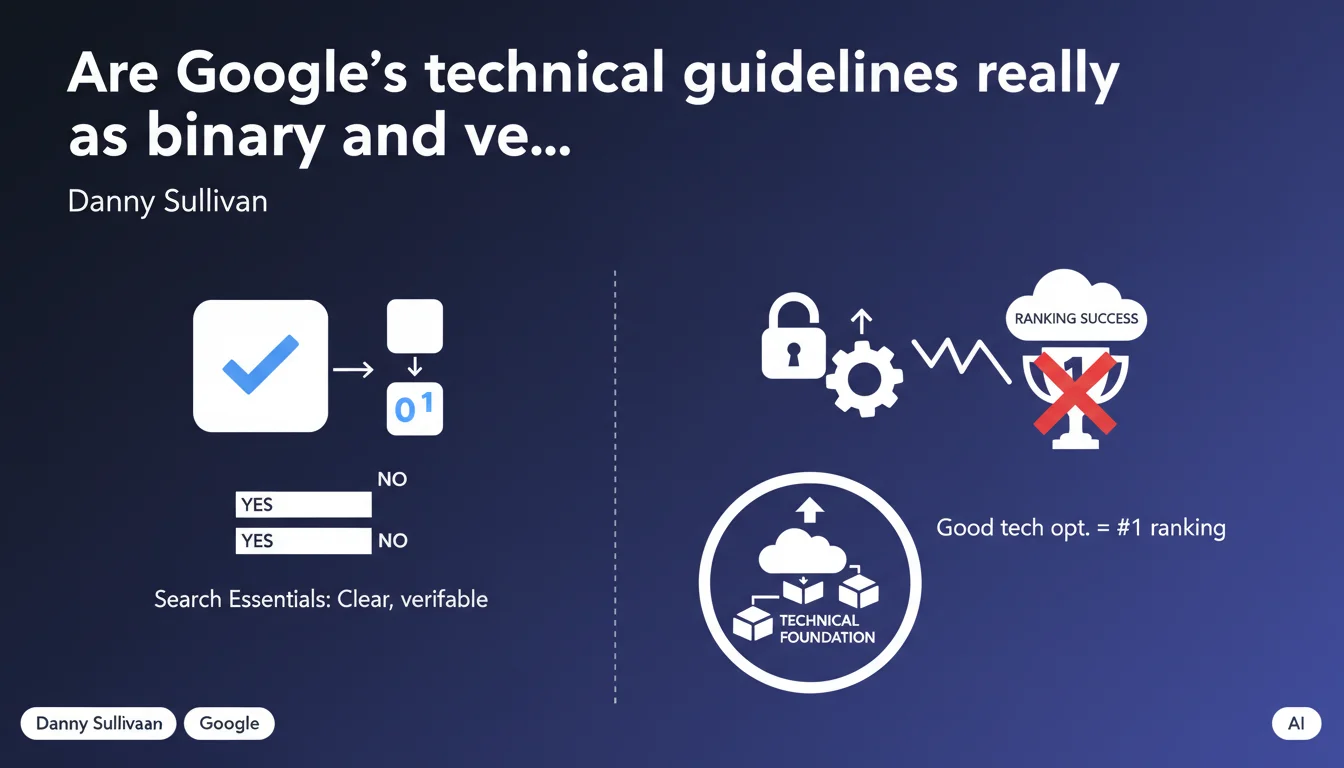
Google maintains that its Search Essentials contain verifiable technical criteria in a yes/no format. Technical optimization does not guarantee high rankings, but remains an indispensable baseline requirement. In other words: it's an entry ticket, not a podium.
What you need to understand
What exactly does 'binary and verifiable guidelines' mean?
Google is talking here about technical rules that theoretically leave no room for interpretation. Either your page is indexable, or it isn't. Either your robots.txt blocks crawling, or it allows it. Either your site returns a 200 OK, or it returns an error.
This positioning aims to distinguish objective technical criteria from qualitative factors like content relevance or domain authority — areas that are inherently gray. Technical guidelines form a minimum foundation that must be respected so Google can explore, index, and understand your pages.
Why specify that technical optimization guarantees nothing?
Because many practitioners fall into the opposite trap: believing that flawless technical configuration is enough to climb the SERPs. Google cuts through this illusion.
Technical optimization puts you in the race. It doesn't make you win. If your content is mediocre, if your backlinks are nonexistent, if your site inspires no trust — you could have green Core Web Vitals and a perfect XML sitemap, and you still won't climb.
What are the key takeaways?
- Search Essentials include clear technical rules (crawlability, indexability, structured data, performance)
- These rules are verifiable in a binary manner: compliance = yes or no
- Respecting these rules guarantees no ranking — it's a prerequisite, not a competitive advantage
- Technical optimization is necessary but not sufficient for performing in search results
- The distinction between technical (binary) and quality (graduated) remains central to SEO strategy
SEO Expert opinion
Is this statement really as binary as it claims?
Let's be honest: the idea that technical guidelines are 'binary' is appealing on paper, but floats a bit in reality. Take crawl budget: Google never says 'your site is allowed X pages crawled per day'. You guess, you deduce from the logs. Same with canonicalization: you indicate a canonical, but Google reserves the right to choose another URL if it deems your signal unreliable.
Binary rules do exist — noindex/index, disallow/allow in robots.txt, presence or absence of a sitemap — but many technical topics remain in a zone of algorithmic interpretation. [To verify]: how strictly does Google apply its own guidelines when signals contradict each other?
What is the intention behind this communication?
Google seeks to reposition technique as a mandatory foundation, not as a ranking lever. Why? Because too many sites focus on micro-optimizations (lazy loading, deferring JavaScript) while neglecting the substance: content, authority, real user experience.
This statement also serves as a safeguard against abusive promises. How many agencies sell 'guaranteed position 1' by only playing with technique? Google hammers home this point: even if everything is perfect code-wise, it's not enough.
What nuances should we add in the field?
In practice, certain technical optimizations indirectly influence rankings. A fast site improves user engagement, thus potentially CTR and bounce rate — two behavioral signals observed. Well-implemented structured data can unlock rich results, thus increase organic CTR.
Technique guarantees nothing, certainly. But it creates the conditions for other levers (content, backlinks, behavioral signals) to work. Ignoring this foundation is shooting yourself in the foot.
Practical impact and recommendations
What concretely should you do to comply with these technical guidelines?
Start by auditing Google's Search Essentials: crawlability, indexability, mobile-first, HTTPS, structured data, Core Web Vitals. These criteria are documented — the challenge is verifying your site respects them.
Use Google Search Console to identify blocked pages, indexation errors, coverage issues. Supplement with a crawl via Screaming Frog or Oncrawl to spot redirect chains, duplicate content, and inconsistent canonical tags.
What errors should you avoid after this statement?
Don't fall into all-technical territory. You can spend weeks optimizing Time to First Byte or fine-tuning your hreflang tags — if your content answers no search intent, you're wasting your time.
Also avoid thinking that 'binary' means 'simple'. Some technical guidelines interact with each other. For example, poorly handled JavaScript can block rendering of main content, making your meta tags invisible to Googlebot — even if technically, the page is indexable.
How do you verify your site complies with technical guidelines?
- Audit your robots.txt and verify no critical sections are blocked
- Check indexation status in Search Console (coverage, sitemaps)
- Validate that all strategic pages return a 200 OK
- Test mobile rendering with Google's Mobile-Friendly Test tool
- Measure Core Web Vitals via PageSpeed Insights and fix pages outside threshold
- Verify structured data consistency with the Rich Results Test
- Analyze server logs to spot crawl anomalies
Technique is an entry ticket, not a guarantee of success. Respect Search Essentials so Google can crawl, index, and understand your pages — but don't stop there. Then focus on content quality, domain authority, and real user experience.
These technical optimizations can quickly become complex, especially on large sites or specific architectures. If you lack internal resources or visibility on certain blockers, working with a specialized SEO agency may be worthwhile for in-depth diagnosis and tailored recommendations.
❓ Frequently Asked Questions
Qu'est-ce qu'une directive technique binaire selon Google ?
L'optimisation technique peut-elle garantir un bon classement ?
Quels sont les critères techniques prioritaires à vérifier ?
Pourquoi Google insiste-t-il sur le caractère binaire de ces règles ?
Les directives techniques sont-elles vraiment aussi claires que Google le prétend ?
🎥 From the same video 14
Other SEO insights extracted from this same Google Search Central video · published on 22/08/2023
🎥 Watch the full video on YouTube →
💬 Comments (0)
Be the first to comment.