
Official statement
Other statements from this video 16 ▾
- □ Are Google Search Essentials Really Enough to Rank Well in Google?
- □ Is user-centric content really the ranking factor Google claims it to be?
- □ Is Trust Really the True Central Pillar of E-E-A-T According to Google?
- □ Has first-hand experience become a non-negotiable ranking factor for Google?
- □ Is creator expertise really the game-changing ranking factor Google claims it is?
- □ Is thematic authority really enough to position yourself as a reference source in Google's eyes?
- □ Does Google really penalize you for not specifying timezone information in your structured data dates?
- □ Should you really update your article's publication date every time you make changes?
- □ Should you really remove all secondary dates from a page to boost your SEO performance?
- □ Does Google really not care how you structure your editorial approach to breaking news?
- □ Should you remove logos and watermarks from your images to boost SEO performance?
- □ Why does Google News require complete transparency about author identity?
- □ Does Google really penalize websites when ads dominate editorial content?
- □ Are pop-ups and ads really killing your SEO rankings?
- □ Do you really need to tag ALL your outbound links with rel=sponsored or rel=ugc?
- □ Is your paywall triggering Google's cloaking detection without you knowing it?
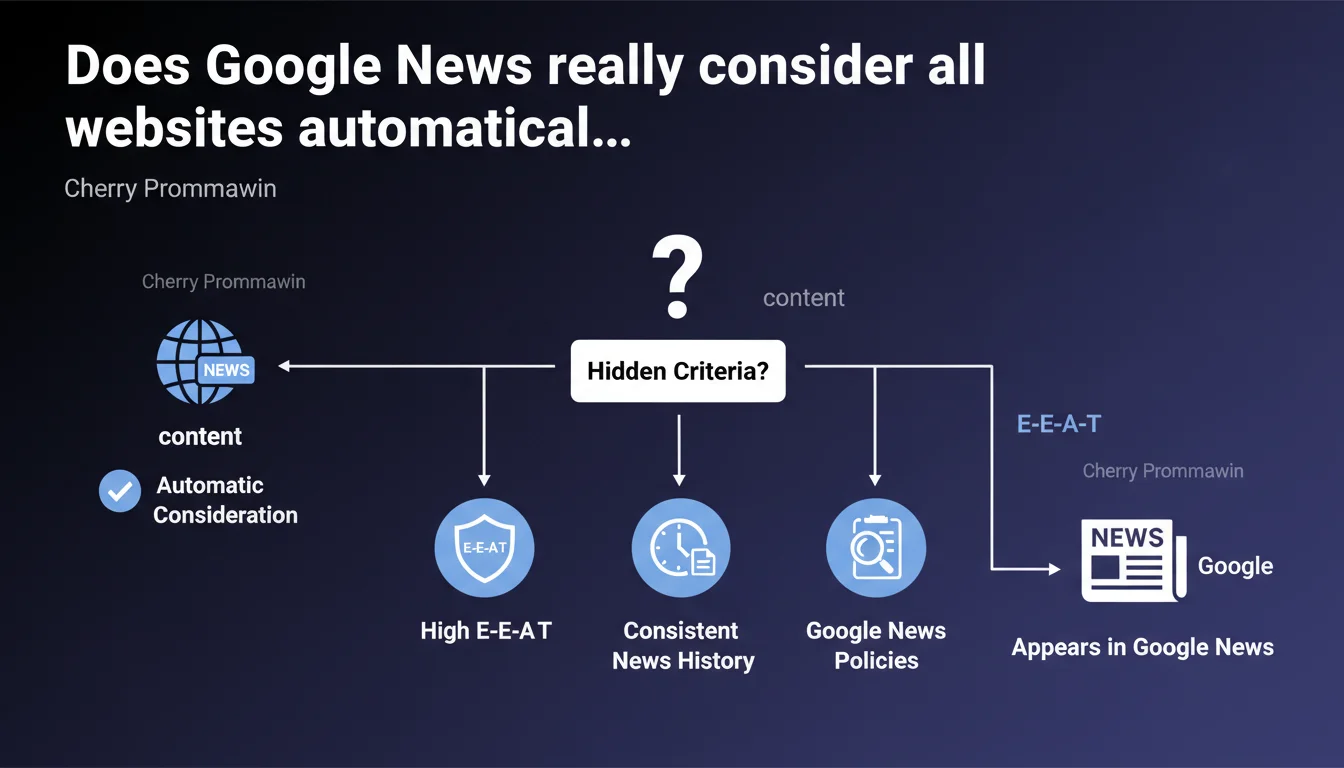
Google confirms that all web content is automatically considered for Google News without prior registration. Three criteria determine eligibility: high E-E-A-T levels, a consistent history of news content publication, and compliance with Google News policies. However, the promise of automaticity deserves to be nuanced.
What you need to understand
What does this "automatic consideration" really mean?
Google announces that all websites are now automatically evaluated to appear in Google News, without manual submission. The old registration system is gone — at least in theory.
In practice, this automaticity guarantees no visibility. It simply means that Google's crawlers examine content to determine whether it deserves to appear in the News tab. Important nuance: being considered is not the same as being retained.
What are these three eligibility criteria?
First criterion: high E-E-A-T (Experience, Expertise, Authoritativeness, Trustworthiness). Google seeks content produced by identifiable authors, recognized in their field, published on credible sites.
Second criterion: consistent history of news production. A site that occasionally publishes an article about an event won't be treated as a media outlet. Google wants to see regular frequency and a clear editorial line.
Third criterion: compliance with Google News policies. This includes absence of misleading content, aggressive clickbait, intrusive ads, or content violating editorial rules.
- Automaticity does not exempt you from strict eligibility criteria
- E-E-A-T becomes decisive for news sites
- A regular editorial history is essential
- Google News policies remain hard boundaries that cannot be crossed
Why is Google communicating about this now?
This clarification probably comes to simplify communication around Google News. The old registration system created confusion — some thought manual approval was required.
In reality, Google wants to streamline its approach: all content is scanned, but only those meeting standards emerge. This aligns with Google's overall strategy: automate processes while maintaining rigorous quality filters.
SEO Expert opinion
Is this statement consistent with real-world observations?
Let's be honest: the automaticity announced by Google doesn't always match what we observe. Many sites regularly producing quality news content never manage to appear in Google News.
The "consistent history" criterion remains vague. How many articles? Over what period? At what frequency? [To verify] Google provides no quantitative threshold, making diagnosis difficult. Is a site publishing 2 articles per week considered regular? 5? 10?
What does "high levels of E-E-A-T" really hide?
E-E-A-T is not a binary metric you check off or not. It's a composite concept that Google evaluates through hundreds of signals: author mentions, backlinks from recognized media, detailed "About" pages, external citations, and more.
Problem: Google doesn't say what E-E-A-T level qualifies as "high." Can a specialized blog run by a recognized expert compete with an established media outlet? [To verify] Field feedback suggests Google heavily favors traditional media and sites already with strong domain authority.
Are Google News policies applied uniformly?
Some sites appearing in Google News openly violate the announced policies — clickbait headlines, intrusive ads, poorly substantiated content. The consistency of enforcement is questionable.
This suggests that algorithmic filters aren't as strict as Google claims, or that exceptions exist for certain publishers. Either way, the promise of automatic and fair treatment deserves to be qualified.
Practical impact and recommendations
What should you do concretely to appear in Google News?
First, structure your content like a media outlet. Add schema.org markup of type Article or NewsArticle, with properties like datePublished, author, headline. Google favors technically well-marked content.
Next, work on author identity. Create detailed author pages with biography, social media links, published articles elsewhere. E-E-A-T relies largely on clear author identification.
Finally, adopt a regular editorial frequency. A pace of 3 to 5 articles per week appears to be a minimum, even if Google doesn't officially confirm it. Irregularity is a negative signal.
- Implement schema.org NewsArticle markup on all news content
- Create rich, detailed author pages with verification links
- Publish minimum 3 news articles per week consistently
- Remove all intrusive ads or aggressive clickbait practices
- Acquire backlinks from recognized media to strengthen authority
- Verify strict compliance with Google News policies (original content, source attribution)
What common mistakes compromise eligibility?
First mistake: publishing sporadically. A site producing 10 articles one month then nothing for two months has no chance of being considered a regular media outlet.
Second mistake: neglecting author mentions. Articles signed "Editorial Team" or "Newsroom" without individually identifiable authors are penalized. Google wants real people, traceable.
Third mistake: duplicating agency content (AFP, Reuters) without editorial value-add. Google News favors originality and distinctive editorial angle.
How do you verify if your site is already considered by Google News?
Use the site:yourdomain.com operator directly in Google's News tab. If none of your articles appear, you're not eligible — or your content isn't judged sufficiently recent or relevant.
Another method: check in Google Search Console if your articles generate impressions with the "Discover and Google News" filter. Complete absence of impressions confirms you're not in the loop.
Appearing in Google News rests on three pillars: demonstrable E-E-A-T, regular editorial production, and strict policy compliance. But precise thresholds remain opaque.
Implementing these optimizations — technical structuring, strengthening author authority, sustained editorial pace — requires pointed expertise and constant monitoring. If your organization lacks internal resources to pilot this strategy, support from an SEO agency specialized in media and E-E-A-T can significantly accelerate your results.
❓ Frequently Asked Questions
Faut-il toujours s'inscrire manuellement à Google News ?
Quel niveau d'E-E-A-T est considéré comme suffisant pour Google News ?
Quelle fréquence de publication minimale pour être éligible ?
Un blog personnel peut-il apparaître dans Google News ?
Comment Google mesure-t-il le respect des politiques Google News ?
🎥 From the same video 16
Other SEO insights extracted from this same Google Search Central video · published on 15/05/2023
🎥 Watch the full video on YouTube →
💬 Comments (0)
Be the first to comment.