
Official statement
Other statements from this video 16 ▾
- □ Are Google Search Essentials Really Enough to Rank Well in Google?
- □ Is Trust Really the True Central Pillar of E-E-A-T According to Google?
- □ Has first-hand experience become a non-negotiable ranking factor for Google?
- □ Is creator expertise really the game-changing ranking factor Google claims it is?
- □ Is thematic authority really enough to position yourself as a reference source in Google's eyes?
- □ Does Google really penalize you for not specifying timezone information in your structured data dates?
- □ Should you really update your article's publication date every time you make changes?
- □ Should you really remove all secondary dates from a page to boost your SEO performance?
- □ Does Google really not care how you structure your editorial approach to breaking news?
- □ Should you remove logos and watermarks from your images to boost SEO performance?
- □ Does Google News really consider all websites automatically, or are there hidden criteria you need to know about?
- □ Why does Google News require complete transparency about author identity?
- □ Does Google really penalize websites when ads dominate editorial content?
- □ Are pop-ups and ads really killing your SEO rankings?
- □ Do you really need to tag ALL your outbound links with rel=sponsored or rel=ugc?
- □ Is your paywall triggering Google's cloaking detection without you knowing it?
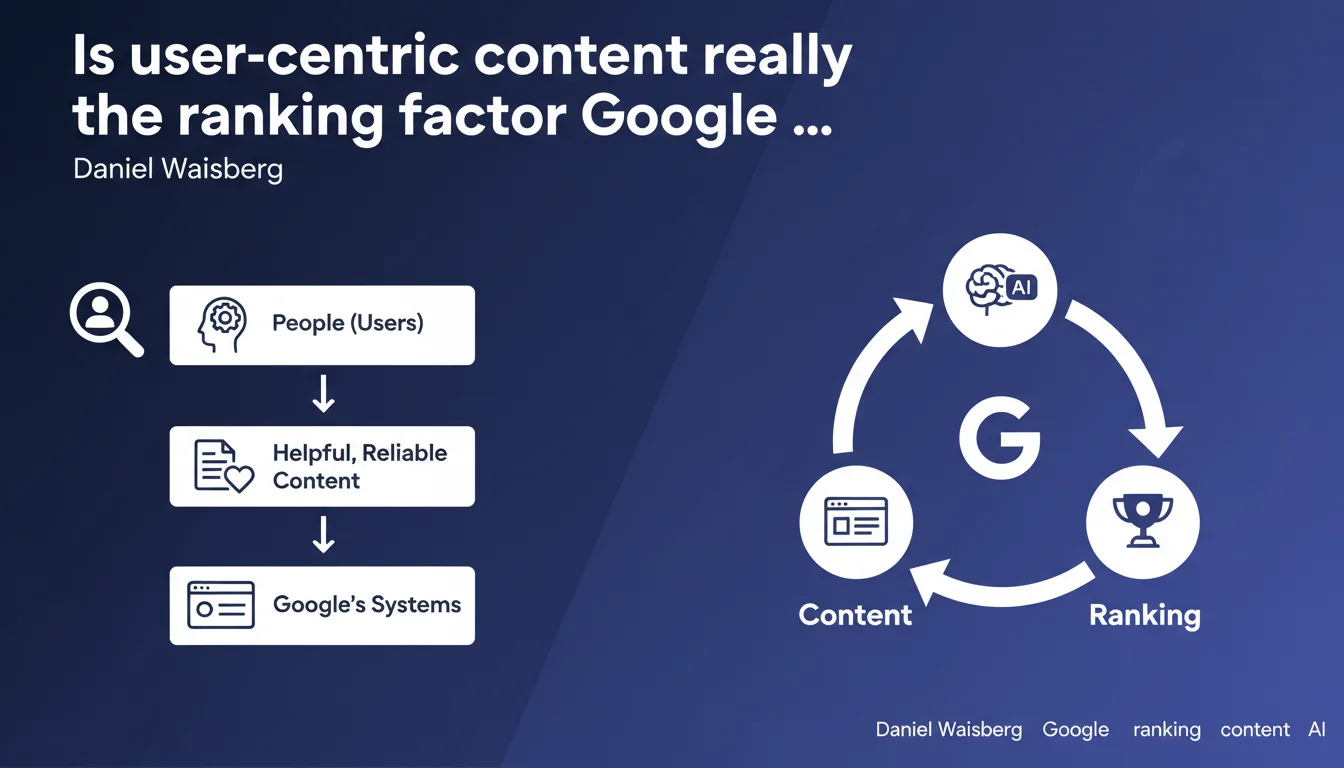
Google asserts that its systems prioritize helpful, reliable content created for people rather than search engines. This statement elevates user intent to a fundamental ranking principle, yet remains vague on the technical signals that allow the algorithm to distinguish authentic content from optimized content.
What you need to understand
What does "created for people" actually mean in practice?
Google draws a distinction here between two approaches: content designed to answer real user questions, and content optimized first for ranking. The problem is that this distinction is theoretical — all professional web content necessarily incorporates SEO considerations.
The nuance lies in priority order. A "user-centric" article starts with an identified need, proposes a comprehensive answer, then gets optimized. The reverse — starting with keywords to manufacture content without added value — is what Google fights through its Helpful Content Updates.
What signals allow Google to measure "helpfulness"?
Google remains vague on concrete metrics. We suspect a mix of behavioral signals (time on page, bounce rate, pogosticking), quality signals (E-E-A-T, freshness, depth), and semantic analysis via BERT/MUM.
But no official data confirms the exact weight of these factors. The phrasing "designed to surface" suggests the algorithm evaluates editorial intent — but how does a machine judge intent? That's where the ambiguity persists.
- Helpful content: precisely answers a query, delivers added value vs. competition
- Reliable content: identifiable author, cited sources, demonstrated expertise (E-E-A-T)
- User-centric content: clear structure, accessibility, no keyword stuffing over-optimization
- Fundamental principle: this statement isn't new — it reformulates guidelines existing since Panda (2011)
Why does Google emphasize this so much?
Because generative AI has exploded low-effort content production. Entire websites are now automatically generated with perfect technical SEO optimization but zero editorial value.
Google must publicly justify its ability to filter this spam. This statement also serves as legal cover: "we warned you, create for humans." Except in reality, plenty of mediocre content still ranks very well.
SEO Expert opinion
Is this statement consistent with real-world observations?
Partially. On YMYL queries (health, finance), Google does filter low-quality content more effectively. Sites with recognized expertise and solid E-E-A-T signals dominate.
But on transactional or generic informational queries, we still see weak pages ranking thanks to aggressive backlink profiles or historical domain authority. "User-centric" doesn't always beat powerful off-page signals.
Concretely? A mediocre article on an authoritative site often beats an excellent article on a new site. [Worth verifying]: Google claims content wins, yet domain authority remains a massive lever — they never say so publicly.
What are the gray areas in this statement?
The word "primarily" is crucial. Google doesn't say "exclusively" for users. So content can be SEO-optimized as long as that's not the sole intention. But where's the line?
Another point: "reliable." Google never precisely defines how it measures reliability at scale. Citations? Backlinks from authoritative sources? Absence of misinformation? We extrapolate from patents and tests, but nothing official.
When does this principle not really apply?
On ultra-competitive queries ("car insurance," "mortgage loan"), "helpful" content is necessary but far from sufficient. SERPs are dominated by historical players with massive link-building budgets.
Same for e-commerce sites: generic product descriptions on a fast site with good internal linking and backlinks will outrank a meticulously crafted description on a weak site. "User-centric" becomes a tiebreaker between competitors at the same level — not the dominant factor.
Practical impact and recommendations
What should you do concretely to align with this principle?
First, audit each published page with a simple checklist: does this page answer a question the user can't find answered elsewhere? If the answer is "no" or "barely," rework or delete it.
Next, strengthen E-E-A-T signals: identified author with bio, external sources cited, visible publication/update date. Google wants tangible proof that your content comes from genuine expertise.
Structure-wise: prioritize clarity (coherent heading hierarchy, short paragraphs, explanatory visuals) and accessibility (load time, mobile-first). "Helpful" content that's hard to read or slow to load doesn't fulfill its mission.
- Start with user need (keyword research, forums, Google People Also Ask) before writing
- Avoid keyword stuffing — aim for natural density, prioritize semantics (LSI, co-occurrences)
- Cite reliable external sources when presenting facts or data
- Add author bio with demonstrated expertise (LinkedIn, publications, certifications)
- Structure with logical heading hierarchy, lists, visuals — no walls of text
- Regularly update existing content to maintain freshness
- Remove or consolidate weak pages that dilute site authority (thin content)
What mistakes should you absolutely avoid?
Don't fall into the "content for content's sake" trap. Publishing 50 mediocre articles per month to "feed the blog" is counterproductive since Helpful Content Update. Better to have 10 excellent articles than 50 average ones.
Also avoid copying generic answers found in the top 3 Google results. If your content merely rewords what already exists, it adds nothing — so Google has no reason to rank it.
Finally, don't neglect off-page signals under the pretense that "content is king." Excellent content without backlinks or domain authority will take months to rank, if it ranks at all on competitive queries.
How can you verify your site respects this principle?
Use Google Search Console to identify pages with high impressions but low CTR: a sign your content isn't convincing in the SERPs. Rework titles, meta descriptions, and the content itself.
Analyze user behavior via Google Analytics 4: engagement time, scroll depth, bounce rate. If visitors leave quickly, your content doesn't answer their needs — even if it ranks.
Run A/B tests on strategic pages: compare an "over-optimized" version vs. a "user-centric" version. Measure organic CTR, engagement time, conversions. Real-world data beats Google's statements.
❓ Frequently Asked Questions
Google pénalise-t-il vraiment les contenus optimisés pour le SEO ?
Comment Google mesure-t-il qu'un contenu est « centré utilisateur » ?
Un contenu généré par IA peut-il être considéré comme « utile » par Google ?
Faut-il supprimer tous les anciens contenus faibles pour éviter une pénalité ?
Cette déclaration change-t-elle la stratégie SEO à adopter ?
🎥 From the same video 16
Other SEO insights extracted from this same Google Search Central video · published on 15/05/2023
🎥 Watch the full video on YouTube →
💬 Comments (0)
Be the first to comment.