
Official statement
Other statements from this video 16 ▾
- □ Les Google Search Essentials suffisent-ils vraiment pour bien se positionner dans Google ?
- □ Le contenu « centré sur l'utilisateur » est-il vraiment le critère de classement que Google prétend ?
- □ Le Trust est-il vraiment le pilier central de l'E-E-A-T selon Google ?
- □ L'expérience de première main est-elle devenue un critère de ranking incontournable ?
- □ L'expertise du créateur de contenu est-elle vraiment un critère de classement déterminant ?
- □ L'autorité thématique suffit-elle à se positionner comme source de référence aux yeux de Google ?
- □ Pourquoi Google insiste-t-il autant sur les fuseaux horaires dans les données structurées de dates ?
- □ Faut-il vraiment modifier la date de publication après chaque mise à jour d'article ?
- □ Faut-il vraiment supprimer toutes les dates secondaires d'une page pour optimiser son SEO ?
- □ Google se fiche-t-il vraiment de votre structure éditoriale pour les actualités récurrentes ?
- □ Faut-il bannir les logos et filigranes de vos images pour améliorer votre SEO ?
- □ Google News : est-ce vraiment automatique ou existe-t-il des critères cachés ?
- □ Pourquoi Google News impose-t-il une transparence totale sur l'identité des auteurs ?
- □ Pourquoi Google exige-t-il que le contenu éditorial prime sur la publicité ?
- □ Les pop-ups et publicités tuent-elles vraiment votre référencement ?
- □ Faut-il vraiment baliser TOUS vos liens sortants avec rel=sponsored ou rel=ugc ?
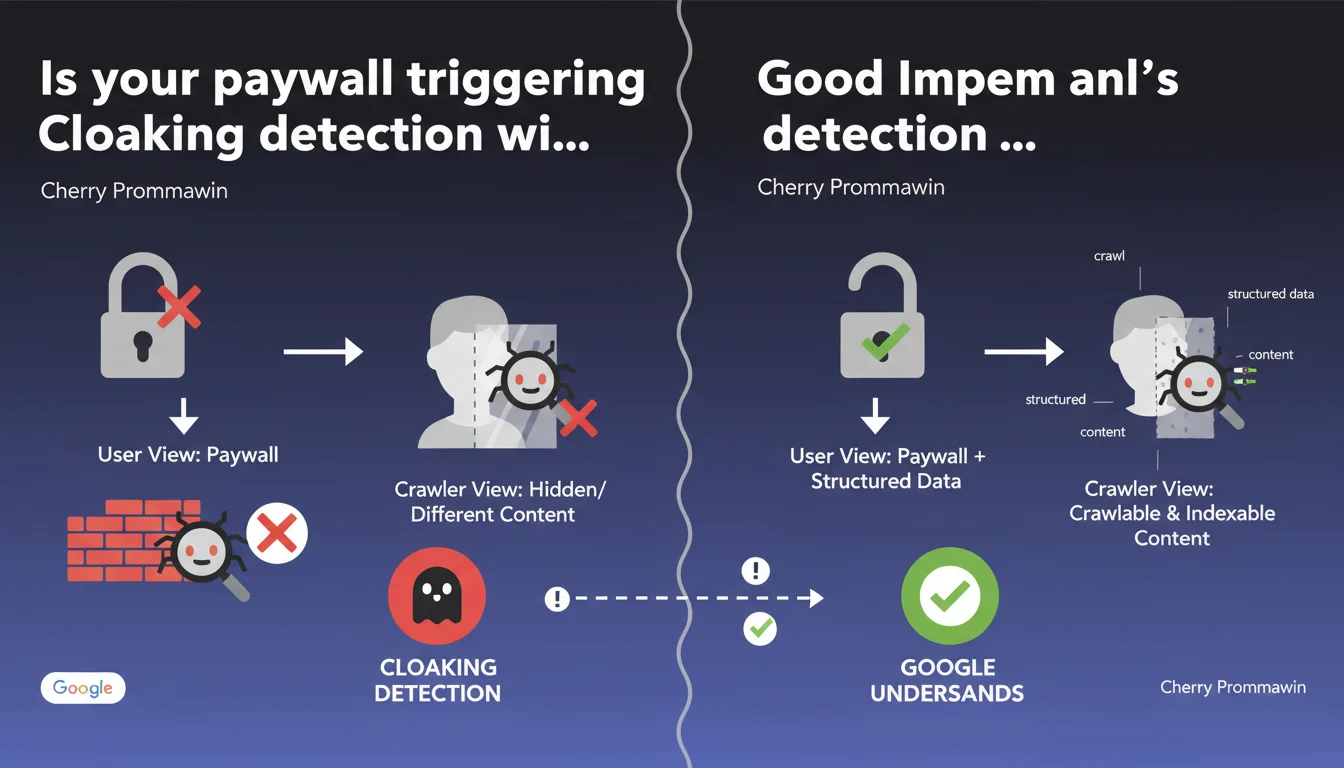
Google requires sites with paywalls, metered access, or login walls to use appropriate structured data to avoid being penalized for cloaking. Content behind the paywall must remain crawlable and indexable, otherwise you risk violating the anti-spam policy.
What you need to understand
Why does Google equate certain paywalls with cloaking?
Cloaking consists of showing different content to search bots and users. When you implement a paywall without proper markup, Googlebot can access the full article while the average user sees a wall. This differential treatment triggers Google's anti-spam detectors.
Cherry Prommawin reminds us that technical context makes all the difference: a legitimate paywall is not cloaking if you declare it correctly via structured data. Without this declaration, Google cannot distinguish your business model from an attempt at manipulation.
What structured data should you use for a paywall or metered access?
Google recommends schema.org NewsArticle or Article markup with the isAccessibleForFree property set to false, combined with hasPart to delineate paid sections. For a metered paywall, you must signal how many free articles are available via cssSelector.
The CreativeWork schema also supports these properties. The key is to be explicit about what is free, what is limited, and what requires a subscription. Without this markup, you leave Google guessing — and it will guess wrong.
Should paid content be crawlable and indexable?
Yes, and this is where many get it wrong. Google is clear: content behind the paywall must remain accessible to bots. Blocking Googlebot with robots.txt or noindex on premium articles deprives you of organic visibility and defeats the purpose of an SEO-friendly paywall.
Concretely, Googlebot must be able to read the entire text to index it, even if the average user only sees an excerpt. This transparency is what prevents the cloaking penalty while allowing your premium articles to rank.
- Explicitly declare your business model via structured data
- Never block Googlebot from accessing paid content
- Technically differentiate between legitimate paywall and manipulative cloaking
- The
isAccessibleForFreemarkup is your primary ally
SEO Expert opinion
Is this guidance consistent with observed real-world practices?
Overall yes, but with gray areas. News sites that properly implement NewsArticle markup with isAccessibleForFree typically don't encounter issues. However, manual penalties do still exist for sites that allow Googlebot free access without proper markup while showing users a strict wall.
The challenge: Google doesn't clearly define where legitimate paywall ends and cloaking begins when markup is only partially present. Does a site showing 30% of the article free before the wall rank better with correct markup than a site showing 10%? [Needs verification] — no public data settles this question.
What nuances should be added to this recommendation?
First point: the term "crawlable and indexable" can be confusing. Technically, you can make content crawlable (Googlebot reads the complete HTML) without the entirety being displayed in SERPs. The snippet can be truncated, which is normal — Google respects your business model.
Second point: some sectors (SaaS, B2B platforms) use login walls that aren't paywalls in the strict sense. The WebPage markup with requiresSubscription exists but remains underdocumented. If your content just requires a free account, the boundary with cloaking becomes blurry. [Needs verification] — Google doesn't provide clear guidance for this case.
In what cases does this rule not fully apply?
Niche sites with ultra-specialized content (databases, academic research) can block Googlebot on certain sections without major risk, since their model relies on direct access rather than organic discovery. But this is a strategic choice: you sacrifice SEO for these pages.
Similarly, SaaS platforms that hide entire dashboards behind login don't fall under this rule — this isn't indexable editorial content. The scope of this Google recommendation primarily concerns informational content (articles, studies, guides) likely to rank on search queries.
Practical impact and recommendations
What do you need to do concretely to stay compliant?
First step: identify all content subject to paywall, metered access, or login walls. For each type, implement the appropriate schema.org markup: NewsArticle or Article with isAccessibleForFree: false, and delineate paid sections via hasPart and cssSelector.
Second step: verify that Googlebot can actually crawl this content. Test with the URL Inspection tool in Search Console and review the HTML rendering. If Googlebot sees a blank page or error message, fix it immediately — this means your paywall is blocking too aggressively.
Third step: audit your robots.txt file and meta tags. No Disallow or noindex directive should target premium URLs if you want them to rank. Paid content must be indexable but clearly labeled as such.
What errors must you absolutely avoid?
Never serve different content to Googlebot via user-agent sniffing without explicit markup. Even if your intent is good ("I want Google to index my full article"), this is still technical cloaking. Structured markup is the only legitimate way to justify this difference.
Another common mistake: implementing isAccessibleForFree: false without precisely delineating paid sections. Google needs to know where the wall starts to display coherent snippets in SERPs. Vague or incomplete markup can hurt your click-through rate.
- Implement NewsArticle or Article markup with
isAccessibleForFree - Delineate paid sections via
hasPartandcssSelector - Verify that Googlebot accesses the full content (URL Inspection)
- Never block premium URLs in robots.txt or via noindex
- Regularly audit Search Console to detect cloaking alerts
- Test bot rendering vs. user rendering to confirm consistency
How can you verify your implementation is correct?
Use Google's Rich Results Test to validate your schema markup. It should recognize the isAccessibleForFree and hasPart properties without errors. If warnings appear, fix them before deploying to production.
Then compare Googlebot rendering (via URL Inspection) with actual user rendering (private browsing without cookies). If Googlebot sees 100% of the text and the user sees 20% with a wall, this is normal as long as markup is present. Without markup, it's cloaking.
❓ Frequently Asked Questions
Puis-je bloquer Googlebot sur mes articles premium sans risque ?
Le balisage isAccessibleForFree suffit-il à éviter une pénalité ?
Quelle différence entre un paywall et un mur de connexion pour Google ?
Mon site SaaS avec dashboard privé est-il concerné par cette règle ?
Comment tester si mon paywall est conforme aux yeux de Google ?
🎥 From the same video 16
Other SEO insights extracted from this same Google Search Central video · published on 15/05/2023
🎥 Watch the full video on YouTube →
💬 Comments (0)
Be the first to comment.