
Official statement
Other statements from this video 16 ▾
- □ Les Google Search Essentials suffisent-ils vraiment pour bien se positionner dans Google ?
- □ Le contenu « centré sur l'utilisateur » est-il vraiment le critère de classement que Google prétend ?
- □ Le Trust est-il vraiment le pilier central de l'E-E-A-T selon Google ?
- □ L'expérience de première main est-elle devenue un critère de ranking incontournable ?
- □ L'autorité thématique suffit-elle à se positionner comme source de référence aux yeux de Google ?
- □ Pourquoi Google insiste-t-il autant sur les fuseaux horaires dans les données structurées de dates ?
- □ Faut-il vraiment modifier la date de publication après chaque mise à jour d'article ?
- □ Faut-il vraiment supprimer toutes les dates secondaires d'une page pour optimiser son SEO ?
- □ Google se fiche-t-il vraiment de votre structure éditoriale pour les actualités récurrentes ?
- □ Faut-il bannir les logos et filigranes de vos images pour améliorer votre SEO ?
- □ Google News : est-ce vraiment automatique ou existe-t-il des critères cachés ?
- □ Pourquoi Google News impose-t-il une transparence totale sur l'identité des auteurs ?
- □ Pourquoi Google exige-t-il que le contenu éditorial prime sur la publicité ?
- □ Les pop-ups et publicités tuent-elles vraiment votre référencement ?
- □ Faut-il vraiment baliser TOUS vos liens sortants avec rel=sponsored ou rel=ugc ?
- □ Comment éviter que Google confonde votre paywall avec du cloaking ?
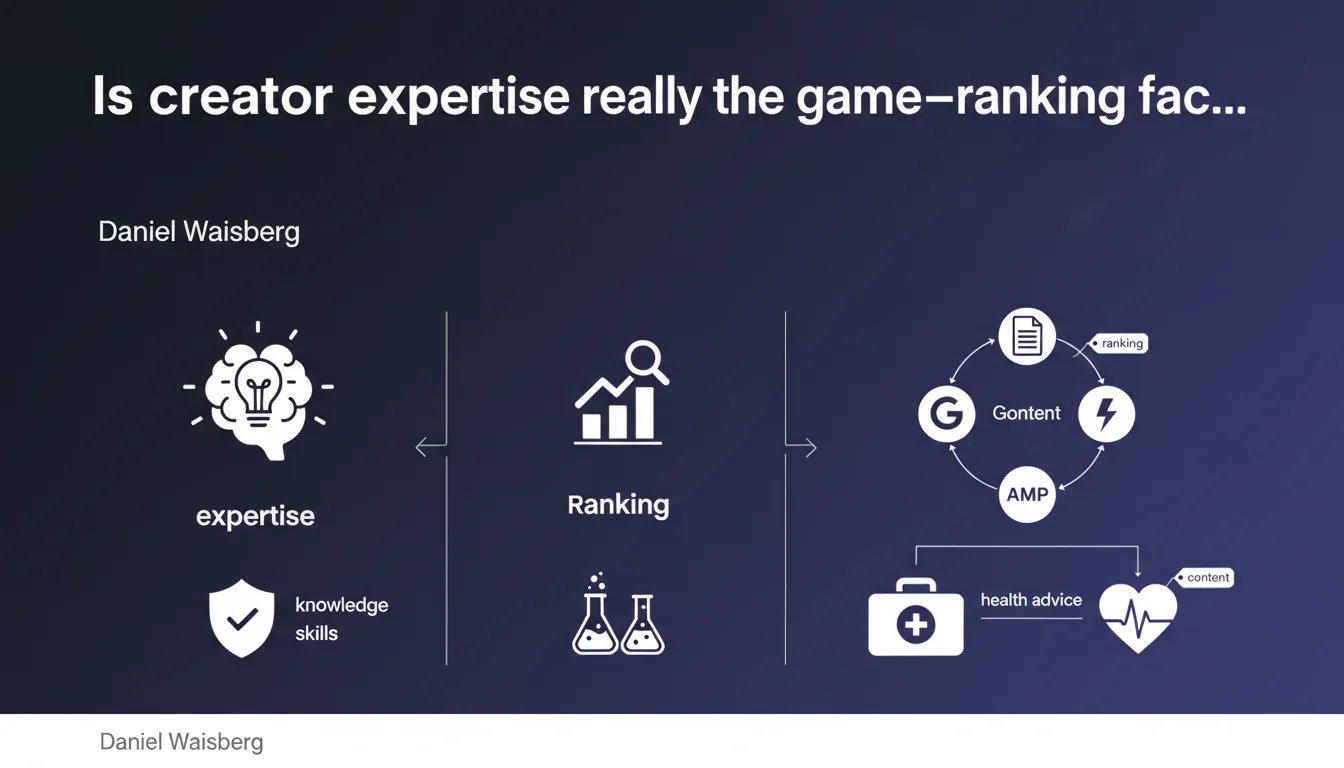
Google states it prioritizes content written by creators with documented expertise on the topic covered. For sensitive sectors (health, finance), author qualification becomes a major trust signal. Concretely, this means author mentions, their credentials, and their sectoral legitimacy count in quality evaluation.
What you need to understand
Why is Google emphasizing expertise now?
This statement fits within the E-E-A-T criteria (Experience, Expertise, Authoritativeness, Trustworthiness) that Google uses to evaluate content quality. Expertise is the central "E" that validates the creator's legitimacy on a given subject.
In YMYL sectors (Your Money Your Life), such as health or finance, Google openly acknowledges that formal expertise becomes a critical signal. A medical article written by a licensed physician will naturally carry more weight than generic content with no identified author.
How does Google concretely evaluate this expertise?
Google has never detailed precisely the algorithmic mechanisms behind this evaluation. Quality Raters are trained to spot expertise signals: author biography, mentions of degrees, professional affiliations, previous publications.
The algorithm likely tries to cross these human signals with detectable patterns: presence of detailed author pages, external citations of the creator, verifiable professional profiles (LinkedIn, institutional websites).
Does this rule apply to all types of content?
No. Google specifies that expected expertise varies based on the risk level of the subject. For a cooking recipe guide, formal expertise matters less than demonstrated practical experience. For investment or medical treatment advice, qualifications become crucial.
The notion of expertise is therefore contextual. A travel blogger can demonstrate expertise through years of detailed accounts without a university degree, whereas content on tax matters requires formal credentials.
- Expertise is a pillar of Google's E-E-A-T framework used to evaluate content quality
- In YMYL domains, formal qualifications (degrees, professional titles) become strong signals
- The evaluation likely relies on on-page signals (author pages, bios) and off-page signals (citations, external profiles)
- The level of expertise required depends on the sector and risk associated with the content
- Google does not reveal the precise algorithmic mechanisms behind this evaluation
SEO Expert opinion
Is this statement consistent with field observations?
Yes, partially. In health and finance sectors, we clearly see a long-standing dominance of institutional sites and platforms where authors are identified with their qualifications. Generic blogs with no identified author struggle to rank on these sensitive queries.
But the nuance is that declared expertise isn't enough. I've seen medical websites with verifiable doctors stagnate while mainstream platforms like Reddit or Quora rank on health queries. Google sometimes seems to prioritize measured user satisfaction (reading time, engagement) over formal credentials. [To verify]: To what extent do behavioral signals counterbalance pure expertise signals?
What limitations should be placed on this claim?
Google remains deliberately vague about the actual weighting of this criterion. Saying "Google prioritizes" doesn't mean "Google ranks solely based on". Expertise is one signal among dozens of others: semantic relevance, backlinks, UX, content freshness.
Practically speaking, a poorly optimized site with expert authors will struggle to perform. Conversely, well-crafted SEO content without an identified author can still rank if overall quality signals (links, engagement) are there. Expertise helps, but it doesn't compensate for everything.
In which cases does this rule not really apply?
On basic informational queries or entertainment, formal expertise matters little. No one expects an engineering degree to write a "How to Install VLC" tutorial. Google will prioritize clarity and practical usefulness of the content.
Another case: emerging sectors where formal expertise doesn't yet exist (blockchain, generative AI two years ago). There, Google falls back on other signals: authority built via backlinks, community engagement, editorial consistency. Expertise then becomes a form of implicit reputation rather than official qualification.
Practical impact and recommendations
What should you concretely do to signal expertise?
Create detailed author pages for each contributor. Include: education, professional experience, previous publications, affiliations (universities, companies, associations). Link these pages from each signed article via clear AuthorProfile Schema.org markup.
Add external proof of legitimacy: links to LinkedIn profiles, Google Scholar, recognized institutional websites. If the author has published elsewhere, cite these publications. The goal is to allow a Quality Rater to quickly verify credentials.
On YMYL topics, systematically prioritize qualified writers. A health site must involve identifiable healthcare professionals. A finance outlet must display certified analysts or advisors. The shortcut of "generalist SEO writer" no longer works on these verticals.
What mistakes should you absolutely avoid?
Don't create fake author profiles with invented credentials. Google can cross-reference this info with external databases (professional networks, official registries). A detected inconsistency can undermine all site trust.
Avoid YMYL content with no identified author. A medical article signed "The Editorial Team" or worse, unsigned, sends a massive negative signal. If you can't associate an expert, either rework the angle (make the content less prescriptive), or skip it entirely.
Don't delegate YMYL writing to unqualified freelancers just to produce volume. Poor health content signed by a pseudo-expert causes more damage than good generic content well-sourced. Quantity never compensates for lack of sectoral legitimacy.
How do you verify your site meets this criterion?
Conduct an author page audit: Do all critical pages have a clearly identified author with a detailed bio? Do links to external profiles work? Is Schema.org Author markup in place and valid?
Analyze the competitors ranking on your target YMYL queries. Who are their authors? What credentials do they display? Compare with your own visible expertise level. If the gap is glaring, it's probably a priority lever to pull.
- Create or enrich author pages with verifiable education, experience, and affiliations
- Implement Schema.org Author markup on all signed content
- Link external profiles (LinkedIn, Google Scholar, institutional sites) from author bios
- Recruit or collaborate with qualified experts for YMYL content
- Remove or rework sensitive content that is unsigned or signed by weak profiles
- Regularly audit consistency between declared credentials and external proof
- Analyze competitor authors on strategic YMYL queries
❓ Frequently Asked Questions
Faut-il obligatoirement avoir un diplôme pour démontrer son expertise ?
Le contenu généré par IA peut-il être considéré comme expert ?
Est-ce que Google vérifie réellement les diplômes déclarés ?
Un site peut-il ranker sans auteur identifié sur des requêtes YMYL ?
Combien de temps faut-il pour que Google reconnaisse l'expertise ajoutée ?
🎥 From the same video 16
Other SEO insights extracted from this same Google Search Central video · published on 15/05/2023
🎥 Watch the full video on YouTube →
💬 Comments (0)
Be the first to comment.