
Official statement
Other statements from this video 16 ▾
- □ Les Google Search Essentials suffisent-ils vraiment pour bien se positionner dans Google ?
- □ Le contenu « centré sur l'utilisateur » est-il vraiment le critère de classement que Google prétend ?
- □ Le Trust est-il vraiment le pilier central de l'E-E-A-T selon Google ?
- □ L'expertise du créateur de contenu est-elle vraiment un critère de classement déterminant ?
- □ L'autorité thématique suffit-elle à se positionner comme source de référence aux yeux de Google ?
- □ Pourquoi Google insiste-t-il autant sur les fuseaux horaires dans les données structurées de dates ?
- □ Faut-il vraiment modifier la date de publication après chaque mise à jour d'article ?
- □ Faut-il vraiment supprimer toutes les dates secondaires d'une page pour optimiser son SEO ?
- □ Google se fiche-t-il vraiment de votre structure éditoriale pour les actualités récurrentes ?
- □ Faut-il bannir les logos et filigranes de vos images pour améliorer votre SEO ?
- □ Google News : est-ce vraiment automatique ou existe-t-il des critères cachés ?
- □ Pourquoi Google News impose-t-il une transparence totale sur l'identité des auteurs ?
- □ Pourquoi Google exige-t-il que le contenu éditorial prime sur la publicité ?
- □ Les pop-ups et publicités tuent-elles vraiment votre référencement ?
- □ Faut-il vraiment baliser TOUS vos liens sortants avec rel=sponsored ou rel=ugc ?
- □ Comment éviter que Google confonde votre paywall avec du cloaking ?
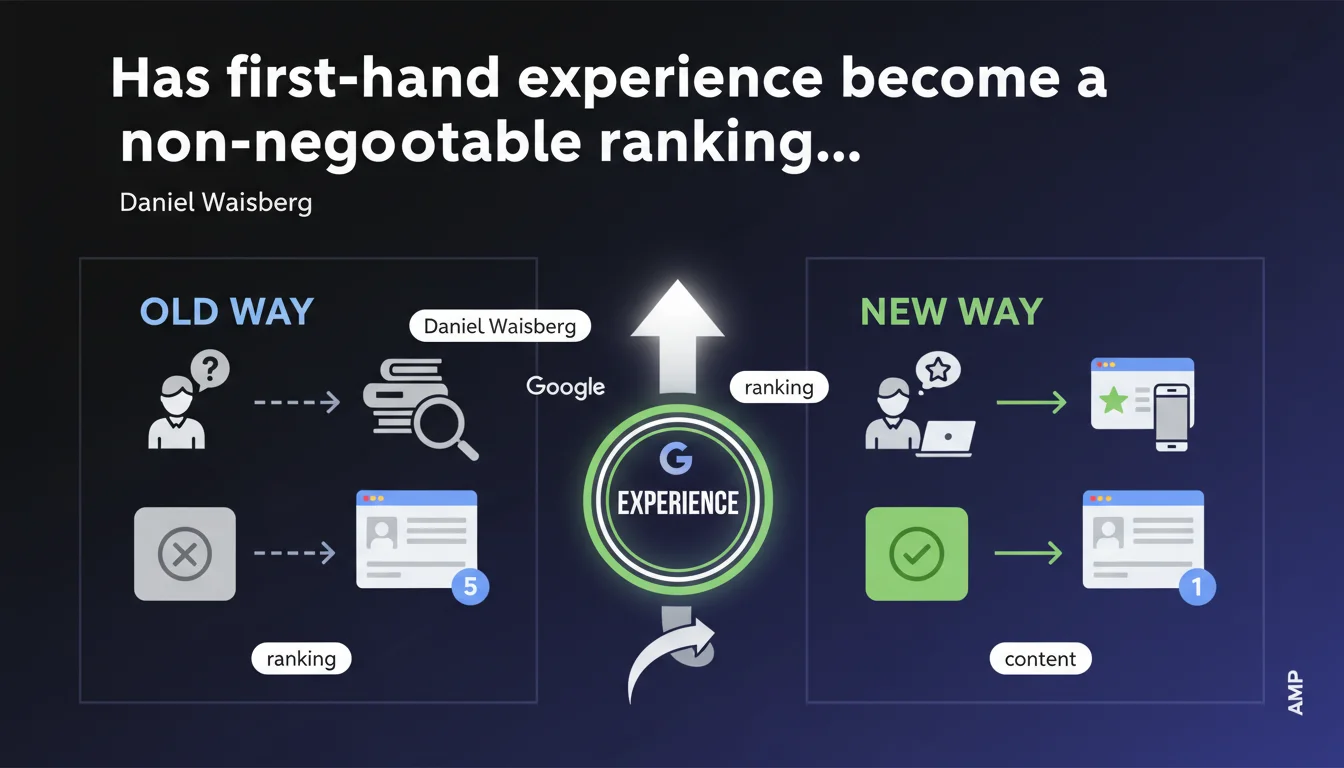
Google states that it values content created by authors with direct experience of the subject matter. For product reviews in particular, the search engine prioritizes creators who have actually used what they are evaluating. This statement aligns with the E-E-A-T framework, where the first "E" (Experience) was recently added to distinguish theoretical expertise from hands-on practice.
What you need to understand
Why does Google insist on first-hand experience?
Google seeks to filter out generic or purely theoretical content that proliferates on the web. By valuing direct experience, the search engine wants to favor creators who share authentic insights rather than compilations of information already available elsewhere.
This evolution responds to a concrete problem: the multiplication of content produced en masse by writers who have never touched the product, visited the place, or practiced the activity they're writing about. The addition of "E" for Experience in E-E-A-T marks a turning point: expertise alone is no longer sufficient if it remains purely academic.
How does Google detect this first-hand experience?
The statement remains vague on concrete detection methods. Google does not specify whether it relies on linguistic signals (vocabulary, specific details), on author metadata, or on other indicators. [To verify]: the lack of technical details leaves considerable room for interpretation.
Several hypotheses are plausible: semantic analysis to detect detailed descriptions, verification of consistency between author profile and subject matter, consideration of visual evidence such as original photos. But nothing is officially confirmed.
Which types of content are primarily affected?
Google explicitly mentions product reviews, a sector where spam and generic content are historically massive. Successive Product Reviews Updates have already targeted this segment with strict quality criteria.
But first-hand experience logically applies well beyond: travel guides (having visited the destination), technical tutorials (having practiced the skill), medical content (clinical experience), service reviews, etc. Any content where lived experience provides additional informational value is potentially affected.
- First-hand experience becomes a pillar of E-E-A-T alongside expertise, authority, and trustworthiness
- Google targets product reviews as a priority, but the principle extends to many sectors
- Detection methods remain officially undocumented
- Purely compilatory content loses ground to authentic testimony
- Adding personal details and concrete elements becomes a competitive advantage
SEO Expert opinion
Does this statement truly change the game for niche websites?
Let's be honest: sites that already performed well in product reviews were applying these principles even before this statement. Detailed reviews with original photos, precise measurements, and actual usage feedback were already dominating competitive SERPs since the Product Reviews Updates. This official communication simply formalizes a practice already being rewarded.
The problem is that many sites settled for reformulating manufacturer datasheets or aggregating technical specifications. For them, the adjustment will be brutal—and costly. It's impossible to simulate experience at scale without investing in real product testing. Low-cost content farms are directly threatened.
Can you quantify the impact of experience on rankings?
[To verify]—Google provides no metrics, no relative weight for this criterion. We're navigating blind. Field observations suggest that experience plays a role in commercial and informational queries with high stakes, but its exact weight remains a black box.
What is observable: pages that display strong signals of experience (dated original photos, numerical comparisons, mentions of usage duration) tend to better resist algorithm fluctuations. Correlation is not causality, but the pattern is consistent.
What limitations should be pointed out in this recommendation?
First limitation: not all subjects lend themselves to first-hand experience. An article on medieval history, a macro-economic analysis, or a scientific synthesis can be excellent without the author having "lived" the subject. Documentary expertise remains valid in many domains.
Second limitation: the risk of bias. Valuing first-hand experience exclusively can favor subjective content at the expense of more nuanced analyses based on multiple sources. A good article can combine personal experience and thorough research—one does not exclude the other.
Practical impact and recommendations
How do you concretely integrate first-hand experience into your content?
Start by identifying content where your real experience can make a difference. For a product review: add original photos of your usage, precise measurements, details that only a user would know (noise level of a device, texture of a material, actual startup time).
For a how-to guide: document your process with timestamped screenshots, mention obstacles you encountered and how you overcame them, share numerical results. The reader must feel that you have done it, not merely read about it.
On the author structure side: enrich your bio pages with proof of experience. Portfolios, certifications, professional history, projects completed. The Schema.org Person/Author markup can highlight these elements to crawlers.
Should you rework existing content or focus on new content?
Both. First audit your high-traffic and high-conversion pages: where adding personal experience can immediately boost performance. A top 5 that could become top 3 with additional details is worth the investment.
For new content, integrate this logic from the creation phase. Brief your writers: systematically include a "field experience" or "tests conducted" section. This changes the production dynamic—slower, but far more differentiating.
What mistakes should you avoid in this compliance effort?
Mistake #1: forcing experience where it adds nothing. A technical definition page doesn't need an artificial personal anecdote. Stay relevant.
Mistake #2: confusing experience with unsupported opinion. "I think this product is good" has no value. "After 3 months of daily use, the battery still lasts 8 hours compared to 10 hours advertised" has considerable value. Facts before impressions.
Mistake #3: neglecting author/subject consistency. If your finance expert suddenly signs off on electric bike reviews without any established legitimacy, Google won't be fooled. The credibility of the author on the subject matters as much as the experience itself.
- Identify priority pages where adding experience can have immediate impact
- Enrich content with original photos, precise measurements, and concrete usage details
- Document author profiles with proof of experience (bio, portfolio, certifications)
- Implement Schema.org markup for Author and Review with experience attributes
- Train editorial teams on E-E-A-T criteria and Google's expectations
- Regularly audit author/subject consistency to avoid credibility inconsistencies
- Prioritize verifiable facts over generic opinions in review sections
❓ Frequently Asked Questions
L'expérience de première main est-elle obligatoire pour tous les types de contenus ?
Comment Google peut-il vérifier qu'une expérience est authentique et non inventée ?
Faut-il obligatoirement montrer son visage ou son identité réelle pour prouver l'expérience ?
Les contenus générés par IA peuvent-ils intégrer de l'expérience de première main ?
Quel impact sur les sites affiliés qui ne testent pas tous les produits recommandés ?
🎥 From the same video 16
Other SEO insights extracted from this same Google Search Central video · published on 15/05/2023
🎥 Watch the full video on YouTube →
💬 Comments (0)
Be the first to comment.