
Official statement
Other statements from this video 16 ▾
- □ Les Google Search Essentials suffisent-ils vraiment pour bien se positionner dans Google ?
- □ Le contenu « centré sur l'utilisateur » est-il vraiment le critère de classement que Google prétend ?
- □ Le Trust est-il vraiment le pilier central de l'E-E-A-T selon Google ?
- □ L'expérience de première main est-elle devenue un critère de ranking incontournable ?
- □ L'expertise du créateur de contenu est-elle vraiment un critère de classement déterminant ?
- □ L'autorité thématique suffit-elle à se positionner comme source de référence aux yeux de Google ?
- □ Pourquoi Google insiste-t-il autant sur les fuseaux horaires dans les données structurées de dates ?
- □ Faut-il vraiment supprimer toutes les dates secondaires d'une page pour optimiser son SEO ?
- □ Google se fiche-t-il vraiment de votre structure éditoriale pour les actualités récurrentes ?
- □ Faut-il bannir les logos et filigranes de vos images pour améliorer votre SEO ?
- □ Google News : est-ce vraiment automatique ou existe-t-il des critères cachés ?
- □ Pourquoi Google News impose-t-il une transparence totale sur l'identité des auteurs ?
- □ Pourquoi Google exige-t-il que le contenu éditorial prime sur la publicité ?
- □ Les pop-ups et publicités tuent-elles vraiment votre référencement ?
- □ Faut-il vraiment baliser TOUS vos liens sortants avec rel=sponsored ou rel=ugc ?
- □ Comment éviter que Google confonde votre paywall avec du cloaking ?
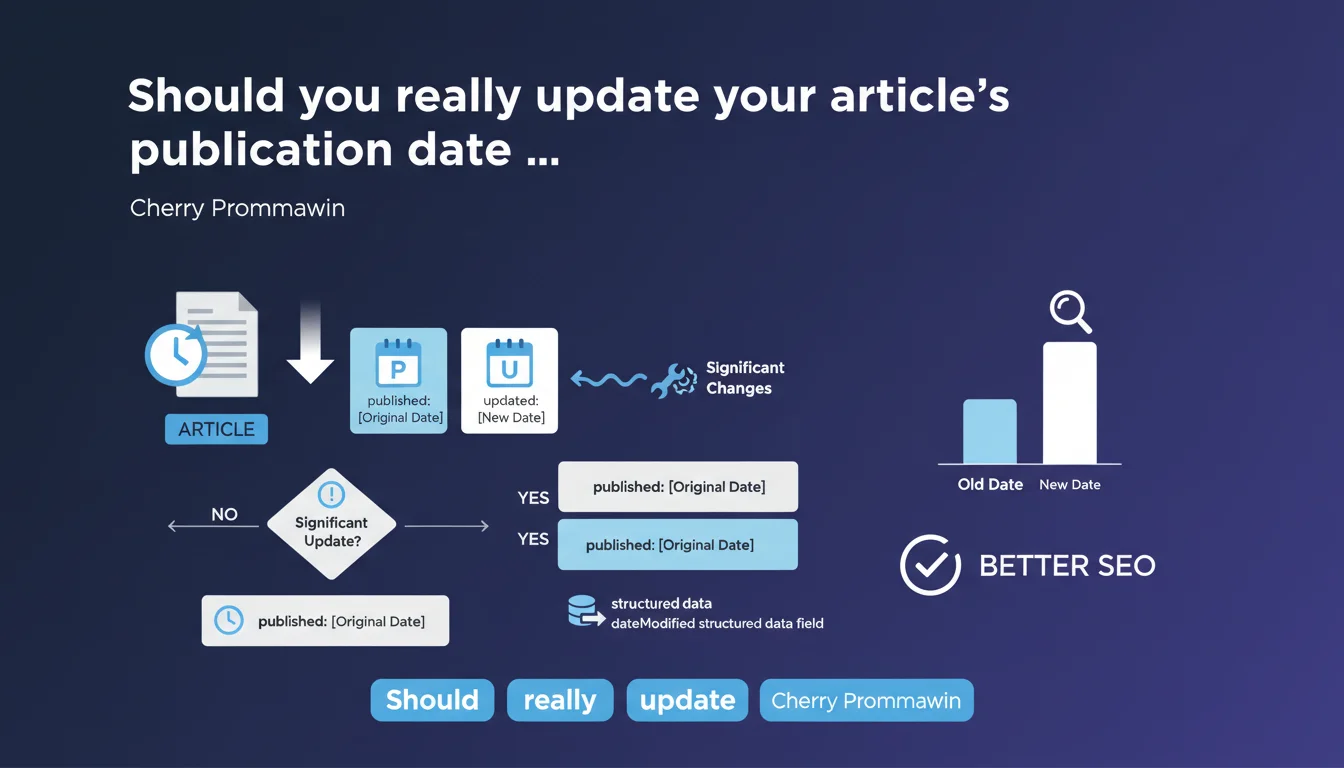
Google explicitly recommends modifying article dates during significant updates and using clear textual labels ('updated', 'last updated') paired with the dateModified field in structured data. This guidance primarily targets user transparency and the perceived freshness of content in SERPs.
What you need to understand
Why does Google insist on modifying the date?
Content freshness remains a relevance signal for Google, especially for news queries or evolving topics. Modifying the publication date after a substantial update sends a freshness signal to both users and crawlers.
But be careful: Google specifically mentions "significant updates". Fixing a typo or tweaking a sentence doesn't justify changing the date. The idea is to reflect real content enrichment — new data, added paragraphs, structural overhaul.
What does "labeling dates with text" really mean?
Google asks you to accompany dates with an explicit label: "Published on", "Updated on", "Last modified". This textual marking improves readability for the user and clarifies the timeline for the bot.
In practice, many sites display only a date without specifying whether it's the initial publication or a revision. This ambiguity can undermine user trust and muddy the signals sent to Google.
What is the role of the dateModified field in structured data?
The dateModified field (schema.org Article) allows Google to formally distinguish the publication date (datePublished) from the last modification date. It's a structured signal, more reliable than simple text displayed in the DOM.
Without this field, Google must guess which date to use to estimate freshness. Why not make it easier for them — and avoid inconsistencies between the visible date and the one parsed by the bot.
- Modify the date only for substantial updates, not minor tweaks.
- Use explicit textual labels ("Published on", "Updated on") visible to the user.
- Implement the dateModified field in Article structured data.
- Maintain consistency between displayed dates and those declared in JSON-LD.
SEO Expert opinion
Does this guidance apply to all types of content?
Google specifically mentions "articles". Product pages, landing pages, or evergreen informational content aren't necessarily subject to the same rules. On an e-commerce site, modifying a product sheet date each time a customer review is added would be counterproductive.
Common sense dictates adapting this recommendation to editorial context. A tech news blog will update dates frequently; a timeless how-to guide may keep its original publication date even after enrichment — as long as the update is clearly marked via dateModified.
Is Google consistent with its own freshness practices?
Let's be honest: Google has always been vague about the exact weight of freshness as a ranking factor. We know Query Deserves Freshness (QDF) exists, but its application remains opaque. [To verify]: no public data quantifies the impact of a modified date on ranking.
What we observe in the field: on YMYL or news queries, an article updated with a fresh date can regain visibility. On evergreen topics, the effect is much less pronounced. This recommendation therefore hinges as much on user transparency as on pure SEO.
What are the risks of modifying dates too frequently?
Modifying the publication date without genuine substantial updates can be perceived as an attempt to manipulate the freshness signal. Google could ignore these changes — or worse, view it as abusive schema behavior.
Practical impact and recommendations
How do you properly implement dateModified on your site?
First, ensure your CMS natively manages the distinction between publication and modification dates. WordPress, for example, offers get_the_date() and get_the_modified_date(). You should display both if they differ.
Next, integrate these dates into the JSON-LD Article: "datePublished": "2022-03-15" and "dateModified": "2023-11-20". Validation via Google's Rich Results Test to avoid format errors.
What if your content only received a partial update?
If only a section of the article was enriched, you have two options: mention the nature of the update (e.g., "Updated March 12: added 2023 statistics") or keep the original date and simply update dateModified behind the scenes.
The key is not to mislead the user. An article dated last month that only had one paragraph touched shouldn't present itself as completely fresh content.
What mistakes should you absolutely avoid?
- Don't modify the date for minor tweaks (typo fixes, CSS adjustments).
- Avoid inconsistencies between the displayed date and structured data dates.
- Never remove the original publication date — preserving history demonstrates transparency.
- Don't default to today's date on all articles to simulate freshness.
- Verify that dateModified is only populated if a genuine modification occurred.
❓ Frequently Asked Questions
Dois-je modifier la date d'un article après chaque correction mineure ?
Que se passe-t-il si je n'utilise pas le champ dateModified ?
Dois-je afficher à la fois la date de publication et de modification ?
Le changement de date impacte-t-il directement le ranking ?
Peut-on automatiser la modification de dateModified à chaque sauvegarde d'article ?
🎥 From the same video 16
Other SEO insights extracted from this same Google Search Central video · published on 15/05/2023
🎥 Watch the full video on YouTube →
💬 Comments (0)
Be the first to comment.