
Official statement
Other statements from this video 16 ▾
- □ Les Google Search Essentials suffisent-ils vraiment pour bien se positionner dans Google ?
- □ Le contenu « centré sur l'utilisateur » est-il vraiment le critère de classement que Google prétend ?
- □ Le Trust est-il vraiment le pilier central de l'E-E-A-T selon Google ?
- □ L'expérience de première main est-elle devenue un critère de ranking incontournable ?
- □ L'expertise du créateur de contenu est-elle vraiment un critère de classement déterminant ?
- □ L'autorité thématique suffit-elle à se positionner comme source de référence aux yeux de Google ?
- □ Pourquoi Google insiste-t-il autant sur les fuseaux horaires dans les données structurées de dates ?
- □ Faut-il vraiment modifier la date de publication après chaque mise à jour d'article ?
- □ Faut-il vraiment supprimer toutes les dates secondaires d'une page pour optimiser son SEO ?
- □ Google se fiche-t-il vraiment de votre structure éditoriale pour les actualités récurrentes ?
- □ Faut-il bannir les logos et filigranes de vos images pour améliorer votre SEO ?
- □ Google News : est-ce vraiment automatique ou existe-t-il des critères cachés ?
- □ Pourquoi Google News impose-t-il une transparence totale sur l'identité des auteurs ?
- □ Les pop-ups et publicités tuent-elles vraiment votre référencement ?
- □ Faut-il vraiment baliser TOUS vos liens sortants avec rel=sponsored ou rel=ugc ?
- □ Comment éviter que Google confonde votre paywall avec du cloaking ?
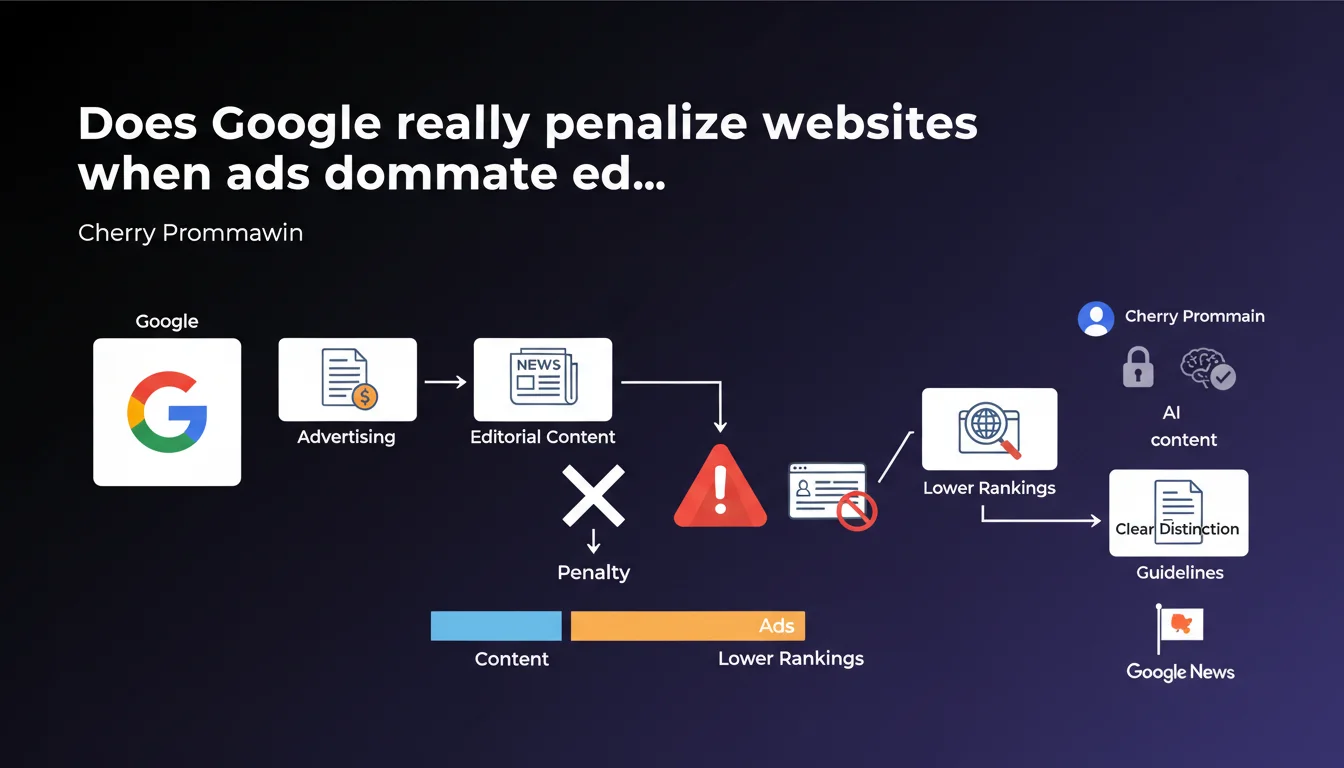
Google reminds us through Cherry Prommawin that advertising and promotional placements must never overshadow a page's editorial content. The distinction between paid and organic content must be crystal clear, especially to remain compliant with Google News guidelines. A rule that targets both user experience and editorial credibility.
What you need to understand
What is the context behind this Google directive?
Google doesn't publish this rule by chance. The balance between content and advertising is a historical quality criterion in the Quality Rater Guidelines. When ads overwhelm content, user experience collapses — and Google doesn't want to index pages that look like disguised advertisements.
For Google News, it's even stricter. The editorial credibility of a news source depends on its ability to clearly separate journalism from promotion. A media outlet filled with poorly labeled native ads loses its legitimacy.
What does Google mean by "must not exceed"?
The phrasing is deliberately vague. Google doesn't set a precise ratio — like "60% content / 40% ads maximum". In reality, the algorithm evaluates whether advertising dominates visually or structurally on the page.
Concretely: if your 300-word article is surrounded by 6 banners, 3 sponsored videos, and an interstitial, you're exceeding. If your content is 2000 words with 2 discrete side banners, you pass.
Why is the distinction between paid and non-paid content so critical?
Because native advertising blurs the lines. A sponsored article that looks exactly like editorial content misleads the user. Google wants clear markers: labels like "Sponsored", "Advertisement", "Partner Content".
For Google News, it's a matter of strict compliance. A site that doesn't respect this separation can be excluded from the News index — with direct consequences for referral traffic.
- The ad/content balance impacts user experience and therefore ranking
- Google News applies stricter criteria than general search
- Mandatory transparency: every paid placement must be clearly labeled
- No official numerical ratio — evaluation remains qualitative and contextual
- Poorly tagged native advertising exposes you to editorial penalties
SEO Expert opinion
Is this directive really applied algorithmically?
Honestly? Partially. Google has technical indicators — density of advertising scripts, ratio of ad surface to content via DOM rendering, UX signals like bounce rate. But fine-grained evaluation remains human, via Quality Raters.
In practice, sites that abuse don't all experience a sharp drop. Some aggregators stuffed with native ads continue to rank well. The reason: their domain authority and backlink volume compensate. It's inconsistent with the official discourse, but it's observable in the field.
What nuances should be made depending on site type?
An e-commerce site is not a media outlet. Google won't penalize an Amazon product page because it contains commercial suggestions everywhere — it's the nature of the page itself.
Conversely, an affiliate blog that buries 150 words of text under 8 banners and 3 popups? There, you're out of bounds. Editorial context changes everything. A news site must maintain apparent neutrality; a price comparison site, not necessarily. [To verify]: Google has never published differentiated thresholds by site type, but observation shows variable tolerance.
In which cases does this rule not apply strictly?
Pure transactional pages — PPC landing pages, e-commerce product pages — partially escape this logic. They don't have an editorial purpose. Google then evaluates content relevance to the query, not the ad/editorial balance.
But be careful: an affiliate landing page that pretends to provide information ("The Complete Guide to the Best Running Shoes") while being a disguised catalog will be judged as biased editorial content. The transparency of intent matters as much as visual ratio.
Practical impact and recommendations
What must you do concretely to stay compliant?
First, audit the visual ratio of your key pages. Open an article in private browsing, disable ad blockers, and observe: what proportion of the screen is dedicated to editorial content above the fold? If it's less than 50%, you have a problem.
Next, verify the clarity of advertising labeling. Every sponsored block, native ad, affiliate link must carry a visible mention: "Advertisement", "Sponsored", "Partner Link". Not in light gray 8px in a corner — in sufficient contrast to be readable.
What mistakes should you absolutely avoid?
Don't confuse "monetization optimization" with "maximization at any cost". Stacking AdSense units, auto-play sponsored videos, popups, and interstitials kills UX — and Google captures this via Core Web Vitals and behavioral signals.
Also avoid undeclared native advertising. An article "The 10 Best SEO Tools" that's actually a disguised advertorial for a specific tool, with no clear mention, is editorial disguise. Google News can blacklist you for that.
How can you verify that your site respects this balance?
Use visual analysis tools like Chrome DevTools to measure the surface occupied by advertising iframes vs. text content. Compare the weight of third-party scripts (ads) to the total page weight.
Also test the mobile experience — that's where imbalances are most flagrant. A sticky banner that takes up 30% of the mobile screen is unacceptable. The Layout Shifts caused by late-loading ads also degrade your CLS.
- Visually audit the content/ad ratio on priority pages
- Verify that all paid placements are clearly labeled
- Measure the surface occupied by advertising blocks (especially mobile)
- Limit intrusive formats: popups, interstitials, auto-play videos
- Analyze Core Web Vitals to detect the impact of advertising scripts
- Test in private browsing to see actual user experience
- Review native ads to guarantee transparency and clear distinction
❓ Frequently Asked Questions
Google fixe-t-il un pourcentage maximal de publicité autorisé sur une page ?
Un site e-commerce peut-il être pénalisé pour excès de contenu promotionnel ?
Comment signaler correctement un contenu sponsorisé ?
Cette règle s'applique-t-elle différemment pour Google News ?
Les scripts publicitaires impactent-ils les Core Web Vitals ?
🎥 From the same video 16
Other SEO insights extracted from this same Google Search Central video · published on 15/05/2023
🎥 Watch the full video on YouTube →
💬 Comments (0)
Be the first to comment.