
Official statement
Other statements from this video 16 ▾
- □ Is user-centric content really the ranking factor Google claims it to be?
- □ Is Trust Really the True Central Pillar of E-E-A-T According to Google?
- □ Has first-hand experience become a non-negotiable ranking factor for Google?
- □ Is creator expertise really the game-changing ranking factor Google claims it is?
- □ Is thematic authority really enough to position yourself as a reference source in Google's eyes?
- □ Does Google really penalize you for not specifying timezone information in your structured data dates?
- □ Should you really update your article's publication date every time you make changes?
- □ Should you really remove all secondary dates from a page to boost your SEO performance?
- □ Does Google really not care how you structure your editorial approach to breaking news?
- □ Should you remove logos and watermarks from your images to boost SEO performance?
- □ Does Google News really consider all websites automatically, or are there hidden criteria you need to know about?
- □ Why does Google News require complete transparency about author identity?
- □ Does Google really penalize websites when ads dominate editorial content?
- □ Are pop-ups and ads really killing your SEO rankings?
- □ Do you really need to tag ALL your outbound links with rel=sponsored or rel=ugc?
- □ Is your paywall triggering Google's cloaking detection without you knowing it?
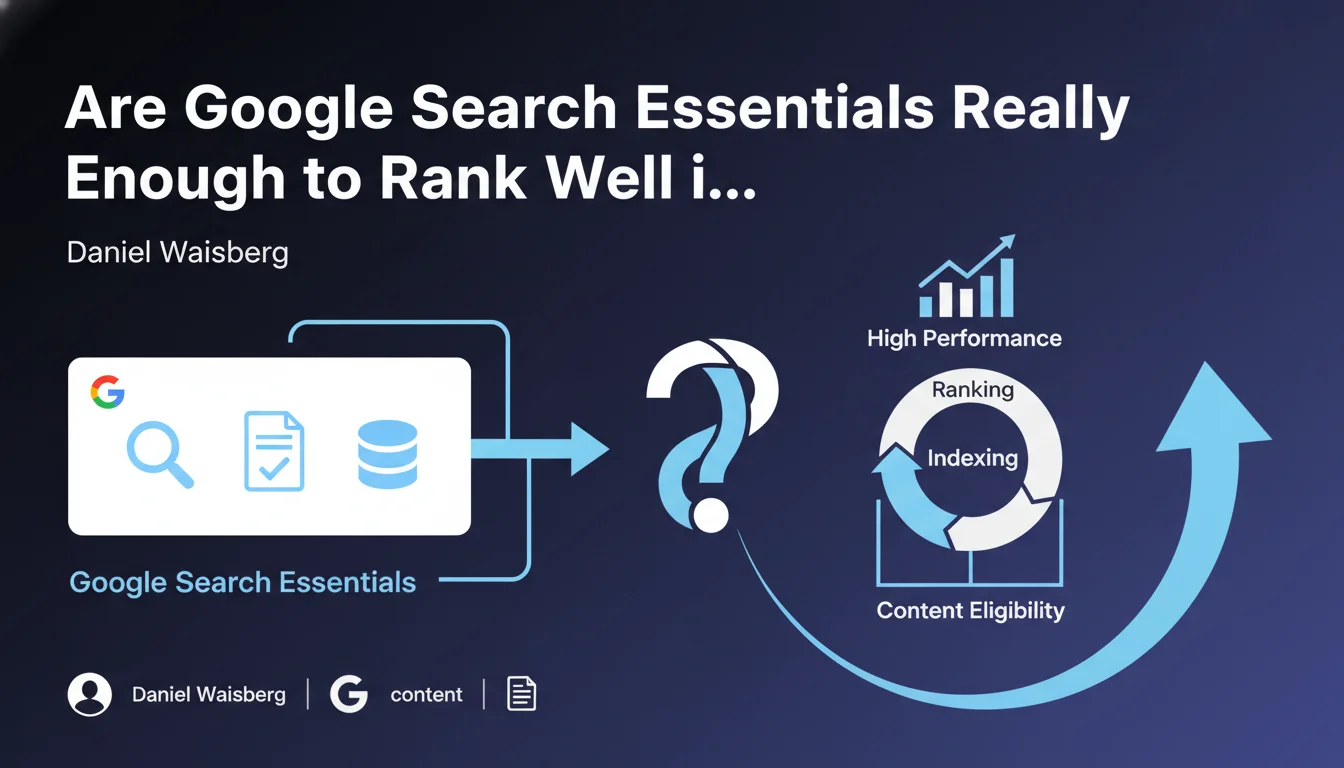
Google is redefining the minimum criteria for content to be indexed and ranked in its results. Search Essentials don't guarantee good positioning — they establish an eligibility threshold. The gap between "being indexable" and "performing well" remains unclear, and Google provides no precise metrics to measure the latter.
What you need to understand
What's the Difference Between "Eligible" and "Well-Ranked"?
Google now explicitly distinguishes two concepts: indexation eligibility and ability to perform well. Search Essentials cover both, but without clarifying where one ends and the other begins.
In concrete terms? A site can meet all technical and content quality criteria, be perfectly indexable, and yet languish on page 3. Google doesn't explain what makes content tip from "eligible" to "performing well."
Are Technical Criteria Really Still Decisive?
Yes, but their relative weight continues to decline. Google emphasizes fundamental technical aspects (crawler accessibility, absence of robots.txt blocks, HTTPS) while downplaying their direct impact on ranking.
The underlying message: a technically flawless site guarantees nothing if the content lacks distinctive value. The reverse also holds true — exceptional content invisible to the crawler is worthless.
Why Is Google Making This Clarification Now?
Two likely reasons. First, clarify minimum expectations in the face of the explosion of AI-generated content — a way of saying "here's the bar, anything below it doesn't exist."
Second, reposition the narrative after successive Core Updates. Google probably wants to reduce frustration from sites that check all technical boxes but don't rank, by officially stating that respecting Essentials is merely a prerequisite.
- Search Essentials define an entry threshold, not a formula for success
- Google provides no quantifiable metrics to measure promised "performance"
- The boundary between technical criteria and content quality is becoming increasingly blurred
- This statement officially acknowledges that following the rules ≠ ranking well
SEO Expert opinion
Is This Communication Consistent with What We Observe in the Field?
Yes and no. In principle, nothing new — we've known for years that technique + content ≠ automatically top positions. But the explicit formalization of this distinction is interesting.
What's problematic: Google continues mixing binary criteria (indexable/not indexable) with graduated criteria (content quality, authority) without ever providing thresholds. We remain in the dark about what makes content tip from "eligible" to "performing." [To verify]: Does Google itself have a clear internal metric, or does this ambiguity reflect the real complexity of the algorithm?
What Nuances Should Be Applied to This Statement?
First nuance: Search Essentials evolve. What's considered "fundamental" today wasn't three years ago (cf. Core Web Vitals). Presenting this as an immutable foundation is misleading.
Second nuance: The relative importance of criteria varies by search query. For a generic informational query, content freshness and depth take priority. For a local transactional query, proximity signals and reviews weigh more heavily. Google presents Essentials as universal, but their weight fluctuates enormously depending on search context.
In What Cases Does This Rule Not Fully Apply?
For established brands and authority sites, some technical criteria can be partially compensated by trust signals. An institutional site with poor information architecture can still rank on its brand name and core topics.
Conversely, a new site with perfect technical optimization but no backlinks or history can respect all Essentials and remain invisible for months. Google doesn't say how long this "probation period" lasts, or how to shorten it. [To verify]: Is there an authority threshold below which Essentials never suffice, regardless of quality?
Practical impact and recommendations
What Should You Audit First on Your Site?
Start by verifying that your site actually passes the technical eligibility bar. Use Google Search Console to identify discovered but non-indexed pages, and understand why.
Next, challenge the distinctive value of each content section. Ask yourself this question: if this content disappeared tomorrow, would someone search for it elsewhere? If the answer is no, either you need to dramatically improve it or abandon it.
- Verify crawler accessibility: robots.txt, unintentional noindex tags, redirect chains
- Check complete HTTPS coverage (no mixed content, valid certificate)
- Analyze Core Web Vitals across strategic pages — not just the homepage
- Identify "eligible but invisible" pages: indexed, technically OK, but with no organic traffic
- Measure actual content uniqueness (not just absence of duplication, but genuine original value)
- Evaluate alignment between search intent and content format offered
What Mistakes Must You Absolutely Avoid?
Don't fall into the trap of believing that checking all Search Essentials boxes will automatically boost your rankings. These are necessary conditions, not sufficient ones.
Another classic mistake: neglecting Essentials under the premise that "content is king." Exceptional content invisible to the crawler or not indexed serves absolutely no purpose. Both legs are essential.
How Do You Concretely Measure Whether Your Site "Performs" According to Google?
Google provides no official metrics. You must therefore build your own indicators: actual indexation rate (indexed pages / submitted pages), organic traffic evolution on target queries, average positions on your strategic intentions.
Also monitor indirect signals: click-through rate in SERPs (Search Console), average session duration from Google, conversion rate from organic traffic. If these metrics stagnate despite respecting Essentials, the problem lies beyond the eligibility threshold.
- Define performance KPIs beyond indexation (qualified traffic, top 3 positions, conversions)
- Compare your evolution to that of your direct competitors on the same queries
- Measure indexation speed of your new content (delay between publication and appearance in index)
- Analyze post-Core Update fluctuations to identify if you benefit or suffer from algorithm adjustments
Google Search Essentials provide a minimal foundation, but trace no path to the summit. Between "being indexable" and "ranking well," there's an ocean of nuances that Google doesn't document.
SEO optimization becomes increasingly complex because it now requires simultaneously mastering technical aspects, content quality, domain authority, and deep understanding of search intent. For most businesses, navigating this complexity without dedicated expertise amounts to moving forward blindfolded.
If your site respects Essentials but isn't taking off, it may be wise to engage a specialized SEO agency capable of precisely auditing where the bottleneck lies — between technology, content, authority, or intent/format alignment — and building a personalized strategy to cross the performance threshold.
❓ Frequently Asked Questions
Les Search Essentials remplacent-ils les anciens Webmaster Guidelines ?
Un site peut-il être indexé sans respecter tous les Search Essentials ?
Les Core Web Vitals font-ils partie des critères d'éligibilité ou de performance ?
Google donne-t-il un poids relatif aux différents critères des Search Essentials ?
Faut-il attendre une validation de Google après avoir appliqué les Search Essentials ?
🎥 From the same video 16
Other SEO insights extracted from this same Google Search Central video · published on 15/05/2023
🎥 Watch the full video on YouTube →
💬 Comments (0)
Be the first to comment.