
Official statement
Other statements from this video 16 ▾
- □ Les Google Search Essentials suffisent-ils vraiment pour bien se positionner dans Google ?
- □ Le contenu « centré sur l'utilisateur » est-il vraiment le critère de classement que Google prétend ?
- □ Le Trust est-il vraiment le pilier central de l'E-E-A-T selon Google ?
- □ L'expérience de première main est-elle devenue un critère de ranking incontournable ?
- □ L'expertise du créateur de contenu est-elle vraiment un critère de classement déterminant ?
- □ L'autorité thématique suffit-elle à se positionner comme source de référence aux yeux de Google ?
- □ Faut-il vraiment modifier la date de publication après chaque mise à jour d'article ?
- □ Faut-il vraiment supprimer toutes les dates secondaires d'une page pour optimiser son SEO ?
- □ Google se fiche-t-il vraiment de votre structure éditoriale pour les actualités récurrentes ?
- □ Faut-il bannir les logos et filigranes de vos images pour améliorer votre SEO ?
- □ Google News : est-ce vraiment automatique ou existe-t-il des critères cachés ?
- □ Pourquoi Google News impose-t-il une transparence totale sur l'identité des auteurs ?
- □ Pourquoi Google exige-t-il que le contenu éditorial prime sur la publicité ?
- □ Les pop-ups et publicités tuent-elles vraiment votre référencement ?
- □ Faut-il vraiment baliser TOUS vos liens sortants avec rel=sponsored ou rel=ugc ?
- □ Comment éviter que Google confonde votre paywall avec du cloaking ?
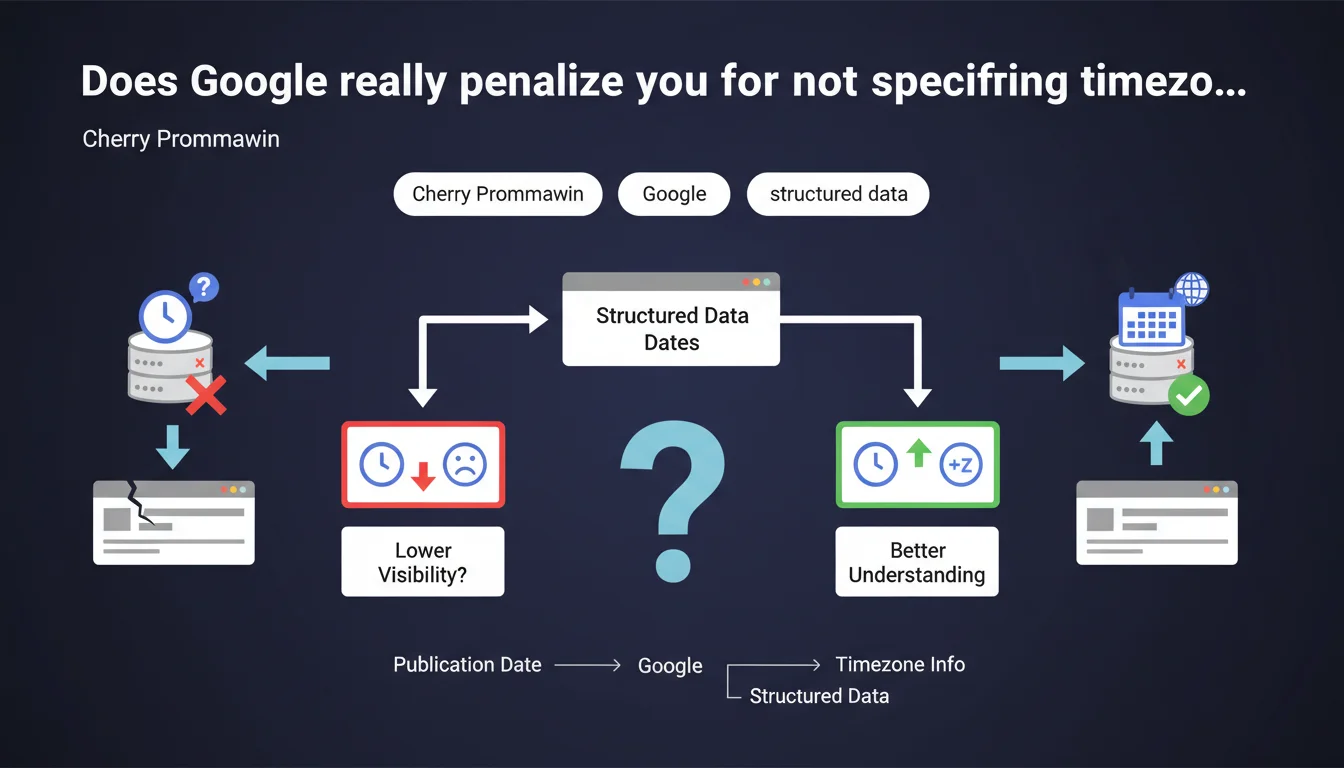
Google is asking publishers to explicitly specify both the publication date AND timezone via structured data to improve the precision of date displays in search results. A simple datePublished tag is no longer enough — you need to integrate timezone to avoid interpretation discrepancies. The stakes: preventing an article published on March 15th at 11pm GMT from displaying as published on March 16th in certain geographic zones.
What you need to understand
What's the real difference between a plain date and a date with timezone information?
Most websites include a datePublished field in their structured data, but without specifying the timezone. Result: Google interprets this date according to its own reference system, creating display inconsistencies depending on the user's geographic location.
By specifying the timezone (e.g., 2023-05-15T14:30:00+02:00), you're telling Google the exact and local time of publication. This ensures the correct information displays consistently across all geographic contexts, without ambiguity.
Why does Google need this level of precision right now?
News searches and temporal filters in the SERP (past hour, past day) are becoming increasingly granular. If the date isn't precise, your article can be sorted incorrectly chronologically — or even excluded from temporal filters.
Google processes billions of queries across the globe. Without timezone information, a few hours' difference is enough to distort chronological sorting, especially for time-sensitive content (breaking news, live events, financial announcements).
Which structured data formats are affected by this?
This recommendation applies mainly to Article, NewsArticle, BlogPosting, and Event schema types. The relevant properties are datePublished, dateModified, and startDate/endDate.
- Always use the ISO 8601 format with timezone (e.g.,
2023-03-15T09:00:00+01:00) - Avoid dates without time or without timezone — Google tolerates them but interprets them less reliably
- Maintain consistency between the date visible on the page and the one in structured data
- Use the timezone of the publication location, not the server location
SEO Expert opinion
Is this recommendation really new?
Let's be honest: no. The ISO 8601 format with timezone has been recommended for years in Schema.org documentation. What's changing is Google's emphasis on this point — a sign that many sites are still neglecting this precision.
Real-world observations show that Google tolerates dates without timezone, but interprets them variably depending on context. Result: display inconsistencies that can hurt your visibility on time-sensitive queries.
What nuances should we add to this statement?
Google talks about "better understanding" dates, but remains vague about the actual impact of a date without timezone. No precise metrics are provided: no figures on visibility loss, no before/after comparisons. [Verify this] with your own data.
In practice, the impact is highly variable depending on content type. For an evergreen article published 2 years ago, hourly precision matters little. For a news story published 3 hours ago, it's critical — and that's where timezone makes the difference.
Another point: Google doesn't clarify how it handles conflicts between the visible date (byline) and the one in structured data. Experience shows it generally prioritizes structured data, but this isn't guaranteed 100% of the time.
Practical impact and recommendations
How do you correctly implement timezone in your structured data?
Technically, you need to dynamically generate the date in ISO 8601 format with the appropriate timezone. If your CMS automatically generates dates, verify it includes the timezone — many default configurations omit it.
Example of correct format: "datePublished": "2023-05-15T14:30:00+02:00". The +02:00 indicates UTC+2, the T separates date and time, everything is without spaces.
What errors should you avoid when implementing this?
The most common mistake: using the server's timezone instead of the editorial timezone. If your editorial team is in Paris but your server is in New York, it's Paris timezone that matters for editorial consistency.
Second trap: inconsistently changing timezone across articles. If you publish in UTC, stick with UTC everywhere. If you use local timezone, keep it consistently. Google detects inconsistencies.
- Audit your existing structured data with Google's Rich Results Test
- Verify your CMS generates the complete ISO 8601 format (date + time + timezone)
- Check consistency between the displayed byline date and the one in structured data
- Test display in different geographic locations (VPN) to detect shifts
- Document your editorial team's reference timezone in your editorial guidelines
- Update strategically important older articles if their dates lack precision
❓ Frequently Asked Questions
Est-ce que l'absence de fuseau horaire dans datePublished peut pénaliser mon classement ?
Faut-il mettre à jour les anciens articles pour ajouter le fuseau horaire ?
Quel fuseau horaire utiliser pour un site international ?
Comment vérifier que Google interprète correctement mes dates ?
Que se passe-t-il si la date visible diffère de celle dans les structured data ?
🎥 From the same video 16
Other SEO insights extracted from this same Google Search Central video · published on 15/05/2023
🎥 Watch the full video on YouTube →
💬 Comments (0)
Be the first to comment.