
Official statement
Other statements from this video 16 ▾
- □ Are Google Search Essentials Really Enough to Rank Well in Google?
- □ Is user-centric content really the ranking factor Google claims it to be?
- □ Has first-hand experience become a non-negotiable ranking factor for Google?
- □ Is creator expertise really the game-changing ranking factor Google claims it is?
- □ Is thematic authority really enough to position yourself as a reference source in Google's eyes?
- □ Does Google really penalize you for not specifying timezone information in your structured data dates?
- □ Should you really update your article's publication date every time you make changes?
- □ Should you really remove all secondary dates from a page to boost your SEO performance?
- □ Does Google really not care how you structure your editorial approach to breaking news?
- □ Should you remove logos and watermarks from your images to boost SEO performance?
- □ Does Google News really consider all websites automatically, or are there hidden criteria you need to know about?
- □ Why does Google News require complete transparency about author identity?
- □ Does Google really penalize websites when ads dominate editorial content?
- □ Are pop-ups and ads really killing your SEO rankings?
- □ Do you really need to tag ALL your outbound links with rel=sponsored or rel=ugc?
- □ Is your paywall triggering Google's cloaking detection without you knowing it?
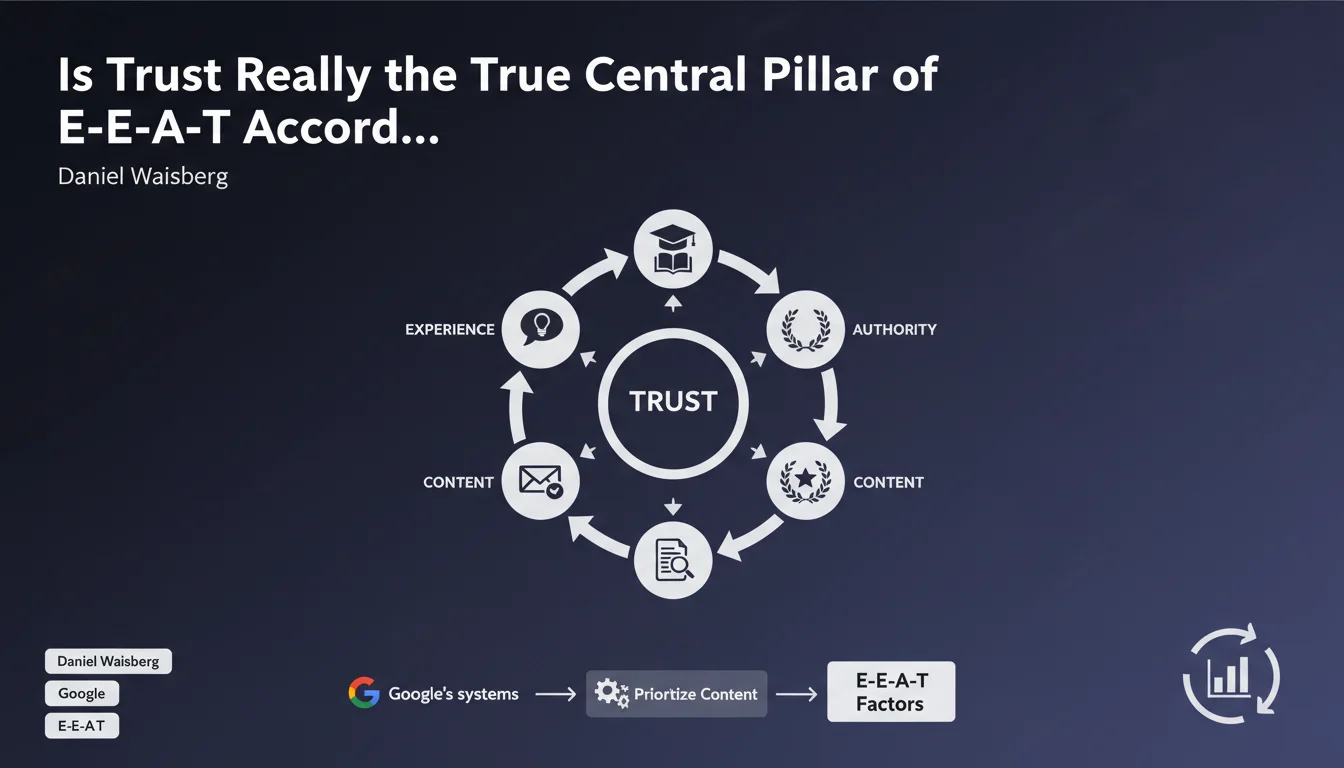
Google confirms that its systems prioritize content according to E-E-A-T (Experience, Expertise, Authority, Trustworthiness), but clarifies that Trust is its most important component. This explicit hierarchy changes the game: not all E-E-A-T signals are equal, and trustworthiness now officially takes precedence over pure expertise.
What you need to understand
Why is Google now hierarchizing the components of E-E-A-T?
Until now, Google presented E-E-A-T as a set of criteria without really specifying their respective weight. This statement changes the perspective: Trust is not one factor among others, it's the foundation on which the other three rest.
Concretely, content can display flawless technical expertise, but if it comes from a source whose reliability is questionable, it won't be prioritized. Google clearly indicates that trust conditions the effectiveness of other signals — expertise without trustworthiness serves no purpose in their algorithm.
How does Google evaluate this "trust" in practice?
The statement deliberately remains vague about the exact mechanisms. We know that the Quality Raters Guidelines define Trust as safety, accuracy, and legitimacy of a page. But the concrete algorithmic signals remain opaque.
Field observations suggest that Google crosses multiple indicators: domain reputation, consistency of information with authoritative sources, editorial transparency, technical security signals. Nothing fundamentally new, but this official hierarchy confirms what many suspected.
Does E-E-A-T remain a "blend of factors" despite this hierarchy?
Yes, and that's where all the ambiguity lies. Google speaks of a "blend of factors," which implies variable weighting depending on search query context. Trust may be the most important member globally, but its relative weight probably fluctuates depending on content type.
For a YMYL query (health, finance), Trust will weigh heavily. For a generic informational query, the balance between all four components may be different. Google doesn't say "Trust represents 60% of the score," it just says it's the most important — subtle difference.
- Trust is now officially the central pillar of E-E-A-T, not a factor equal to the others
- Google's systems use a variable blend of these factors depending on context
- This hierarchy clarifies SEO strategy: prioritize trustworthiness before pure expertise
- Precise algorithmic mechanisms remain undocumented — as usual
SEO Expert opinion
Does this hierarchy contradict observed SEO practices in the field?
Not really. Professionals working in YMYL niches have known for years that domain reputation outweighs technical optimization. What Google is doing here is simply verbalizing an algorithmic reality already in place.
Where it gets tricky is with classic informational sites. Many well-ranked contents don't shine either by verifiable reliability or editorial authority — they simply make do with being useful and well-optimized. If Trust truly becomes the main filter, we should see a gradual cleanup. But nothing spectacular so far. [To verify]: this statement may reflect more of a strategic direction than a reality already fully deployed.
Does Google provide enough actionable elements to improve Trust?
No. And it's frustrating. The statement remains completely vague about how to concretely measure or improve this Trust. The Quality Raters Guidelines provide qualitative hints (transparency, accuracy, legitimacy), but no clear technical signals.
You can speculate: mentions of qualified authors, links from reliable sources, verifiable factual consistency, absence of red flags (invasive advertising, deceptive pop-ups). But these are hypotheses based on observation, not Google documentation. The gap between E-E-A-T theory and concrete SEO levers remains wide open.
Should you radically change your content strategy after this statement?
It depends on your starting point. If you're already working on editorial credibility — identified authors, cited sources, transparency — no revolution needed. This statement simply validates your choices.
If your content relies mainly on keyword optimization and volume, however, there's a strategic adjustment to plan for. Producing more is no longer enough if perceived reliability is low. Google clearly states that authority and experience don't compensate for a trust deficit.
Practical impact and recommendations
What levers should you activate as a priority to strengthen your site's Trust?
First reflex: clearly identify your authors. Complete author pages with bio, credentials, links to professional profiles. Google must be able to verify that the person exists and possesses legitimacy in their domain.
Next, editorial transparency. Accessible legal notices, visible editorial policy, explicit fact-checking process if relevant. Sites that hide their identity or business model start with a handicap.
Technical side: HTTPS obviously, but also perceived security (no aggressive pop-ups, no deceptive advertising). A site can be technically secure but give off a spam impression — Google captures this via behavioral data.
How can you verify that your content meets Google's trustworthiness criteria?
Use the Quality Raters Guidelines as an audit framework. Ask yourself the questions human evaluators would ask: is the author identifiable? Is the information verifiable? Does the site inspire trust at first glance?
Cross-reference with your analytics: a high bounce rate on otherwise well-positioned pages can signal a mismatch between SEO promise and perceived credibility. Users click but don't stay — alarm signal.
Compare your editorial treatment with that of sites ranking better than you on your target queries. If they systematically cite their sources and you don't, if they have expert authors and you have anonymous writers, you've identified a concrete Trust gap.
What common mistakes undermine a site's perceived reliability?
Editorial anonymity remains the number one mistake. Content without an identifiable author instantly loses credibility, especially on sensitive topics. Even excellent content suffers from this deficit.
Easily verifiable factual inconsistencies. If your article contradicts reference sources without justification, Google can detect it through its automated fact-checking systems. Consistency with established consensus matters.
Finally, excessive advertising optimization. A site packed with banners, unlabeled sponsored content, aggressive calls-to-action sends a clear signal: monetization takes priority over quality. It destroys Trust faster than any other factor.
- Create or enrich author pages with verifiable credentials
- Clearly display legal notices and editorial policy
- Systematically cite sources on factual or sensitive content
- Audit user experience: advertising, pop-ups, perceived security
- Verify factual consistency with domain reference sources
- Implement a transparent and documented editorial process
- Monitor behavioral signals (bounce rate, session time) as a proxy for perceived Trust
❓ Frequently Asked Questions
Le Trust remplace-t-il les autres composantes d'E-E-A-T ?
Comment Google mesure-t-il concrètement le Trust d'un site ?
Un nouveau site peut-il construire du Trust rapidement ?
Cette hiérarchisation impacte-t-elle tous les types de requêtes de la même façon ?
Les backlinks restent-ils importants si le Trust devient central ?
🎥 From the same video 16
Other SEO insights extracted from this same Google Search Central video · published on 15/05/2023
🎥 Watch the full video on YouTube →
💬 Comments (0)
Be the first to comment.