
Official statement
Other statements from this video 16 ▾
- □ Are Google Search Essentials Really Enough to Rank Well in Google?
- □ Is user-centric content really the ranking factor Google claims it to be?
- □ Is Trust Really the True Central Pillar of E-E-A-T According to Google?
- □ Has first-hand experience become a non-negotiable ranking factor for Google?
- □ Is creator expertise really the game-changing ranking factor Google claims it is?
- □ Is thematic authority really enough to position yourself as a reference source in Google's eyes?
- □ Does Google really penalize you for not specifying timezone information in your structured data dates?
- □ Should you really update your article's publication date every time you make changes?
- □ Should you really remove all secondary dates from a page to boost your SEO performance?
- □ Does Google really not care how you structure your editorial approach to breaking news?
- □ Should you remove logos and watermarks from your images to boost SEO performance?
- □ Does Google News really consider all websites automatically, or are there hidden criteria you need to know about?
- □ Does Google really penalize websites when ads dominate editorial content?
- □ Are pop-ups and ads really killing your SEO rankings?
- □ Do you really need to tag ALL your outbound links with rel=sponsored or rel=ugc?
- □ Is your paywall triggering Google's cloaking detection without you knowing it?
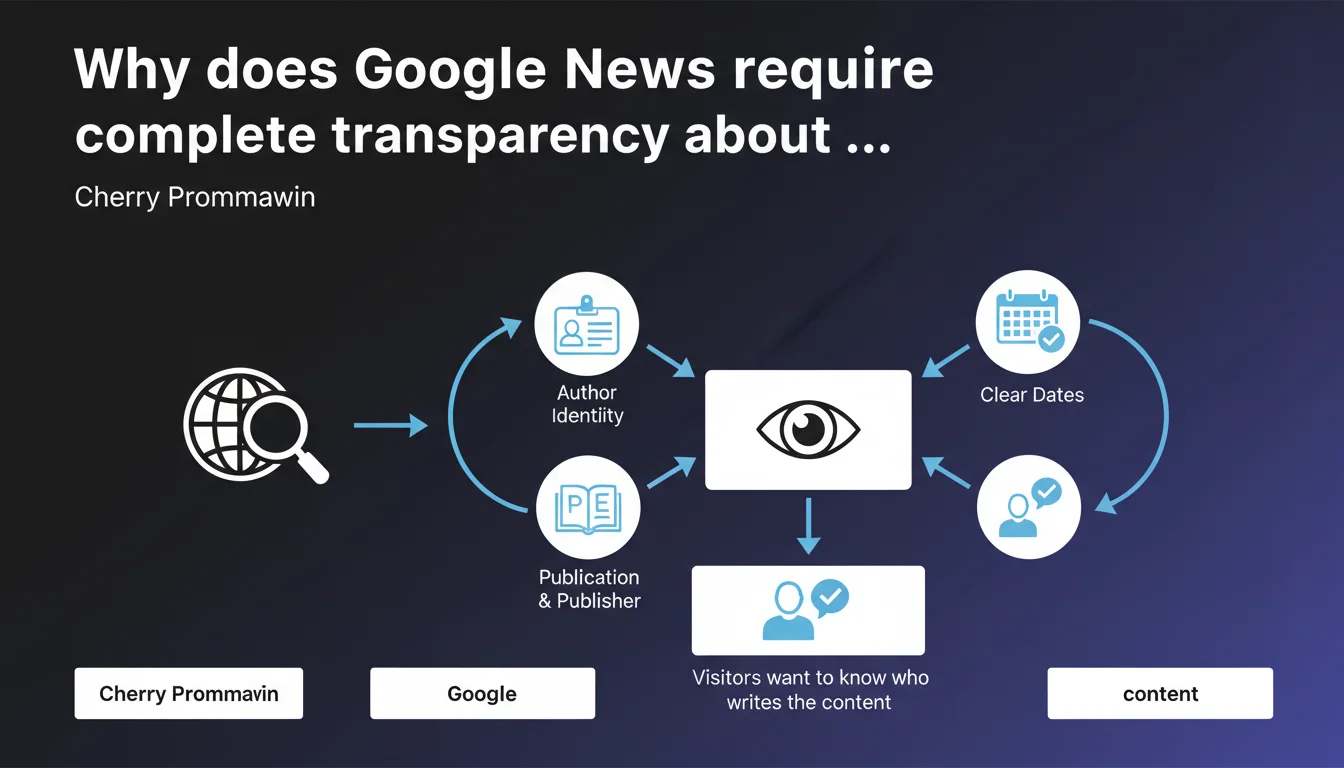
Google News requires complete transparency about author identity, publication dates, and editorial information. This policy aims to meet reader expectations who want to know who produces the content they consume. For publishers, it is a non-negotiable condition of eligibility for the Google News feed.
What you need to understand
What does this transparency requirement concretely mean?
Google News requires publishers to provide clear information on four dimensions: publication date, author identity, publication name, and responsible editor. This policy is not a recommendation — it is an entry condition.
The logic is straightforward: a reader must be able to immediately identify who is speaking, when, and under which editorial banner. Without these elements, the article will not be eligible for Google News, even if it meets all other quality criteria.
Why is Google taking a harder line on attribution?
Misinformation and content farms have made users distrustful. Google is responding by making attribution mandatory to restore trust in its news feed.
Cherry Prommawin emphasizes that visitors want to know who writes. It is not just a question of technical compliance — it is a user expectation that has become a filtering criterion. An anonymous article or one without a clear date will be considered non-transparent, and therefore excluded.
Does this rule apply to all content formats?
No. This policy concerns specifically Google News, not classic Search. A personal blog can certainly rank in the SERPs without displaying an author. But as soon as you target the News feed, the rules change.
The distinction is crucial: what works in traditional SEO is not enough for Google News. Editorial criteria there are stricter and more formal.
- Author attribution must be visible and explicit, not buried at the bottom of the page
- Publication dates must be clearly displayed, ideally in ISO 8601 format in the markup
- The publication name and editor must be identifiable without ambiguity
- This information must be present in the visible HTML code and in structured markup (Schema.org Article)
- Google News is not Search: eligibility criteria are distinct and more demanding
SEO Expert opinion
Is this statement consistent with observed practices?
Absolutely. Sites that succeed in Google News consistently display authors, dates, and editorial mentions. Tests show that an article without a clear byline disappears from the News feed, even if it ranks well in organic Search.
What is interesting is that Google does not detail the level of granularity required. Do you need a complete author profile with photo and bio? Or is just a name enough? The statement remains vague. [To verify] on sites of varying sizes to identify the real thresholds.
What nuances should be applied to this rule?
First nuance: transparency does not guarantee inclusion. I have seen sites perfectly compliant on attribution but excluded for other reasons (expertise, freshness, editorial quality). Transparency is a necessary condition, not a sufficient one.
Second nuance: all authors are not equal in Google News' eyes. A recognized journalist with a solid track record carries more weight than an anonymous pseudonym. Google does not say so officially, but field observations confirm it. [To verify]: the differential impact of an expert author vs. novice author on the News inclusion rate.
In what cases does this rule pose problems?
For financial information sites or specialized media where author anonymity is sometimes required to protect sources. Google provides no explicit exceptions, which can create tensions between News compliance and sensitive journalistic practices.
Another thorny case: AI-generated content. Should you mention a human editor author, the AI tool, or both? The statement does not answer. My observation: Google News still favors classic human bylines. Articles signed "AI" or "Editorial Staff" without a proper name struggle to pass.
Practical impact and recommendations
What do you need to do concretely to be compliant?
First, clearly display the author's name at the beginning of each article. Not in a discreet footer, not in invisible metadata — at the top, visible, ideally with a link to their author page.
Next, integrate the Schema.org Article markup with the properties author (Person), datePublished, publisher (Organization). Google News crawls this markup to validate compliance with transparency policies.
- Add a visible author block at the beginning of the article with name and link to profile
- Display the publication date in readable format (e.g., May 15) at the top of the page
- Implement Schema.org Article markup with
author,datePublished,publisher - Create dedicated author pages with bio, photo, and list of published articles
- Explicitly mention the publication name and editor in the footer or header
- Test Google News eligibility via the Publisher Center or the structured data testing tool
- Verify that dates are in ISO 8601 format in JSON-LD (e.g., 2023-05-15T10:00:00+02:00)
What mistakes should you absolutely avoid?
Not displaying an author at all, obviously. But also: displaying "Editorial Staff" as the only byline. Google News wants proper names, not vague collective entities.
Another common mistake: putting the last update date instead of the initial publication date. Google News values freshness, but first wants to know when the information was published. If you update, keep datePublished intact and add dateModified.
Google News compliance rests on complete editorial transparency: identified author, clear date, assumed editor. Without these three pillars, eligibility for the News feed is compromised. Technically, this involves visible display work and consistent structured markup.
If your news site struggles to enter Google News despite quality content, the problem often comes from these transparency details. Implementing these adjustments requires cross-disciplinary expertise in technical SEO, structured markup, and editorial architecture. Faced with this complexity, calling on a specialized SEO agency can prove worthwhile for tailored support and precious time savings.
❓ Frequently Asked Questions
La transparence sur l'auteur est-elle obligatoire pour ranker en Search classique ?
Peut-on utiliser un pseudonyme comme nom d'auteur pour Google News ?
Faut-il créer une page auteur dédiée pour chaque rédacteur ?
Que se passe-t-il si on ne respecte pas cette politique de transparence ?
Le balisage Schema.org suffit-il, ou faut-il aussi afficher l'auteur visuellement ?
🎥 From the same video 16
Other SEO insights extracted from this same Google Search Central video · published on 15/05/2023
🎥 Watch the full video on YouTube →
💬 Comments (0)
Be the first to comment.