
Official statement
Other statements from this video 18 ▾
- □ Is it really safe to show structured paid content only to Googlebot without risking penalties?
- □ Does the DMCA really apply page by page, or can an entire site be reported?
- □ Does Google really index every single piece of content you publish?
- □ Can an invalid AMP page still be indexed by Google?
- □ Can Safe Search really stop your adult site from ranking for your own brand?
- □ Could the Product Reviews Update impact your site even if it's not in English?
- □ Which method should you choose for multilingual content: geotargeting or hreflang?
- □ Can Google arbitrarily choose which language version to index when the content is identical?
- □ Should you really block advertising URLs in robots.txt?
- □ Should you give up on dynamic keyword injection to avoid Google penalties?
- □ Does client-side rendering with React really create ranking challenges for Google?
- □ Should you really block all internal search URLs in robots.txt?
- □ Are SEO sites truly exempt from YMYL criteria?
- □ Does Google penalize invisible or misleading structured breadcrumbs?
- □ Can you really link multiple sites in the footer without risking your SEO?
- □ Should you really worry about crawl budget on a site with fewer than 10,000 URLs?
- □ Robots.txt or noindex: which option should you choose to block indexing?
- □ Does artificial traffic really affect Google rankings?
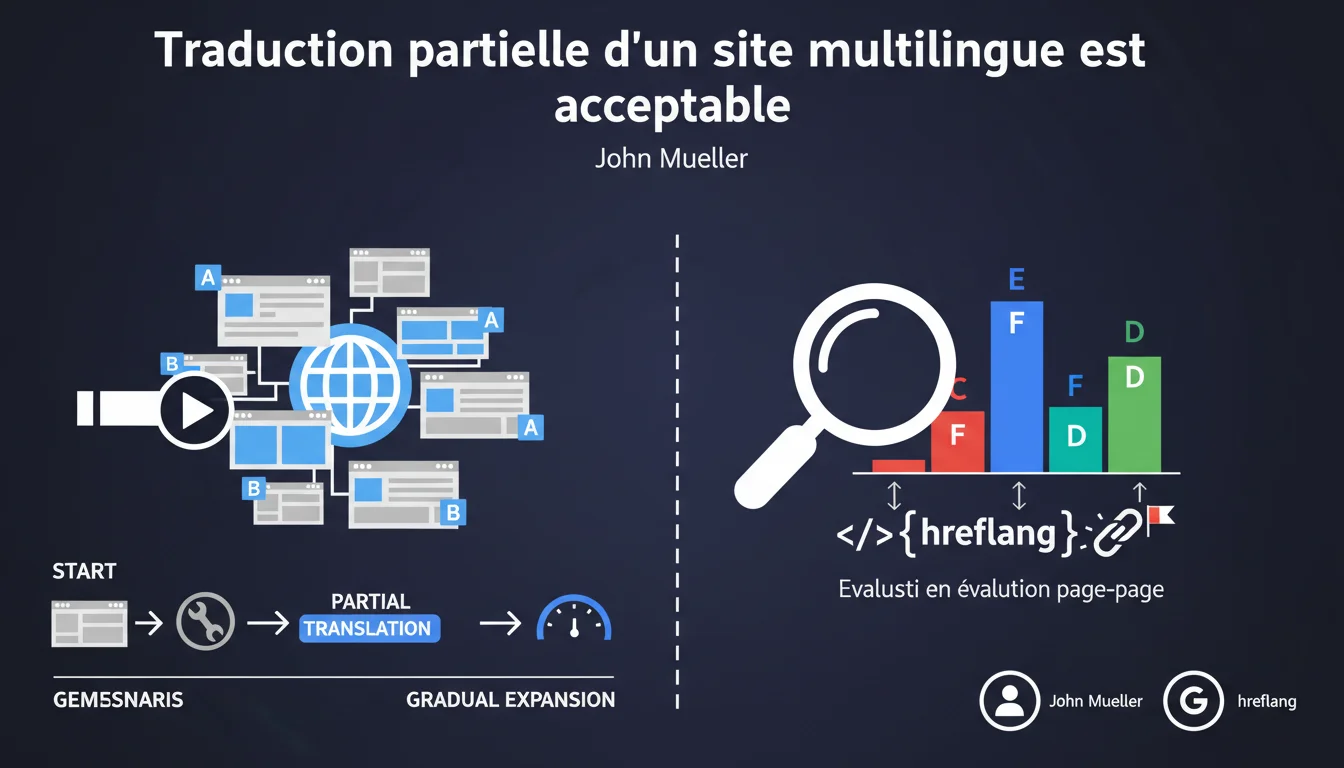
Google evaluates each page in each language independently. Gradually translating a site, even partially, is a perfectly valid strategy. Hreflang operates on a page-by-page basis, not at the overall site level.
What you need to understand
How does this clarification change the game for multilingual sites?
Many SEOs believe that a multilingual site must be fully translated to be considered by Google. This belief leads to massive investments right from the launch of a language version. Mueller debunks this myth: Google does not expect perfect parity between language versions. Each page is indexed and evaluated in its own language, independently of other versions. If you translate 20 pages out of 500, those 20 pages can very well rank in their target language. The other 480 do not affect their performance. The hreflang — a tag that signals alternative language versions — works page by page. You do not need to create a complete link structure between all pages in all languages. Specifically? A page \/fr\/produit-a can point to \/en\/product-a and \/de\/produkt-a via hreflang, even if \/fr\/produit-b has no English or German version. Google does not penalize this asymmetry. This flexibility does not mean total improvisation. A poorly thought-out partial translation can create user experience inconsistencies: broken internal links, hybrid navigation, mixed signals for crawlers. If you translate strategic pages but leave support pages (T&Cs, FAQs) in the original language, you risk a high bounce rate from non-French-speaking users. Google will not make this a direct de-ranking criterion — but low engagement can indirectly affect your rankings.How does Google technically manage this independence?
What pitfalls should you avoid despite this flexibility?
SEO Expert opinion
Is this statement consistent with field observations?
Absolutely. In the audits I conduct, I regularly see sites translate only their main categories and their best-sellers — and rank perfectly in the new target languages. The rest of the catalog remains in the original language without measurable negative impact. What works less well? Sites that translate at random — a product page here, a blog article there — without a user journey logic. Google does not penalize them directly, but users flee, which degrades engagement metrics. Mueller does not specify a crucial point: the indirect impact of missing pages. If you translate a product page but not the parent category page, you break the internal linking in the target language. Result: the translated page becomes orphaned from a crawl perspective. Another rarely discussed limitation: brand signals. A site with 500 pages in French and 10 in English sends a signal of low investment in the English-speaking market. Google does not algorithmically punish it — [To be verified] — but users and potential backlinks perceive it. On seasonal e-commerce sites, translating only best-sellers can be insufficient. If you launch a German version in November without translating your holiday product listings, you miss the positioning window — even if Google technically accepts partial translation. For news or media sites, a partial translation creates an editorial mismatch. If you translate one article out of two, you fragment your audience and complicate your internal linking strategy. Feasible, but less optimal than a complete approach.What nuances should be added to this rule?
When does this gradual approach pose a problem?
Practical impact and recommendations
What practical steps should you take to translate gradually without losing effectiveness?
Start by identifying high ROI pages: those that generate traffic, conversions, or serve as strategic entry points. Translate these pages first, then gradually expand to the necessary support pages for their user journey. Ensure that each translated page has a coherent environment: navigation menu in the correct language, functional internal links, hreflang properly implemented. An isolated page, even if well translated, will perform poorly. Do not translate pages randomly without considering the user journey. If you translate a product sheet but not the category page, the user will land on a dead end. Google will index the page, but it will be orphaned from a crawl perspective. Avoid incomplete hreflang. If a French page has 3 language versions but you only declare 2, Google may misinterpret your signals and display the wrong language in the SERPs.What mistakes should you avoid during a partial multilingual deployment?
❓ Frequently Asked Questions
Dois-je traduire toutes les pages de mon site pour lancer une version multilingue ?
Le hreflang fonctionne-t-il si je ne traduis que quelques pages ?
Google pénalise-t-il un site qui n'a pas le même nombre de pages dans chaque langue ?
Quels risques si je traduis seulement certaines pages produits sans traduire les catégories ?
Quelle est la meilleure stratégie pour traduire progressivement un site e-commerce ?
🎥 From the same video 18
Other SEO insights extracted from this same Google Search Central video · published on 24/12/2021
🎥 Watch the full video on YouTube →
💬 Comments (0)
Be the first to comment.