
Official statement
Other statements from this video 18 ▾
- □ Is it really safe to show structured paid content only to Googlebot without risking penalties?
- □ Does the DMCA really apply page by page, or can an entire site be reported?
- □ Does Google really index every single piece of content you publish?
- □ Can an invalid AMP page still be indexed by Google?
- □ Can Safe Search really stop your adult site from ranking for your own brand?
- □ Which method should you choose for multilingual content: geotargeting or hreflang?
- □ Can Google arbitrarily choose which language version to index when the content is identical?
- □ Should you really block advertising URLs in robots.txt?
- □ Should you give up on dynamic keyword injection to avoid Google penalties?
- □ Does client-side rendering with React really create ranking challenges for Google?
- □ Should you really block all internal search URLs in robots.txt?
- □ Are SEO sites truly exempt from YMYL criteria?
- □ Does Google penalize invisible or misleading structured breadcrumbs?
- □ Can you really link multiple sites in the footer without risking your SEO?
- □ Is it true that you must fully translate a multilingual site to rank well?
- □ Should you really worry about crawl budget on a site with fewer than 10,000 URLs?
- □ Robots.txt or noindex: which option should you choose to block indexing?
- □ Does artificial traffic really affect Google rankings?
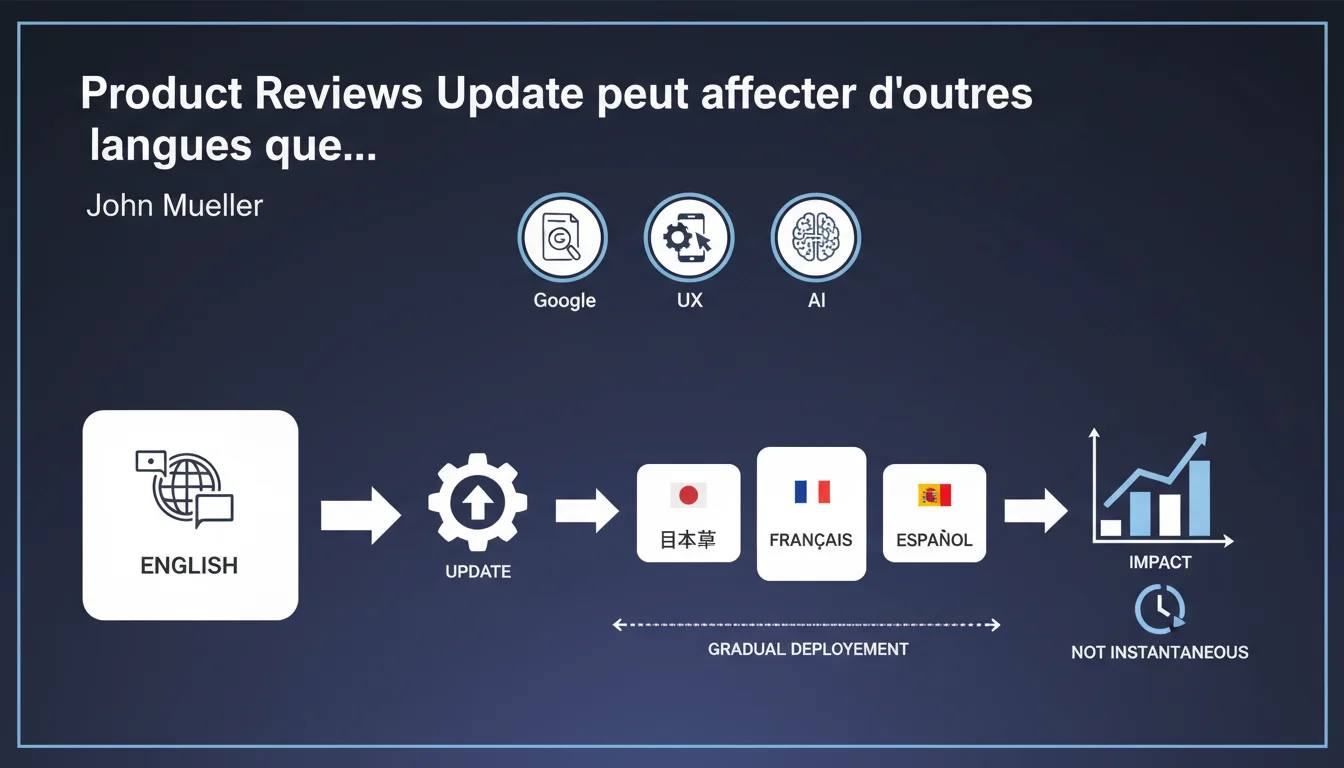
Google initially rolls out the Product Reviews Update in English, but the algorithm may be applied to other languages without prior notice. The multilingual deployment is gradual and opaque — you could be affected without knowing. Non-English sites must therefore adhere to the same quality criteria starting now.
What you need to understand
Why does Google announce this update only in English?
Google usually communicates its major algorithms in English because it's its preferred testing language. The company has a massive corpus of data in English and can measure the impact of changes precisely there.
But — and this is crucial — this does not mean the algorithm remains confined to English. Once validated in this language, deployment to other markets begins, often without official communication.
How does the multilingual extension actually unfold?
The process is gradual and opaque. Google does not publish a timeline or a list of affected languages. SEOs simply notice ranking fluctuations on non-English sites a few weeks or months after the initial announcement.
The algorithm adapts to linguistic specifics: syntax, idiomatic expressions, cultural content formats. This adaptation takes time, which is why deployment is stretched out.
What signals indicate that a site is affected by this extension?
It's difficult to pinpoint exactly. You may observe a dropped visibility on transactional queries related to products, a decline in organic traffic to your review or comparison pages, or a sudden rise of competitors offering more detailed content.
- The Product Reviews Update favors original and detailed reviews based on real product experience.
- Pages that solely compile manufacturer data or copy from other sources are penalized.
- The algorithm values visual proof (personal photos, videos), in-depth comparisons, measurable data.
- The multilingual deployment is silent: no prior announcement by language.
- Quality criteria apply universally, regardless of the language of content.
SEO Expert opinion
Is this gradual extension consistent with field observations?
Yes, absolutely. I have noticed on several French and German projects unexplained variations a few weeks after the official English rollout of the Product Reviews Update. E-commerce sites with light content have lost between 20 and 40% visibility on their product pages.
What is frustrating is the lack of official confirmation. Google will never say "the algorithm has been active in French since X." We navigate in the dark, correlating the dates of fluctuations with English announcements.
What nuances should be added to this statement?
Mueller remains deliberately vague about timelines. "Gradually" could mean three weeks to six months. [To be verified]: it's impossible to know if all languages will eventually be covered or if some will remain excluded due to insufficient data.
Another point: the intensity of the algorithm may vary by market. An average French site may not undergo the same level of filtering as an English site on equivalent queries — the quality thresholds may be locally adjusted.
In what cases does this rule not apply?
If your site does not produce review or product comparison content, you are not affected. The algorithm specifically targets pages that position themselves as "product reviews".
Standard e-commerce product sheets (descriptions, technical specifications) are not directly targeted. However, if you include sections like "Our Opinion", "Detailed Test", or "Comparison", you fall within the scope.
Practical impact and recommendations
What should you concretely do on a non-English site?
Assume that the Product Reviews Update may already be active in your language, or will be soon. Audit your product review pages with the same criteria as those announced for English.
Identify your "review" content: tests, comparisons, buying guides. Evaluate their depth: do they provide unique value based on real experience, or do they merely compile public information?
What mistakes should absolutely be avoided?
Do not just copy manufacturer descriptions with a generic opinion paragraph added. Google detects this type of low-value content.
Avoid comparisons based solely on technical spec tables without real usage context. The algorithm looks for practical insights: "This model heats up after 30 minutes of intensive use", "The power button is poorly placed for left-handers", etc.
How can I check if my content meets the criteria?
Ask yourself these questions: Have I personally tested this product? Are my photos original or downloaded from the manufacturer's website? Am I comparing several products while explaining the trade-offs for each?
If you cannot positively answer these questions, your content is vulnerable. Enrich it with measurable data, screenshots of your tests, nuanced reviews including strengths and weaknesses.
- Audit all "product review" or "comparison" type pages on the site.
- Check for the presence of original visual proof (photos, videos, screenshots).
- Add measurable data from real tests (heating time, autonomy, actual weight vs. advertised).
- Compare multiple products while explaining the relevant usage contexts for each.
- Remove or rewrite purely compilatory content with no added value.
- Monitor ranking fluctuations on product queries after each English announcement from Google.
- Document the expertise of the author: who conducted the test, what is their legitimacy on the subject?
The Product Reviews Update silently and progressively extends to non-English languages. French, German, Spanish, or other sites must apply starting now the quality criteria announced for English, without waiting for hypothetical official communication for their market.
The stakes are high: product review content often represents a major traffic and conversion lever. A qualitative overhaul may require a significant investment of time and resources — real tests, producing original visuals, in-depth rewriting. If your internal teams lack bandwidth or expertise to conduct this audit and optimization, considering support from a specialized SEO agency can speed up the process and ensure full compliance with algorithmic expectations.
❓ Frequently Asked Questions
Google annonce-t-il systématiquement le déploiement du Product Reviews Update pour chaque langue ?
Combien de temps faut-il entre l'annonce anglophone et l'impact sur un site francophone ?
Un site e-commerce classique sans contenu de type 'avis produit' est-il concerné ?
Faut-il obligatoirement tester physiquement chaque produit pour éviter une pénalité ?
Comment savoir si mon site a été touché par cette extension multilingue ?
🎥 From the same video 18
Other SEO insights extracted from this same Google Search Central video · published on 24/12/2021
🎥 Watch the full video on YouTube →
💬 Comments (0)
Be the first to comment.