
Official statement
Other statements from this video 18 ▾
- □ Peut-on vraiment montrer du contenu payant structuré uniquement à Googlebot sans risque de pénalité ?
- □ Le DMCA s'applique-t-il vraiment page par page ou peut-on signaler un site entier ?
- □ Google indexe-t-il vraiment tout le contenu que vous publiez ?
- □ Une page AMP invalide peut-elle quand même être indexée par Google ?
- □ Safe Search peut-il empêcher votre site adulte de ranker sur votre propre marque ?
- □ Le Product Reviews Update peut-il impacter votre site même s'il n'est pas en anglais ?
- □ Géociblage ou hreflang : quelle méthode privilégier pour les contenus multilingues ?
- □ Google peut-il choisir arbitrairement quelle version linguistique indexer quand le contenu est identique ?
- □ Faut-il vraiment bloquer les URLs publicitaires dans robots.txt ?
- □ Faut-il abandonner l'injection dynamique de mots-clés pour éviter les pénalités Google ?
- □ Le client-side rendering React pose-t-il vraiment un problème de classement pour Google ?
- □ Faut-il vraiment bloquer toutes les URLs de recherche interne dans robots.txt ?
- □ Les sites SEO sont-ils vraiment exemptés des critères YMYL ?
- □ Google pénalise-t-il les breadcrumbs structurés invisibles ou trompeurs ?
- □ Faut-il vraiment traduire l'intégralité d'un site multilingue pour bien se positionner ?
- □ Faut-il vraiment s'inquiéter du crawl budget sur un site de moins de 10 000 URLs ?
- □ Robots.txt ou noindex : lequel choisir pour bloquer l'indexation ?
- □ Le trafic artificiel influence-t-il vraiment le classement Google ?
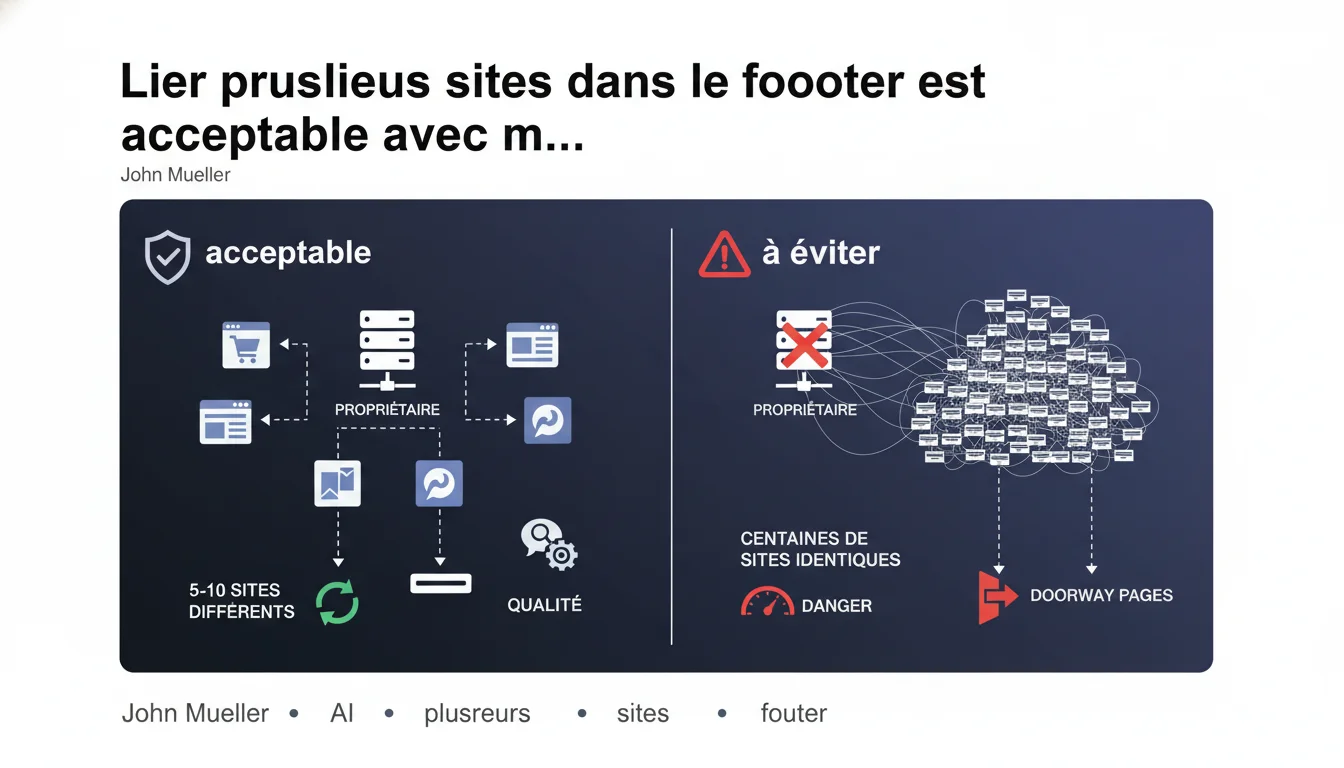
Google tolerates footer links to other sites from the same owner, provided they are significantly different and limited to a maximum of 5-10. Beyond hundreds of links, the signal becomes that of doorway pages and exposes you to penalties. Moderation remains the key.
What you need to understand
Why does Google accept these footer links between sites?<\/h3>
Google's position is based on a simple logic: an owner can legitimately manage multiple distinct web properties<\/strong> and may want to facilitate navigation between them. If a group owns 5 to 10 sites with truly different themes<\/strong>, linking these resources in the footer poses no fundamental issues.<\/p> The engine distinguishes this practice from networks of sites created solely to manipulate rankings. The key lies in differentiation: each site must provide its own value<\/strong>, serve a distinct audience, or tackle a topic that is sufficiently dissimilar from the others.<\/p> Mueller draws a clear line: a few sites (5-10) constitute legitimate cross-linking<\/strong>. Hundreds constitute doorway pages. Between the two? A gray area.<\/p> Google does not provide a specific threshold beyond 10 sites, but the alarm signal gradually rises. A network of 15 thematically coherent sites will likely pass, while 50 nearly identical sites will trigger sanctions. The determining criterion remains significant differentiation<\/strong> of content and audiences.<\/p> Google does not exhaustively detail this, but we can deduce: distinct theme<\/strong>, different target audience, non-duplicated content, unique commercial or editorial objective. An e-commerce shoe site and a hiking blog owned by the same person can legitimately link.<\/p> In contrast, 20 hotel booking sites targeting different cities with identical templates and nearly duplicated content? That's a clear doorway. Differentiation must be substantial and visible<\/strong> to the user, not just cosmetic.<\/p>Where is the line between acceptable practice and spam?<\/h3>
What criteria define “significantly different” sites?<\/h3>
SEO Expert opinion
Does this statement really resolve the ambiguity of footer links?<\/h3>
Not entirely. Mueller gives an acceptable range<\/strong> (5-10 sites) and an alarm signal (hundreds), but leaves a gaping void in between. What happens with 15 sites? 25? 40? [To be verified]<\/strong> — no empirical data communicated on these intermediate thresholds.<\/p> On the ground, we observe that Google tends to tolerate more when sites belong to established brands<\/strong> with history and authority. A large media group with 20 distinct thematic publications passes without issue, whereas a new player with 15 recent sites risks more. Age and reputation clearly matter, even if Google does not openly admit it.<\/p> This is where it gets tricky. Google throws out a subjective criterion without an evaluation grid. Two sites in the same sector but with different editorial angles<\/strong> — is that acceptable? Probably. Two identical sites targeting different geographies? Limits doorways according to Google's jurisprudence.<\/p> In practical terms, differentiation must focus on at least two dimensions: content AND audience<\/strong>, or functionality AND commercial objective<\/strong>. A single axis of variation (like geography) is often not enough. Observed cases of penalties overwhelmingly involve single-axis networks: same templates, same structures, only the city/keyword changes.<\/p> With caution. Mueller speaks of what is “acceptable,” not what is optimal. Having 10 footer links to other sites can dilute the authority<\/strong> passed by your own internal and external links, even if Google does not penalize the practice itself.<\/p> Let's be honest: the more outgoing links you have in the footer, the less weight each link carries individually. It’s basic PageRank<\/strong>. If your goal is to maximize the SEO of each property, limiting to 3-5 sites in the footer remains more effective than putting 10 “because Google allows it.”<\/p>Is the notion of “significantly different” practically applicable?<\/h3>
Can we really trust this threshold of 5-10 sites?<\/h3>
Practical impact and recommendations
What should you do if you currently have more than 10 footer links?<\/h3>
Audit urgently. List all your linked sites and assess their real differentiation<\/strong>. If several sites primarily serve the same audience with similar content, you're in the red zone.<\/p> Prioritize: keep only the sites in the footer that have the strongest strategic complementarity<\/strong>. Others can be linked contextually in content or via a page like "Our other sites" rather than being systematically in the footer. Reducing to a maximum of 5-8 sites keeps you safe.<\/p> Use descriptive anchors<\/strong> that clearly explain the difference between sites. “Our travel blog” vs “Our equipment store” immediately communicates differentiation to Google and users.<\/p> Add a section title such as “Our other sites” instead of drowning the links in a generic footer. This visual segmentation<\/strong> signals a legitimate intent of cross-referencing, not manipulation. Also consider using appropriate rel attributes if some links are not intended to pass SEO juice.<\/p> Never create a network of sites with identical templates<\/strong> and nearly duplicated content just to target variations of keywords or geography. That's the very definition of doorway pages that Google actively fights against.<\/p> Also avoid massive footer links (20+ sites) even if each is different. Beyond a certain threshold, the user experience signal declines: an overloaded footer with external links discredits the site<\/strong> and alerts algorithms. Moderation is better than aggressive optimization.<\/p>How to structure these footer links to minimize risk?<\/h3>
What mistakes should you absolutely avoid?<\/h3>
❓ Frequently Asked Questions
Peut-on utiliser du nofollow sur ces liens footer pour éviter les risques ?
Les liens footer comptent-ils autant que les liens dans le contenu ?
Que se passe-t-il si on dépasse légèrement le seuil de 10 sites ?
Faut-il déclarer ces réseaux de sites dans Search Console ?
Les liens footer reciproques entre sites posent-ils un problème supplémentaire ?
🎥 From the same video 18
Other SEO insights extracted from this same Google Search Central video · published on 24/12/2021
🎥 Watch the full video on YouTube →Related statements
Get real-time analysis of the latest Google SEO declarations
Be the first to know every time a new official Google statement drops — with full expert analysis.
💬 Comments (0)
Be the first to comment.