
Official statement
Other statements from this video 18 ▾
- □ Peut-on vraiment montrer du contenu payant structuré uniquement à Googlebot sans risque de pénalité ?
- □ Le DMCA s'applique-t-il vraiment page par page ou peut-on signaler un site entier ?
- □ Google indexe-t-il vraiment tout le contenu que vous publiez ?
- □ Safe Search peut-il empêcher votre site adulte de ranker sur votre propre marque ?
- □ Le Product Reviews Update peut-il impacter votre site même s'il n'est pas en anglais ?
- □ Géociblage ou hreflang : quelle méthode privilégier pour les contenus multilingues ?
- □ Google peut-il choisir arbitrairement quelle version linguistique indexer quand le contenu est identique ?
- □ Faut-il vraiment bloquer les URLs publicitaires dans robots.txt ?
- □ Faut-il abandonner l'injection dynamique de mots-clés pour éviter les pénalités Google ?
- □ Le client-side rendering React pose-t-il vraiment un problème de classement pour Google ?
- □ Faut-il vraiment bloquer toutes les URLs de recherche interne dans robots.txt ?
- □ Les sites SEO sont-ils vraiment exemptés des critères YMYL ?
- □ Google pénalise-t-il les breadcrumbs structurés invisibles ou trompeurs ?
- □ Peut-on vraiment lier plusieurs sites dans le footer sans risque SEO ?
- □ Faut-il vraiment traduire l'intégralité d'un site multilingue pour bien se positionner ?
- □ Faut-il vraiment s'inquiéter du crawl budget sur un site de moins de 10 000 URLs ?
- □ Robots.txt ou noindex : lequel choisir pour bloquer l'indexation ?
- □ Le trafic artificiel influence-t-il vraiment le classement Google ?
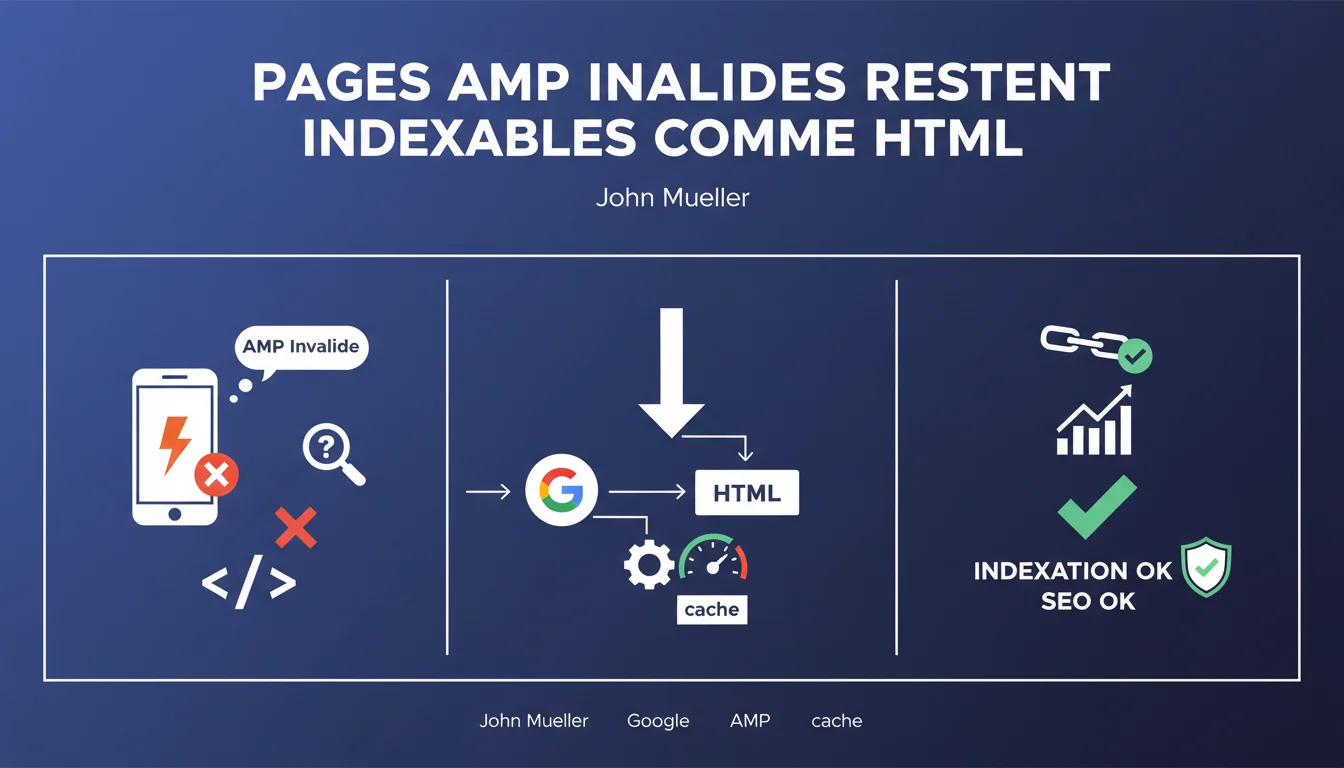
Google indexes invalid AMP pages as standard HTML. They simply lose the benefits of AMP cache, but their organic ranking is not penalized. Indexing remains guaranteed; only the fast distribution via cache disappears.
What you need to understand
What does it mean for a broken AMP page?
A broken AMP page that does not comply with technical specifications of the format will still be crawled and indexed. Google treats it just like any standard HTML page.
The difference? It won't appear in the AMP carousel of mobile search results and will not be served from Google's ultra-fast cache. But its content remains accessible in the index, with the same ranking criteria as a non-AMP page.
What exactly is the AMP cache?
The AMP cache is Google's proprietary CDN that preloads and serves validated AMP pages at lightning speed. When an AMP page is invalid, it loses this priority access.
Practically speaking: your mobile users land on your standard HTML page, with its usual loading time. No lightning badge, no instant pre-rendering.
Why does Google make this distinction?
Google clearly separates indexing and eligibility for premium features. A page can be indexable without deserving the preferential treatments reserved for validated formats.
This is consistent with their approach: the AMP format remains optional, but if you choose this path, it's best to do it correctly. Otherwise, it's back to standard HTML — without penalties, but without bonuses either.
- An invalid AMP page = normal HTML indexing
- Loss of AMP cache and dedicated carousel
- No direct SEO penalty applied
- The rest of the SEO works as usual
SEO Expert opinion
Does this statement hold up in practice?
Yes, and it's observable in diagnostic tools. When Google Search Console reports AMP errors, the affected pages remain indexed — it's just the AMP badge that disappears from mobile SERPs.
What is less clear is the indirect impact. A broken AMP page loading 3 seconds longer than a cached version might see its Core Web Vitals deteriorate. And Google doesn't explicitly mention that here. [Verify] in your own analytics data.
Should we still care about AMP today?
Let's be honest: since Core Web Vitals became an official ranking signal, AMP has lost its near-mandatory status. The format is still useful for certain sectors (media, news), but many sites are doing very well without it.
If your standard HTML page is fast and well-optimized, investing in AMP becomes questionable. However, if you're already on AMP and your pages are invalid, it's better to fix them or abandon AMP altogether — being caught in between is pointless.
What mistakes should be avoided in interpretation?
Don't confuse "no SEO penalty" with "no impact". Losing AMP cache means losing loading speed, which can potentially affect user engagement and bounce rates.
Another trap: believing that partial validation is enough. Google doesn't do half-measures — either the page passes all validation tests, or it's considered standard HTML. No gray area.
Practical impact and recommendations
What to do if your AMP pages are invalid?
First instinct: open Google Search Console and precisely identify the errors reported in the AMP report. Disallowed CSS, non-compliant tags, blocking JavaScript — each error has its documented solution.
Then, make a strategic decision: fix it if AMP brings real value (carousel traffic, critical speed), or completely remove the AMP version and focus on optimizing your standard HTML. Staying on a broken AMP has no interest.
How to check the validation status of your pages?
Use the official AMP validator (validator.ampproject.org) or the URL testing tool in Search Console. Both will give you a precise, line-by-line diagnosis.
Automate monitoring with tools like Screaming Frog or OnCrawl set up to detect AMP errors. If you have thousands of pages, continuous monitoring avoids nasty surprises.
What long-term strategy should you adopt?
If your site can achieve excellent Core Web Vitals scores without AMP, abandon this format. Maintaining a dual version (HTML + AMP) is costly in technical resources for often marginal gains.
However, if you rely on mobile news traffic or are in an ultra-competitive sector where every millisecond counts, invest in a perfectly validated and continuously monitored AMP implementation.
- Audit all AMP pages in Search Console
- Fix validation errors or completely disable AMP
- Test loading speed of standard HTML vs AMP
- Monitor Core Web Vitals after any modification
- Avoid partial or shaky AMP implementations
❓ Frequently Asked Questions
Une page AMP invalide est-elle pénalisée en SEO ?
Peut-on mélanger pages AMP valides et invalides sur un même site ?
Faut-il supprimer les pages AMP invalides ?
Le cache AMP influence-t-il vraiment le SEO ?
Comment savoir si mes pages AMP sont valides ?
🎥 From the same video 18
Other SEO insights extracted from this same Google Search Central video · published on 24/12/2021
🎥 Watch the full video on YouTube →
💬 Comments (0)
Be the first to comment.