
Official statement
Other statements from this video 18 ▾
- □ Peut-on vraiment montrer du contenu payant structuré uniquement à Googlebot sans risque de pénalité ?
- □ Le DMCA s'applique-t-il vraiment page par page ou peut-on signaler un site entier ?
- □ Une page AMP invalide peut-elle quand même être indexée par Google ?
- □ Safe Search peut-il empêcher votre site adulte de ranker sur votre propre marque ?
- □ Le Product Reviews Update peut-il impacter votre site même s'il n'est pas en anglais ?
- □ Géociblage ou hreflang : quelle méthode privilégier pour les contenus multilingues ?
- □ Google peut-il choisir arbitrairement quelle version linguistique indexer quand le contenu est identique ?
- □ Faut-il vraiment bloquer les URLs publicitaires dans robots.txt ?
- □ Faut-il abandonner l'injection dynamique de mots-clés pour éviter les pénalités Google ?
- □ Le client-side rendering React pose-t-il vraiment un problème de classement pour Google ?
- □ Faut-il vraiment bloquer toutes les URLs de recherche interne dans robots.txt ?
- □ Les sites SEO sont-ils vraiment exemptés des critères YMYL ?
- □ Google pénalise-t-il les breadcrumbs structurés invisibles ou trompeurs ?
- □ Peut-on vraiment lier plusieurs sites dans le footer sans risque SEO ?
- □ Faut-il vraiment traduire l'intégralité d'un site multilingue pour bien se positionner ?
- □ Faut-il vraiment s'inquiéter du crawl budget sur un site de moins de 10 000 URLs ?
- □ Robots.txt ou noindex : lequel choisir pour bloquer l'indexation ?
- □ Le trafic artificiel influence-t-il vraiment le classement Google ?
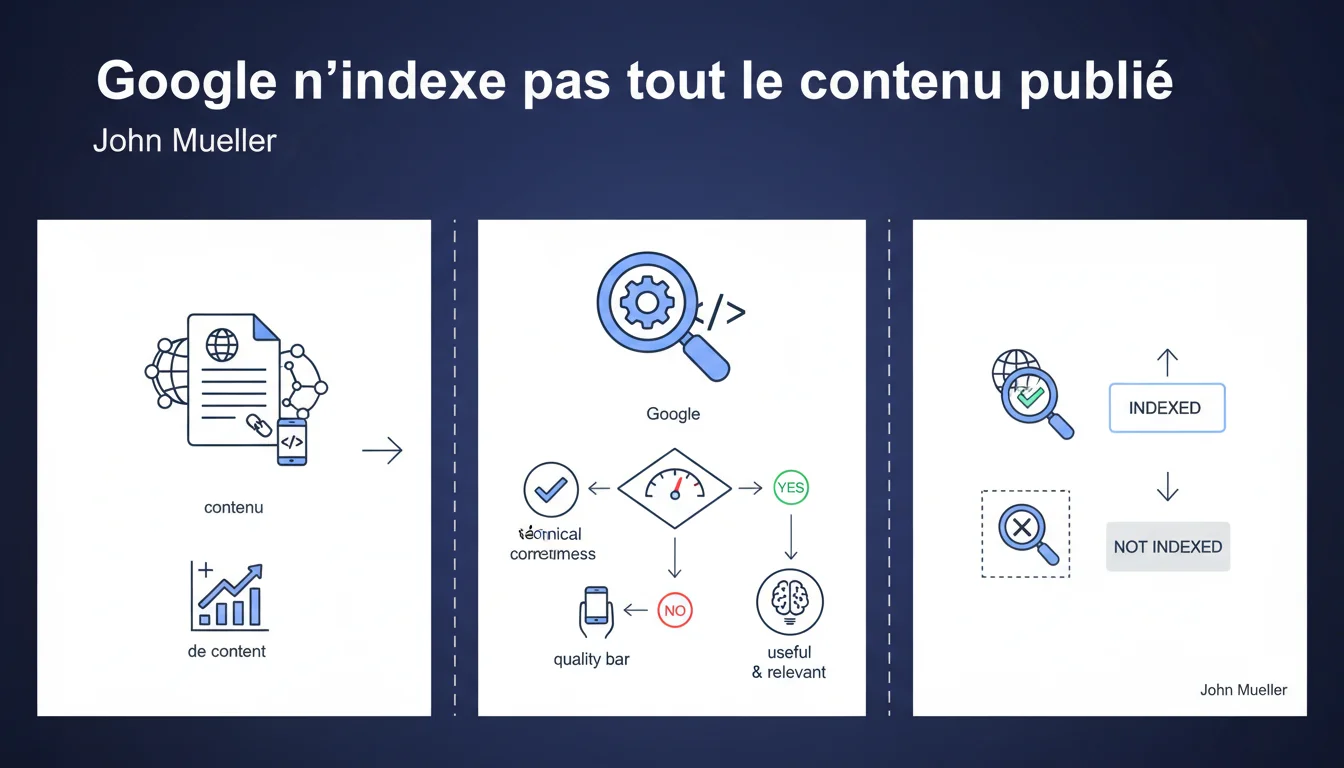
Google no longer guarantees automatic indexing for all published content, even on technically flawless sites. The quality bar has been raised: only content deemed genuinely useful and relevant to users deserves a place in the index. This statement confirms a long-standing reality observed over the past few years.
What you need to understand
Why does Google refuse to index certain technically correct content?<\/h3>
Mueller's statement cuts through an ongoing debate in the SEO community. For a long time, it was believed that a technically impeccable<\/strong> site—crawlable, fast, error-free—guaranteed indexing. That era is over.<\/p> Google has limited resources and an index that cannot grow indefinitely. The perceived quality of content becomes a pre-indexing filter<\/strong>, not just a ranking criterion. In practical terms? Properly structured pages can remain out of the index if Google deems them redundant, superficial, or lacking added value.<\/p> Mueller remains deliberately vague— as often. Google does not provide a specific checklist. It likely refers to a bundle of signals<\/strong>: depth of treatment, originality of the angle, measured satisfaction (reading time, bounce), domain authority context.<\/p> The problem? This vague definition leaves publishers in uncertainty. Two similar articles on different sites can receive opposite treatment without clear explanation.<\/p> No, and that’s crucial. Sites with established authority<\/strong> evidently benefit from a presumption of quality. Their average content often passes the bar when equivalent content on less established sites remains out of the index.<\/p> This asymmetry reinforces the concentration of organic traffic on a few dominant players. A newcomer must produce significantly better content<\/strong> to achieve the same visibility as an established media outlet producing decent content.<\/p>What determines this 'real usefulness' for users?<\/h3>
Is this high quality bar uniformly applied across all sites?<\/h3>
SEO Expert opinion
Is this statement consistent with field observations?<\/h3>
Absolutely. Since 2019-2020, we've observed more capricious indexing<\/strong>, particularly on emerging sites or saturated topics. Pages that are perfectly crawlable can linger for months under "Discovered, currently not indexed" in Search Console without explanation.<\/p> What Mueller is formalizing is a practice already in place but never clearly acknowledged: Google conducts qualitative sorting upstream<\/strong>. The novelty lies in the explicit admission that technique is no longer sufficient.<\/p> [To verify]<\/strong> Mueller does not specify how Google measures this 'real usefulness.' Is it based on prior behavioral signals? On automated semantic analysis? On the overall reputation of the site?<\/p> Let's be honest: this opacity is likely intentional. Providing specific criteria would immediately open the door to mechanical optimization, which is precisely what Google wants to avoid. But this leaves practitioners with few concrete levers of action.<\/p> [To verify]<\/strong> Another nebulous point: is the quality threshold absolute or relative to competition on a query? Does average content on a less-discussed topic pass more easily than good content on a saturated theme?<\/p> News sites and primary sources<\/strong> seem to receive different treatment. An official release, a financial report, or a press agency dispatch are generally indexed quickly, even if they don't provide 'added editorial value.'<\/p> Similarly, large established platforms (marketplaces, social networks, major media) see their content indexed with a presumption of relevance<\/strong> far higher. The double standard is evident but rarely acknowledged.<\/p>What uncertainties remain in this explanation?<\/h3>
When does this rule not really apply?<\/h3>
Practical impact and recommendations
What should you concretely modify in your content strategy?<\/h3>
The first immediate consequence: reduce volume, increase intensity<\/strong>. Publishing 20 mediocre articles per month becomes counterproductive if half remain out of the index and dilute the site's quality signals. Better to publish 8 truly in-depth articles.<\/p> Next, systematically work on differentiating angles<\/strong>. In a competitive theme, the 47th article "How to choose X" stands no chance unless it provides insights, data, or methodologies unavailable elsewhere.<\/p> How to do this? Invest in original case studies, proprietary data, expert interviews, quantitative analyses—anything that cannot be replicated by a competitor<\/strong> in two hours.<\/p> Search Console becomes an indispensable validation tool<\/strong>. Monitor the "Discovered Pages / Indexed Pages" ratio. A growing gap signals that Google deems a significant portion of your output insufficient.<\/p> Analyze which types of content consistently remain out of the index: short articles? Saturated themes? Product pages with generic descriptions? These patterns reveal where the threshold lies for your domain.<\/p> Also test the impact of updating existing content<\/strong>. Substantially enriching a non-indexed article and then requesting reindexing can validate whether the issue was indeed qualitative.<\/p> Don't persist in trying to get weak content indexed by multiplying manual submissions. This doesn't work and sends negative signals<\/strong> about your understanding of quality expectations.<\/p> Avoid the temptation to publish massively to 'saturate' a theme. This strategy was already questionable; it becomes counterproductive now if most content remains out of the index and unnecessarily burdens your crawl budget<\/strong>.<\/p> Don't overlook existing content in favor of constantly producing new. Updating, enriching, consolidating already indexed articles is often more profitable<\/strong> than publishing new mediocre content that won't pass the bar.<\/p>How to diagnose if your content meets this new quality bar?<\/h3>
What mistakes should you avoid in light of this reality?<\/h3>
❓ Frequently Asked Questions
Un site techniquement parfait peut-il quand même avoir des problèmes d'indexation ?
Comment Google détermine-t-il qu'un contenu est réellement utile ?
Cette barre qualitative s'applique-t-elle de la même façon à tous les sites ?
Faut-il continuer à publier régulièrement si certains contenus ne sont pas indexés ?
Comment vérifier si mes contenus passent cette barre qualitative ?
🎥 From the same video 18
Other SEO insights extracted from this same Google Search Central video · published on 24/12/2021
🎥 Watch the full video on YouTube →Related statements
Get real-time analysis of the latest Google SEO declarations
Be the first to know every time a new official Google statement drops — with full expert analysis.
💬 Comments (0)
Be the first to comment.