
Official statement
Other statements from this video 18 ▾
- □ Is it really safe to show structured paid content only to Googlebot without risking penalties?
- □ Does the DMCA really apply page by page, or can an entire site be reported?
- □ Does Google really index every single piece of content you publish?
- □ Can an invalid AMP page still be indexed by Google?
- □ Can Safe Search really stop your adult site from ranking for your own brand?
- □ Could the Product Reviews Update impact your site even if it's not in English?
- □ Which method should you choose for multilingual content: geotargeting or hreflang?
- □ Can Google arbitrarily choose which language version to index when the content is identical?
- □ Should you really block advertising URLs in robots.txt?
- □ Should you give up on dynamic keyword injection to avoid Google penalties?
- □ Does client-side rendering with React really create ranking challenges for Google?
- □ Should you really block all internal search URLs in robots.txt?
- □ Are SEO sites truly exempt from YMYL criteria?
- □ Can you really link multiple sites in the footer without risking your SEO?
- □ Is it true that you must fully translate a multilingual site to rank well?
- □ Should you really worry about crawl budget on a site with fewer than 10,000 URLs?
- □ Robots.txt or noindex: which option should you choose to block indexing?
- □ Does artificial traffic really affect Google rankings?
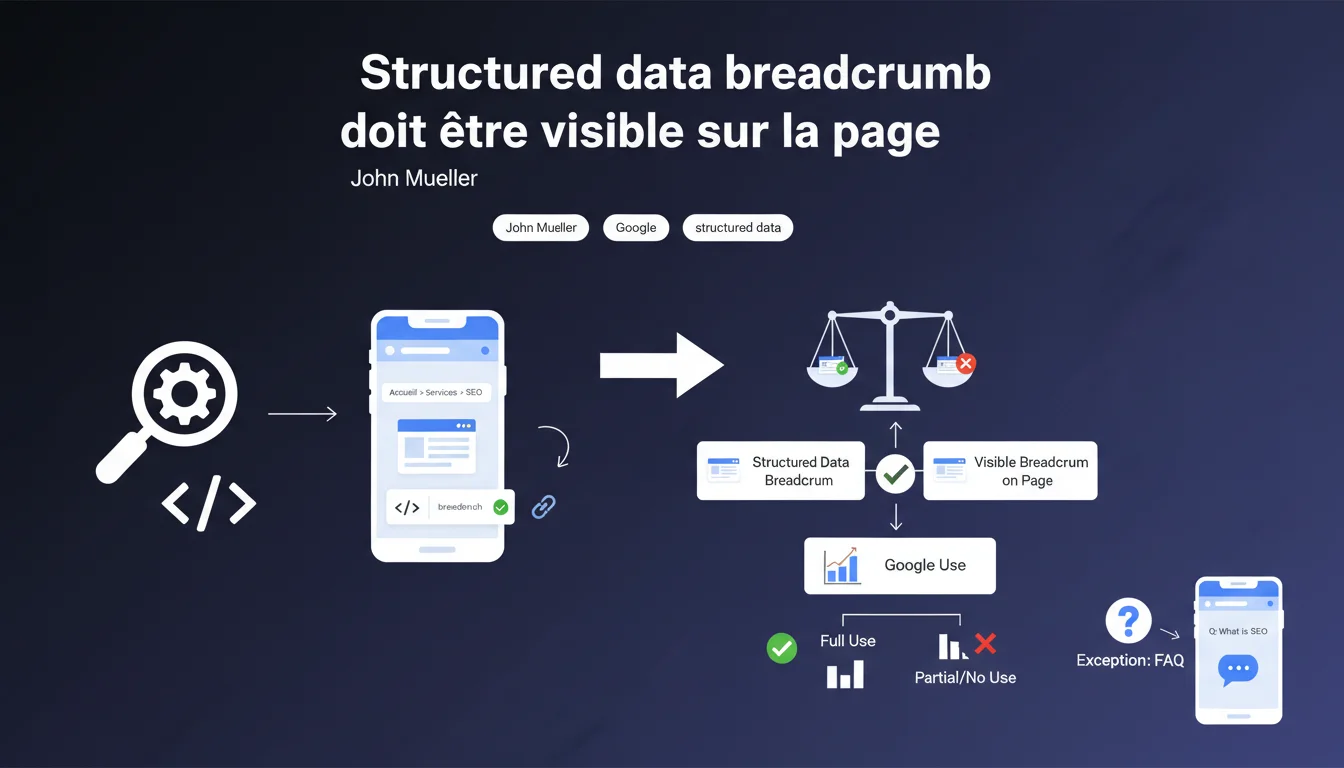
Google checks the consistency between structured breadcrumb data and its visible display on the page. If the markup does not match what the user sees, Google may ignore it entirely or partially. The only exceptions are certain formats like FAQs where only the question needs to be visible.
What you need to understand
Why does Google emphasize the visibility of structured breadcrumbs?
The logic is simple: Google wants to prevent abuse. If you can throw in invisible markup without the user seeing anything, you can manipulate search results. The breadcrumbs displayed in the SERPs must reflect the real navigation of the site—not a fanciful version to please the algorithm. In concrete terms? If your HTML breadcrumb displays "Home > Products > Shoes" but your Schema.org claims "Home > Sports > Running > Trail Shoes", Google detects the inconsistency. And it doesn't like that. Google applies a progressive penalty. In some cases, it completely ignores the markup. In others, it only uses part of it—generally the levels that match what it sees on the page. The problem is that Google does not specify exactly where the tolerance threshold lies. A minor wording difference? Probably tolerated. A completely different structure? No thanks. Mueller mentions FAQs as an exception: only the question should be visible, not necessarily the complete answer in the initial DOM. This aligns with the logic of accordion content or content revealed upon clicking. But beware—this exception does not extend to breadcrumbs. For the latter, the rule remains strict: what you mark up must correspond to what you display.What happens when the markup does not match the visible breadcrumb?
What are the exceptions to this visibility rule?
SEO Expert opinion
Is this statement consistent with observed practices in the field?
Yes, overall. It has been observed for years that Google rarely displays breadcrumbs in SERPs that do not correspond to what is visible on the page. Tests show that glaring inconsistencies are systematically ignored. But—and this is where it gets interesting—there exists a gray area. Sites with slightly different breadcrumbs between HTML and Schema.org sometimes achieve partial display. Google seems to tolerate small wording variations but not structural changes. [To be verified]: the exact tolerance of Google for micro-differences remains unclear. On sites with dynamic or personalized navigation. Imagine an e-commerce site where the breadcrumb changes based on the user journey: arriving from category A or B modifies the displayed structure. What markup to use? Another tricky case: multilingual sites where the translated breadcrumb might have a slightly different structure to adapt to local conventions. Does Google tolerate these adaptations? Mueller's statement does not specify. Not necessarily. Google may choose not to display your breadcrumbs even if they are perfectly implemented— for example, if the URL itself is already clear or if Google believes another display format serves the user better. The absence of breadcrumbs in SERPs is therefore not necessarily a signal of error. But if you have structured markup and Google systematically ignores it, check the consistency between your HTML and your Schema.org. That is probably where the issue lies.In what cases does this rule become problematic?
Should I be concerned if Google does not display my breadcrumbs in SERPs?
Practical impact and recommendations
What should be done concretely to stay compliant?
First step: audit the consistency between your visible breadcrumbs and your Schema.org markup. Take a representative sample of pages (homepage, categories, product sheets, articles) and compare manually. Use the rich results testing tool from Google to ensure your markup is valid. But don’t stop there—the technical validation does not guarantee consistency with the display. Never create structured breadcrumbs purely for SEO that do not visually exist on the page. It’s tempting to manipulate the displayed structure in SERPs, but Google detects and penalizes it. Avoid also subtle but systematic differences: for example, an HTML breadcrumb that uses short labels ("Shoes") while the markup uses long labels ("Men’s Sports Shoes"). Google may interpret that as an inconsistency. For small sites, a manual audit is sufficient. For large catalogs or editorial sites with thousands of pages, automate the verification through a crawl comparing the breadcrumb extracted from the DOM and that from JSON-LD markup. Also monitor your SERP display rates via Search Console. If Google displays your breadcrumbs on 80% of pages and then that rate drops suddenly, that’s a warning sign—probably an inconsistency problem introduced by a template or CMS change.What mistakes should absolutely be avoided?
How can I verify that my site is compliant across all pages?
❓ Frequently Asked Questions
Google pénalise-t-il les breadcrumbs structurés qui ne correspondent pas exactement au breadcrumb HTML ?
Peut-on avoir plusieurs breadcrumbs structurés sur une même page ?
Les breadcrumbs masqués via CSS (display:none) sont-ils acceptés par Google ?
Faut-il inclure la page actuelle dans le breadcrumb structuré ?
Google affiche-t-il toujours les breadcrumbs structurés en SERP si le markup est correct ?
🎥 From the same video 18
Other SEO insights extracted from this same Google Search Central video · published on 24/12/2021
🎥 Watch the full video on YouTube →
💬 Comments (0)
Be the first to comment.