
Official statement
Other statements from this video 18 ▾
- □ Is it really safe to show structured paid content only to Googlebot without risking penalties?
- □ Does the DMCA really apply page by page, or can an entire site be reported?
- □ Does Google really index every single piece of content you publish?
- □ Can an invalid AMP page still be indexed by Google?
- □ Can Safe Search really stop your adult site from ranking for your own brand?
- □ Could the Product Reviews Update impact your site even if it's not in English?
- □ Which method should you choose for multilingual content: geotargeting or hreflang?
- □ Can Google arbitrarily choose which language version to index when the content is identical?
- □ Should you really block advertising URLs in robots.txt?
- □ Should you give up on dynamic keyword injection to avoid Google penalties?
- □ Does client-side rendering with React really create ranking challenges for Google?
- □ Should you really block all internal search URLs in robots.txt?
- □ Does Google penalize invisible or misleading structured breadcrumbs?
- □ Can you really link multiple sites in the footer without risking your SEO?
- □ Is it true that you must fully translate a multilingual site to rank well?
- □ Should you really worry about crawl budget on a site with fewer than 10,000 URLs?
- □ Robots.txt or noindex: which option should you choose to block indexing?
- □ Does artificial traffic really affect Google rankings?
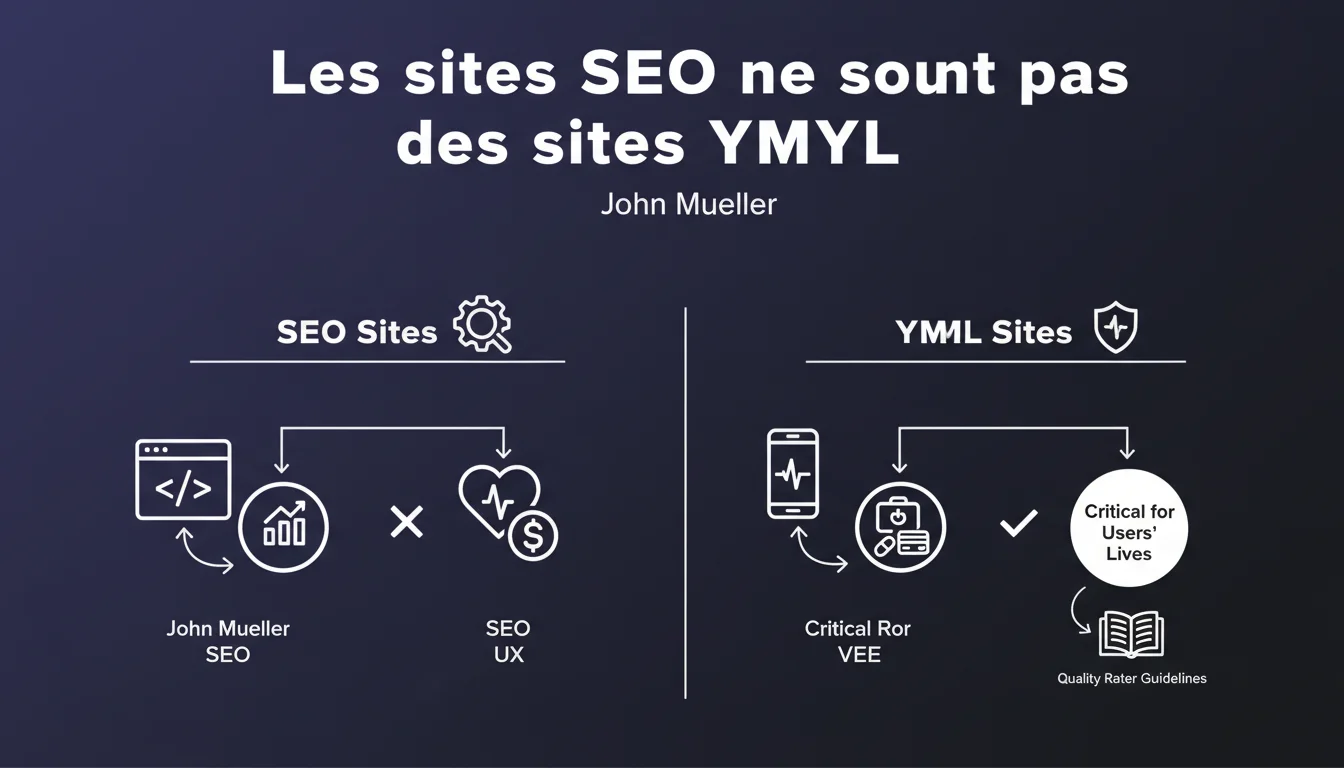
Google confirms that SEO agency websites do not fall under the YMYL (Your Money or Your Life) category. This strict classification applies only to sites critical for health, financial safety, or user well-being. For SEO professionals, this means potentially less rigid E-E-A-T requirements — but not a license to compromise quality.
What you need to understand
Why is this clarification about SEO sites important?
The YMYL category imposes drastically higher quality standards. Google scrutinizes the expertise, authority, and reliability of these contents with increased vigilance, as incorrect information can cause real harm — financial ruin, serious health issues, catastrophic legal decisions. By explicitly excluding SEO sites from this category, Mueller indicates that Google does not view SEO advice as critical to users' lives . Poor SEO advice may harm a site's ranking, but it does not put anyone in immediate physical or financial danger. The Quality Rater Guidelines detail this classification: health and safety, financial stability, public safety, groups of people (ethnicity, religion, sexual orientation), critical official information. This is the strict scope. A site selling SEO advice — even if it charges for its services — does not fall into this framework. The financial stakes exist, certainly, but remain indirect. No one risks their retirement or mortgage based on a title tag recommendation. Absolutely not. E-E-A-T applies to all sites , without exception. The nuance: Google will not impose the same level of demand as it does on a medical or financial advisory site. A SEO site must still demonstrate its expertise (identified authors, verifiable references), its authority (quality backlinks, mentions in the industry), and its reliability (cited sources, transparency). Simply, the tolerance threshold remains broader than for a site advising on cancer treatments.What actually defines a YMYL site?
Does this mean that E-E-A-T standards do not apply to SEO sites?
SEO Expert opinion
Is this statement consistent with field observations?
Yes, and it makes quite a bit of sense. In practice, well-built SEO agency sites rank without deploying the full arsenal necessary for a medical site — no need for a committee of certified doctors to write about the canonical tag.
However — and this is where it gets tricky — some SEO sites produce content on topics that dangerously flirt with YMYL . "How to increase your e-commerce revenue" touches on financial matters. "SEO for health sites" indirectly addresses medical issues. In these cases, the boundary becomes blurry. [To be confirmed] : Does Google apply a thematic contamination logic? No official confirmation. Mueller talks about “SEO business sites.” Fair enough. But what about a SEO blog post advising on optimizing a financial advisory site? Does the content become YMYL by association? Google does not clarify . Another gray area: an SEO site monetizing through courses costing several thousand euros. The financial commitment becomes substantial. Is it enough to shift to YMYL? The guidelines remain silent. In practice, it seems not — but ambiguity persists. Let's take a concrete example: an SEO site that publishes case studies detailing how an SEO strategy generated X million Euros in additional revenue for a client. The financial impact becomes direct and quantified. Another scenario: a paid SEO tool whose automated recommendations can lead to Google penalties — therefore real financial losses. Could Google reevaluate these tools under a YMYL lens? No official indication, but logic suggests that an algorithm making critical decisions would be scrutinized differently than a tips blog.What nuances should be added to this position?
In what cases might this rule not fully apply?
Practical impact and recommendations
What concrete steps should be taken for an SEO site?
First, do not lower quality on the pretext that you are not YMYL. E-E-A-T remains your compass: visible expertise (detailed author bio, professional background), built authority (backlinks from recognized industry sites), demonstrated reliability (cited sources, verifiable case studies). Next, identify if certain sections of your site touch on YMYL themes . A guide “SEO for credit sites”? Treat it with YMYL standards — identifiable expert author, official sources, regular updates. Classic mistake: interpreting “not YMYL” as “no need to prove my expertise.” Wrong. Google still assesses your credibility — simply with less severity than a medical site. Another trap: publishing generic content on sensitive verticals without demonstrating specific expertise. If you advise on SEO for finance, show that you understand finance — not just meta tags. Download the Quality Rater Guidelines — 175 pages, but the YMYL section is condensed into a few chapters. Compare your content to the provided examples. If you are unsure about a topic, lean toward caution: treat it as YMYL. Audit your pages with this checklist: identifiable author? Verifiable sources? Demonstrated expertise? If the answer is no on any of these dimensions, you have work to do.What errors should absolutely be avoided?
How to verify that your site adheres to best practices?
❓ Frequently Asked Questions
Un site SEO qui vend des formations coûteuses devient-il YMYL ?
Les critères E-E-A-T s'appliquent-ils quand même aux sites SEO ?
Si mon site SEO publie sur la finance ou la santé, reste-t-il hors YMYL ?
Où trouver la définition officielle des sites YMYL ?
Un outil SEO automatisé est-il concerné par YMYL ?
🎥 From the same video 18
Other SEO insights extracted from this same Google Search Central video · published on 24/12/2021
🎥 Watch the full video on YouTube →
💬 Comments (0)
Be the first to comment.