
Official statement
Other statements from this video 18 ▾
- □ Is it really safe to show structured paid content only to Googlebot without risking penalties?
- □ Does Google really index every single piece of content you publish?
- □ Can an invalid AMP page still be indexed by Google?
- □ Can Safe Search really stop your adult site from ranking for your own brand?
- □ Could the Product Reviews Update impact your site even if it's not in English?
- □ Which method should you choose for multilingual content: geotargeting or hreflang?
- □ Can Google arbitrarily choose which language version to index when the content is identical?
- □ Should you really block advertising URLs in robots.txt?
- □ Should you give up on dynamic keyword injection to avoid Google penalties?
- □ Does client-side rendering with React really create ranking challenges for Google?
- □ Should you really block all internal search URLs in robots.txt?
- □ Are SEO sites truly exempt from YMYL criteria?
- □ Does Google penalize invisible or misleading structured breadcrumbs?
- □ Can you really link multiple sites in the footer without risking your SEO?
- □ Is it true that you must fully translate a multilingual site to rank well?
- □ Should you really worry about crawl budget on a site with fewer than 10,000 URLs?
- □ Robots.txt or noindex: which option should you choose to block indexing?
- □ Does artificial traffic really affect Google rankings?
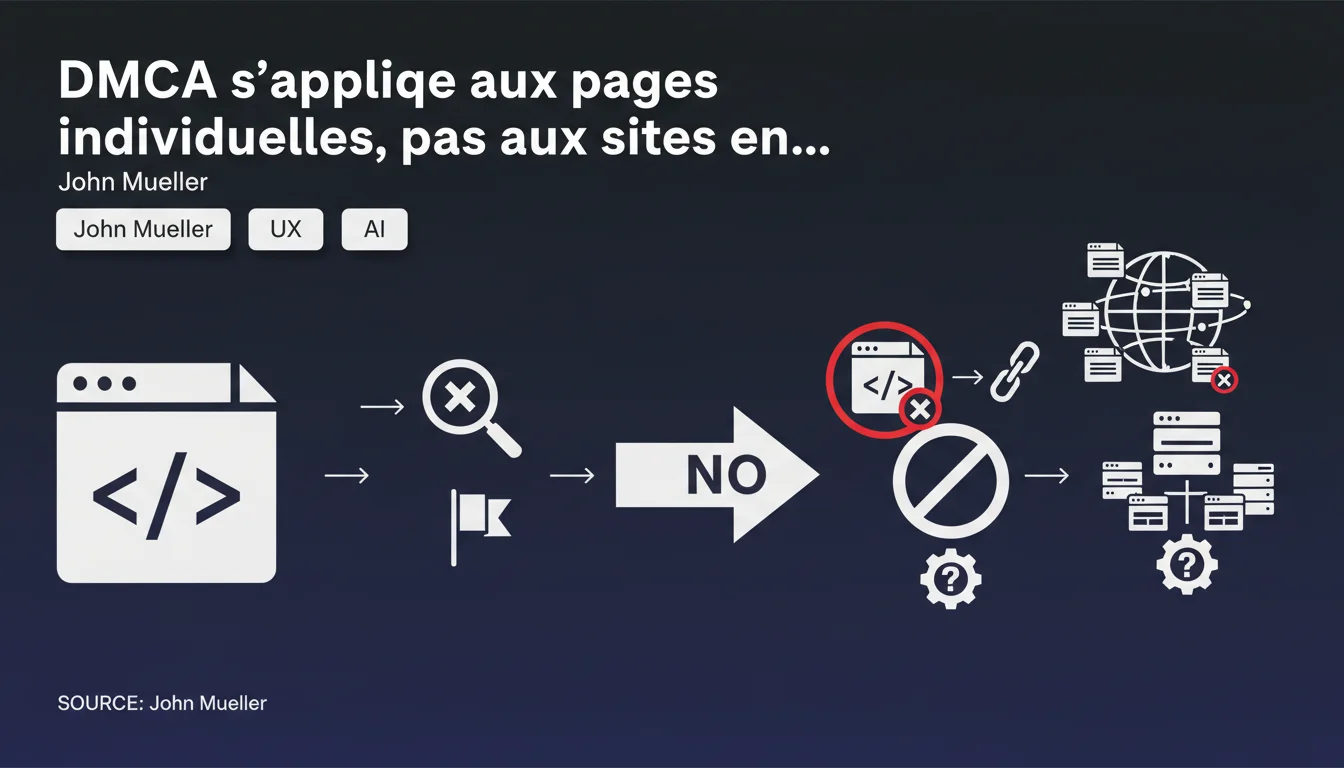
Google strictly limits the use of the DMCA to individual pages that copy your content. It's not possible to report an entire domain, even if multiple pages plagiarize your texts. Each copied URL requires a separate report, making it difficult to tackle industrial scraping.
What you need to understand
Why does Google restrict the DMCA to individual pages?
The Digital Millennium Copyright Act (DMCA) is a legal tool that allows for the removal of content that infringes your copyright from the SERP. Google applies this process granularly: each report can only target one specific URL, not an entire domain.
This approach is based on the indexing logic: Google indexes pages, not sites. A domain can host both original content and copied content — penalizing the entire site would be disproportionate and legally risky.
What’s the difference from algorithmic penalties for duplicate content?
Don’t confuse the DMCA with Google’s anti-duplication filters. The DMCA is a legal recourse that leads to a manual deindexation of a specific page. Algorithmic penalties for duplication (like Panda or quality filters) can affect entire sections or even a complete domain.
However, to trigger a DMCA, you must prove that you own the original content and that the targeted page infringes your rights. It is a legal procedure, not a quality report.
- The DMCA targets only one URL at a time, never an entire site
- Each copied page requires a separate report via the official form
- This process does not replace Google's algorithmic filters against spam or scraping
- A site can accumulate DMCA removals without being banned from the index — unless subsequent manual intervention occurs
How does Google handle sites that accumulate DMCA reports?
Officially, Google does not automatically penalize a domain that receives multiple DMCA requests. Each page is treated independently. In practice, a site that accumulates dozens of removals for copyright infringement may eventually attract the attention of the spam team — but it’s not the DMCA that triggers this action, it’s a manual intervention.
The problem? For a publisher victim of massive scraping, this means hours of administrative work to report each URL one by one. No batch reporting tool exists on Google’s side.
SEO Expert opinion
Is this limitation consistent with the reality of large-scale scraping?
Let’s be honest: no. Google’s position prioritizes protecting the engine against abuse of reporting. Imagine if a competitor could take down an entire site with a single click through the DMCA — it would be unmanageable.
But for legitimate publishers, it’s a practical deadlock. Automated scrapers sometimes copy hundreds of pages. Having to fill out a form for each stolen URL makes the DMCA nearly unusable against industrial content farms. Google knows this but has never proposed a scalable solution.
Are there exceptions observed in practice?
Yes — and this is where it gets tricky. Some spammy domains suddenly disappear from the index after waves of DMCA reports. Officially, it’s not the DMCA that took them down, but rather a manual action triggered simultaneously.
Concretely? A site that gathers 50+ DMCA removals over a few weeks may eventually be manually reassessed by the spam team. But Google never states this clearly — [To be verified] since no official data formally links DMCA and manual penalties.
What alternatives exist when the DMCA isn’t enough?
If a site consistently copies your content, the DMCA quickly becomes insufficient. You can combine several levers: sending demand letters to the thief site’s host, reporting via Google’s anti-spam tools, and especially optimizing your publication and crawl speed.
Google generally favors the URL indexed first. If your content appears in the index before the copy, you have an advantage — but it’s not an absolute guarantee. Authority signals (backlinks, domain history) also weigh in.
Practical impact and recommendations
What should you practically do if your content is copied?
Before launching a DMCA, check that your content is indeed the original. Use tools like Copyscape, Siteliner, or the Search Console (query "exact phrase of your text"). If you find copies, note each specific URL — not just the domain.
Then, use Google’s official DMCA takedown form. You’ll need to supply: your original URL, the copied URL, and a sworn declaration that you are the legitimate owner. Repeat this process for each stolen page.
What mistakes should you avoid when filing a DMCA report?
Never report an entire domain — your request will be rejected. Don’t try to report “inspired” or paraphrased content: the DMCA only covers literal copying. If the text is rephrased, even awkwardly, it’s not within the DMCA’s scope.
Another pitfall: reporting too early. Sometimes, a site copies your content and then removes it themselves a few days later. Check that the copied page is still online and indexed before initiating the procedure.
- Precisely identify each copied URL (not the root domain)
- Keep evidence of prior publication (date of publication, web archives like Wayback Machine)
- Fill out Google’s official DMCA form, never a third-party form
- Monitor the status of your requests through your Google account (you’ll receive email notifications)
- Complement with a spam report if the site engages in mass scraping
- Optimize your indexing speed (up-to-date XML sitemap, optimized crawl budget) to be indexed before the copiers
❓ Frequently Asked Questions
Peut-on signaler plusieurs pages d'un même site en une seule requête DMCA ?
Un site qui reçoit beaucoup de DMCA finit-il par être pénalisé par Google ?
Le DMCA fonctionne-t-il pour du contenu paraphrasé ou reformulé ?
Combien de temps faut-il pour qu'une page soit désindexée après un DMCA ?
Comment protéger son contenu en amont contre le scraping ?
🎥 From the same video 18
Other SEO insights extracted from this same Google Search Central video · published on 24/12/2021
🎥 Watch the full video on YouTube →
💬 Comments (0)
Be the first to comment.