
Official statement
Other statements from this video 18 ▾
- □ Is it really safe to show structured paid content only to Googlebot without risking penalties?
- □ Does the DMCA really apply page by page, or can an entire site be reported?
- □ Does Google really index every single piece of content you publish?
- □ Can an invalid AMP page still be indexed by Google?
- □ Can Safe Search really stop your adult site from ranking for your own brand?
- □ Could the Product Reviews Update impact your site even if it's not in English?
- □ Which method should you choose for multilingual content: geotargeting or hreflang?
- □ Can Google arbitrarily choose which language version to index when the content is identical?
- □ Should you really block advertising URLs in robots.txt?
- □ Should you give up on dynamic keyword injection to avoid Google penalties?
- □ Does client-side rendering with React really create ranking challenges for Google?
- □ Should you really block all internal search URLs in robots.txt?
- □ Are SEO sites truly exempt from YMYL criteria?
- □ Does Google penalize invisible or misleading structured breadcrumbs?
- □ Can you really link multiple sites in the footer without risking your SEO?
- □ Is it true that you must fully translate a multilingual site to rank well?
- □ Should you really worry about crawl budget on a site with fewer than 10,000 URLs?
- □ Robots.txt or noindex: which option should you choose to block indexing?
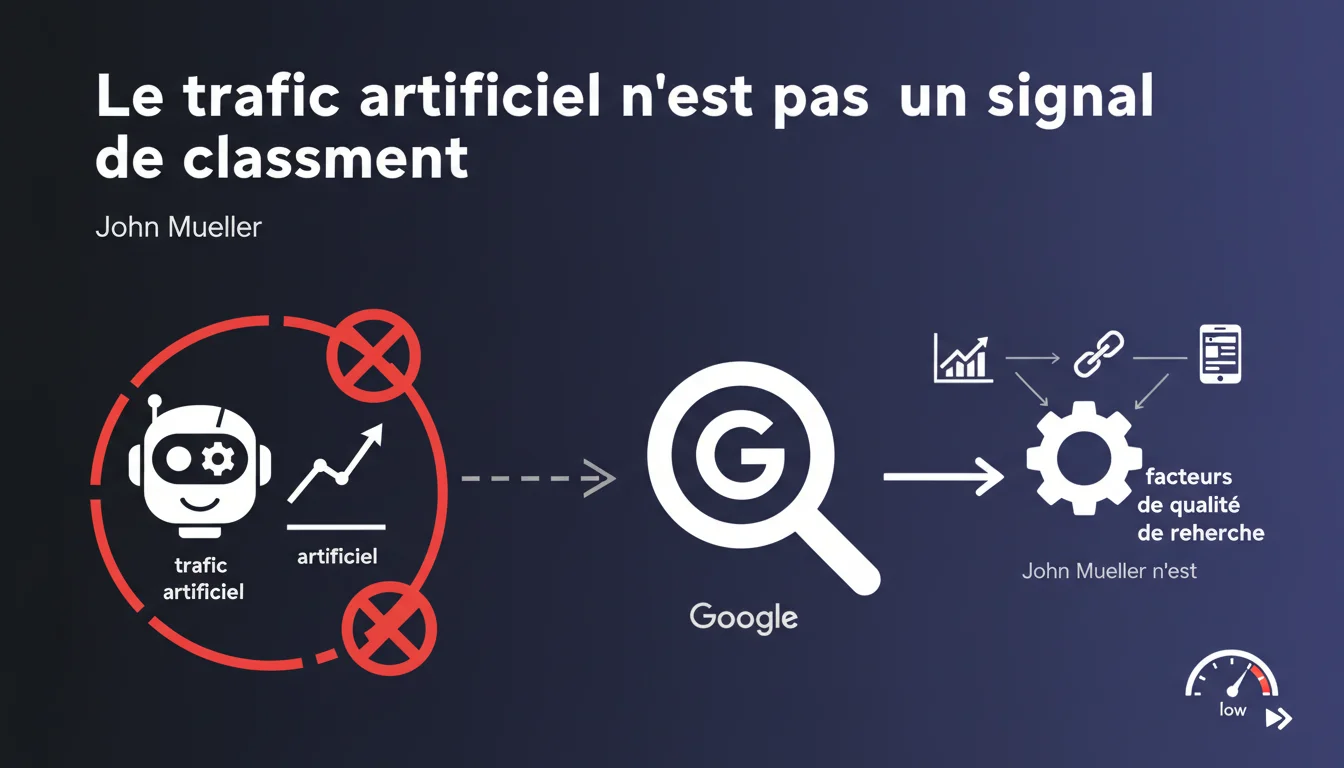
Google claims that artificial traffic (bots) is not a ranking signal. If a site rises in the SERPs after using bots, it’s a coincidence or the effect of other factors—not a direct consequence of the generated traffic.
What you need to understand
What prompted this clarification from Google?
Some SEO tools and services promise to improve rankings by generating artificial traffic to a site. The idea? To convince Google that a page is popular so that it gets promoted in the results. Mueller cuts to the chase: bot traffic is not a ranking signal . Google does not analyze the visitor volume of a site to decide if it deserves better positioning. The algorithms focus on other criteria—content, backlinks, user experience, etc. We’re talking about bots, fraudulent paid clicks, automated scripts that simulate visits. Not legitimate advertising traffic (Google Ads, Meta Ads), nor real organic or direct traffic. The problem with these tactics? They can distort your analytics, waste your server resources, and—in the worst case—trigger penalties if Google detects manipulation . Mueller mentions an accidental correlation . A site that buys bot traffic may also, at the same time, improve its content, gain new backlinks, or optimize its Core Web Vitals. It’s this parallel improvement that explains the rise—not the bots. Confusing correlation with causality is a classic trap in SEO.What exactly do we mean by “artificial traffic”?
If it’s not a signal, why do some sites seem to rise?
SEO Expert opinion
Is this statement consistent with what we observe in the field?
Honestly? Yes. No serious study has ever proven that raw traffic (visit volume) is a direct ranking factor. The observed correlations are always explained otherwise. What matters to Google is what users do on your site—not how many there are. A site with 10,000 bot visitors and a 100% bounce rate is of no interest to the algorithm. Be careful—real traffic indirectly influences SEO . If thousands of people search for your brand on Google (navigational searches), it’s a signal of popularity and quality. But it’s organic traffic, not artificial. Similarly, a highly visited site often generates more natural backlinks, social shares, mentions . These elements do impact rankings. Traffic is an effect, not a cause. [To be verified] : Google could theoretically use Chrome or Analytics data to refine certain behavioral signals, but there’s no official confirmation. It isn’t. Let’s be clear: no bot traffic hack will sustainably elevate a site. Even if Google used traffic as a signal (which it denies), its systems would quickly detect anomalies.What nuances should we consider?
When might this rule be circumvented?
Practical impact and recommendations
What should you do if you’re already using bot traffic?
Stop immediately . Not only is it useless for SEO, but it pollutes your Analytics data and can trigger alerts at Google. If you’ve invested in this type of service, reallocate that budget towards effective levers: content creation, link building, technical optimization . Look at your analytics. Warning signs include: an abnormally high bounce rate, nearly zero session duration, unexplained traffic spikes from inconsistent geographies. Google Analytics 4 and Search Console will never show bot traffic if it generates no real interaction. But third-party tools (server logs, Cloudflare Analytics) can reveal it. Never purchase “guaranteed traffic services” , even if they promise “real” traffic. Google detects abnormal patterns—repeated clicks, suspicious IPs, robotic behaviors. Avoid click exchanges ("I visit your site, you visit mine"). It's ineffective and risky.How can I check if my site is receiving artificial traffic?
What mistakes should I avoid to prevent penalties?
❓ Frequently Asked Questions
Le trafic depuis Google Ads influence-t-il le classement organique ?
Si Google n'utilise pas le trafic, pourquoi mesure-t-on l'engagement utilisateur ?
Un concurrent peut-il nuire à mon site en envoyant du trafic bot ?
Les recherches de marque (branded search) sont-elles un signal de classement ?
Dois-je bloquer le trafic bot dans mon fichier robots.txt ?
🎥 From the same video 18
Other SEO insights extracted from this same Google Search Central video · published on 24/12/2021
🎥 Watch the full video on YouTube →
💬 Comments (0)
Be the first to comment.