
Official statement
Other statements from this video 18 ▾
- □ Is it really safe to show structured paid content only to Googlebot without risking penalties?
- □ Does the DMCA really apply page by page, or can an entire site be reported?
- □ Does Google really index every single piece of content you publish?
- □ Can an invalid AMP page still be indexed by Google?
- □ Could the Product Reviews Update impact your site even if it's not in English?
- □ Which method should you choose for multilingual content: geotargeting or hreflang?
- □ Can Google arbitrarily choose which language version to index when the content is identical?
- □ Should you really block advertising URLs in robots.txt?
- □ Should you give up on dynamic keyword injection to avoid Google penalties?
- □ Does client-side rendering with React really create ranking challenges for Google?
- □ Should you really block all internal search URLs in robots.txt?
- □ Are SEO sites truly exempt from YMYL criteria?
- □ Does Google penalize invisible or misleading structured breadcrumbs?
- □ Can you really link multiple sites in the footer without risking your SEO?
- □ Is it true that you must fully translate a multilingual site to rank well?
- □ Should you really worry about crawl budget on a site with fewer than 10,000 URLs?
- □ Robots.txt or noindex: which option should you choose to block indexing?
- □ Does artificial traffic really affect Google rankings?
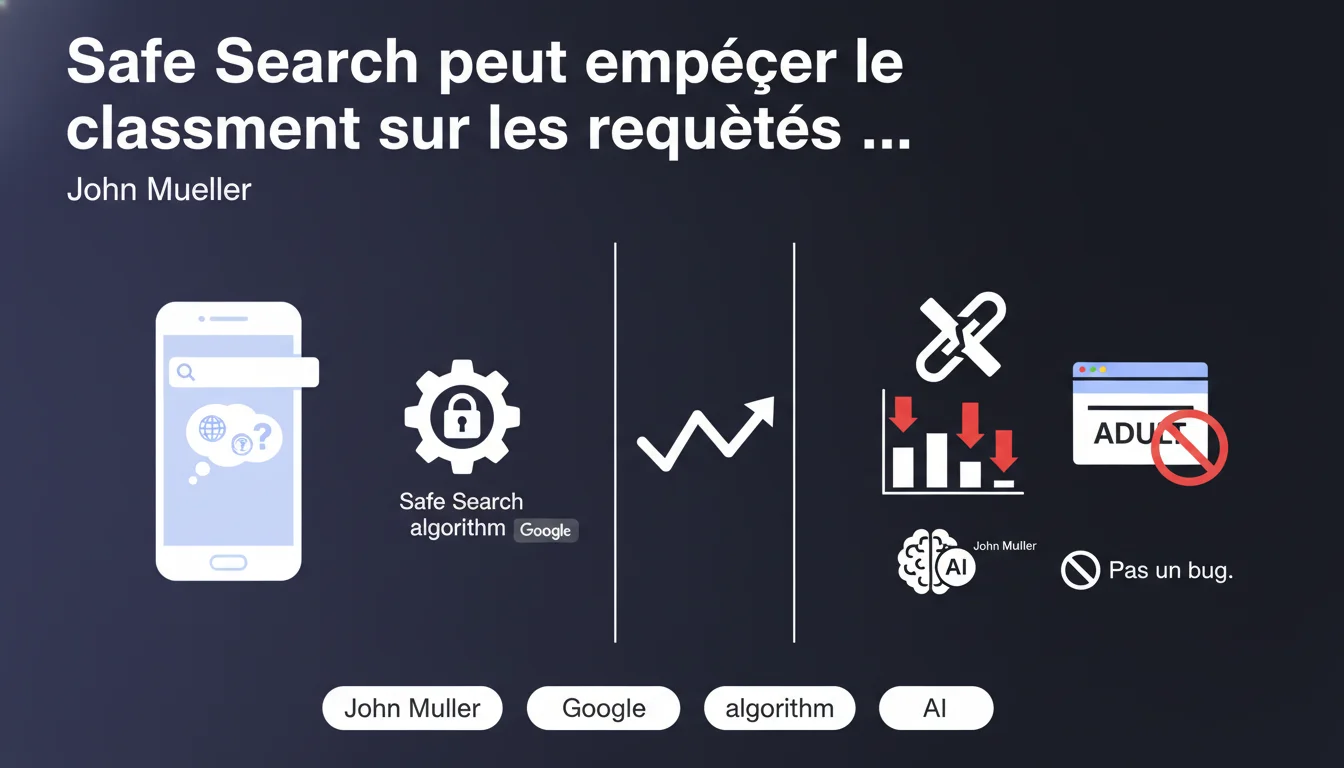
Google confirms that Safe Search can block adult sites from ranking for their own brand queries if users do not expect that type of content. This is not a bug, but an intentional behavior of the algorithm. Therefore, adult sites may be invisible for their own brand name depending on filtering settings.
What you need to understand
What exactly does Safe Search do for brand queries?
Safe Search is Google's filter that hides explicit content from search results. When a user activates this filter (or Google activates it by default in certain contexts), even a precise search for a brand name may return nothing if the site is classified as adult content. In practical terms? An adult site may have a perfect authority on its brand, strong backlinks, and an impeccable technical profile — yet remain invisible to a significant portion of users. Google accepts this behavior and refuses to correct it. Google's position is simple: user intent takes precedence over everything, including site intentions. If a user has activated Safe Search, it means they do not want to encounter adult content — even when searching for a specific brand. Google assumes that many brand queries are actually ambiguous generic searches. A name that resembles a common word, a typo, a vague query — in these cases, Safe Search intervenes to prevent exposing the user to unwanted content. The filtering mainly affects generic or ambiguous brand queries. A brand name that evokes a broad concept, a service, or shares keywords with non-adult searches is more likely to be filtered. Conversely, an ultra-specific search with the exact domain name or very distinctive terms is more likely to bypass the filter. But there's no guarantee — Google decides on a case-by-case basis according to its interpretation of intent.Why does Google think it's not a bug?
What types of queries are affected by this filtering?
SEO Expert opinion
Does this statement align with real-world observations?
Absolutely. Many adult sites have reported unexplained volatility on their brand queries for years. Some days they rank in position 1; other days, they disappear completely — without any technical changes or manual penalties. Mueller's statement confirms what was suspected: Safe Search filtering is not binary. It applies in a contextual and algorithmic manner, depending on Google's interpretation of each query. The result? Total unpredictability for the affected sites. The problem is that Google never precisely defines what a "generic query" is or what triggers Safe Search. [To be verified]: it’s unclear whether filtering depends solely on the query, or also on the user profile, location, or device. Another vague point: what about sites that are not exclusively adult but cover sensitive topics? Sexual health, education, artistic content featuring nudity — where is the line drawn? Google remains deliberately evasive. This is where it gets tricky. A site can invest heavily in SEO, branding, and customer acquisition — and still be structurally handicapped on its own brand with no recourse. No penalty to lift, no bug to fix. Just an algorithm that decides. No, and that’s another mystery. Some established adult sites with a strong reputation seem less affected than newer or niche players. Is it a domain authority issue? Search volume for the brand? Historical user signals? Impossible to say for sure. Google likely applies a progressive trust logic — but without official confirmation, we’re left with assumptions. What’s certain is that two similar adult sites can experience radically different SEO realities for their own brands.What are the gray areas of this policy?
Does this rule apply equally to all adult content?
Practical impact and recommendations
What can an adult site do to maximize its visibility for its brand?
First step: diversify entry points. Don't rely solely on organic SEO to capture your brand traffic. Paid advertising (where permitted), social media, email, partnerships — build acquisition channels independent of Google. On the SEO side, work on the specificity of your brand queries. If your brand name is generic, promote more distinctive variations: full domain name, combinations with niche terms, build recognition around precise formulations. The more recognizable and unique your brand is, the less reason Safe Search has to filter you. Measure the discrepancy between your impressions and your average position for your brand queries in Search Console. A significant gap may indicate intermittent filtering. Compare your data with and without Safe Search activated — but be cautious, these manual tests only reflect part of the problem. Analyze your brand traffic curves: sudden drops without technical explanation or algorithm updates are a red flag. If your site regularly disappears for your own name without apparent reason, Safe Search is probably to blame. Let's be honest: you cannot "fix" this problem. Google sees it as an editorial policy choice, not a malfunction. Your best defense is anticipation and diversification. Build a brand that goes beyond SEO. Invest in channels where Safe Search has no influence. Strengthen your direct community, nurture through email and notifications, create proprietary access points (apps, subscriptions, etc.).How to monitor and quantify the impact of Safe Search?
What strategy to adopt in light of this structural limitation?
❓ Frequently Asked Questions
Safe Search s'applique-t-il aussi aux sites non-adultes mais traitant de sujets sensibles ?
Peut-on demander à Google de whitelister notre marque dans Safe Search ?
Safe Search affecte-t-il uniquement les recherches génériques ou aussi les recherches exactes de domaine ?
Comment savoir si mon site est filtré par Safe Search sur ma marque ?
Ce filtrage a-t-il un impact sur le référencement global du site ?
🎥 From the same video 18
Other SEO insights extracted from this same Google Search Central video · published on 24/12/2021
🎥 Watch the full video on YouTube →
💬 Comments (0)
Be the first to comment.