
Official statement
Other statements from this video 18 ▾
- □ Peut-on vraiment montrer du contenu payant structuré uniquement à Googlebot sans risque de pénalité ?
- □ Le DMCA s'applique-t-il vraiment page par page ou peut-on signaler un site entier ?
- □ Google indexe-t-il vraiment tout le contenu que vous publiez ?
- □ Une page AMP invalide peut-elle quand même être indexée par Google ?
- □ Safe Search peut-il empêcher votre site adulte de ranker sur votre propre marque ?
- □ Le Product Reviews Update peut-il impacter votre site même s'il n'est pas en anglais ?
- □ Géociblage ou hreflang : quelle méthode privilégier pour les contenus multilingues ?
- □ Google peut-il choisir arbitrairement quelle version linguistique indexer quand le contenu est identique ?
- □ Faut-il vraiment bloquer les URLs publicitaires dans robots.txt ?
- □ Faut-il abandonner l'injection dynamique de mots-clés pour éviter les pénalités Google ?
- □ Le client-side rendering React pose-t-il vraiment un problème de classement pour Google ?
- □ Faut-il vraiment bloquer toutes les URLs de recherche interne dans robots.txt ?
- □ Les sites SEO sont-ils vraiment exemptés des critères YMYL ?
- □ Google pénalise-t-il les breadcrumbs structurés invisibles ou trompeurs ?
- □ Peut-on vraiment lier plusieurs sites dans le footer sans risque SEO ?
- □ Faut-il vraiment traduire l'intégralité d'un site multilingue pour bien se positionner ?
- □ Faut-il vraiment s'inquiéter du crawl budget sur un site de moins de 10 000 URLs ?
- □ Robots.txt ou noindex : lequel choisir pour bloquer l'indexation ?
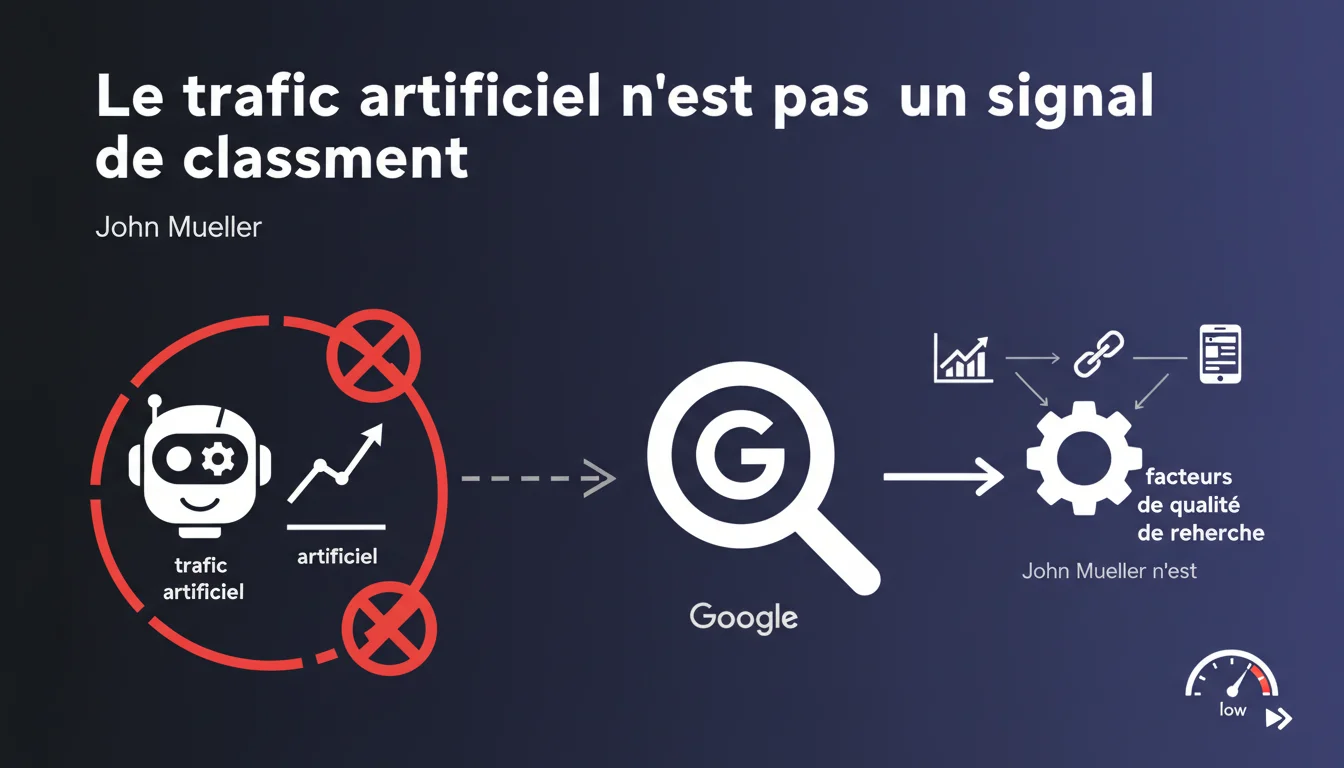
Google claims that artificial traffic (bots) is not a ranking signal. If a site rises in the SERPs after using bots, it’s a coincidence or the effect of other factors—not a direct consequence of the generated traffic.
What you need to understand
What prompted this clarification from Google? <\/h3>
Some SEO tools <\/strong> and services promise to improve rankings by generating artificial traffic to a site. The idea? To convince Google that a page is popular so that it gets promoted in the results.<\/p> Mueller cuts to the chase: bot traffic is not a ranking signal <\/strong>. Google does not analyze the visitor volume of a site to decide if it deserves better positioning. The algorithms focus on other criteria—content, backlinks, user experience, etc.<\/p> We’re talking about bots, fraudulent paid clicks, automated scripts <\/strong> that simulate visits. Not legitimate advertising traffic (Google Ads, Meta Ads), nor real organic or direct traffic.<\/p> The problem with these tactics? They can distort your analytics, waste your server resources, and—in the worst case—trigger penalties if Google detects manipulation <\/strong>.<\/p> Mueller mentions an accidental correlation <\/strong>. A site that buys bot traffic may also, at the same time, improve its content, gain new backlinks, or optimize its Core Web Vitals.<\/p> It’s this parallel improvement that explains the rise—not the bots. Confusing correlation with causality is a classic trap in SEO.<\/p>What exactly do we mean by “artificial traffic”? <\/h3>
If it’s not a signal, why do some sites seem to rise? <\/h3>
SEO Expert opinion
Is this statement consistent with what we observe in the field? <\/h3>
Honestly? Yes. No serious study has ever proven that raw traffic <\/strong> (visit volume) is a direct ranking factor. The observed correlations are always explained otherwise.<\/p> What matters to Google is what users do <\/strong> on your site—not how many there are. A site with 10,000 bot visitors and a 100% bounce rate is of no interest to the algorithm.<\/p> Be careful—real traffic indirectly influences SEO <\/strong>. If thousands of people search for your brand on Google (navigational searches), it’s a signal of popularity and quality. But it’s organic traffic, not artificial.<\/p> Similarly, a highly visited site often generates more natural backlinks, social shares, mentions <\/strong>. These elements do impact rankings. Traffic is an effect, not a cause. [To be verified] <\/strong>: Google could theoretically use Chrome or Analytics data to refine certain behavioral signals, but there’s no official confirmation.<\/p> It isn’t. Let’s be clear: no bot traffic hack will sustainably elevate a site. Even if Google used traffic as a signal (which it denies), its systems would quickly detect anomalies.<\/p>What nuances should we consider? <\/h3>
When might this rule be circumvented? <\/h3>
Practical impact and recommendations
What should you do if you’re already using bot traffic? <\/h3>
Stop immediately <\/strong>. Not only is it useless for SEO, but it pollutes your Analytics data and can trigger alerts at Google.<\/p> If you’ve invested in this type of service, reallocate that budget towards effective levers: content creation, link building, technical optimization <\/strong>.<\/p> Look at your analytics. Warning signs include: an abnormally high bounce rate, nearly zero session duration, unexplained traffic spikes <\/strong> from inconsistent geographies.<\/p> Google Analytics 4 and Search Console will never show bot traffic if it generates no real interaction. But third-party tools (server logs, Cloudflare Analytics) can reveal it.<\/p> Never purchase “guaranteed traffic services” <\/strong>, even if they promise “real” traffic. Google detects abnormal patterns—repeated clicks, suspicious IPs, robotic behaviors.<\/p> Avoid click exchanges <\/strong> ("I visit your site, you visit mine"). It's ineffective and risky.<\/p>How can I check if my site is receiving artificial traffic? <\/h3>
What mistakes should I avoid to prevent penalties? <\/h3>
❓ Frequently Asked Questions
Le trafic depuis Google Ads influence-t-il le classement organique ?
Si Google n'utilise pas le trafic, pourquoi mesure-t-on l'engagement utilisateur ?
Un concurrent peut-il nuire à mon site en envoyant du trafic bot ?
Les recherches de marque (branded search) sont-elles un signal de classement ?
Dois-je bloquer le trafic bot dans mon fichier robots.txt ?
🎥 From the same video 18
Other SEO insights extracted from this same Google Search Central video · published on 24/12/2021
🎥 Watch the full video on YouTube →Get real-time analysis of the latest Google SEO declarations
Be the first to know every time a new official Google statement drops — with full expert analysis.
💬 Comments (0)
Be the first to comment.