
Official statement
Other statements from this video 10 ▾
- □ Does Google really reduce SEO to just two main areas?
- □ Are there really any secrets to ranking first on Google?
- □ Does Google's SEO Starter Guide really contain all the essential techniques you need to rank higher?
- □ Why does Google recommend Search Console over Trends for SEO technical requirements?
- □ Do you really need to chase every emerging trend to rank higher in Google?
- □ Is Google Trends really effective for identifying the right keywords?
- □ Can Google Trends really uncover your hidden SEO opportunities?
- □ Is geographic optimization the missing piece that's holding back your SEO results?
- □ Can Google Trends really accelerate your YouTube video strategy?
- □ Why do YouTube search trends differ so dramatically from traditional Google web search?
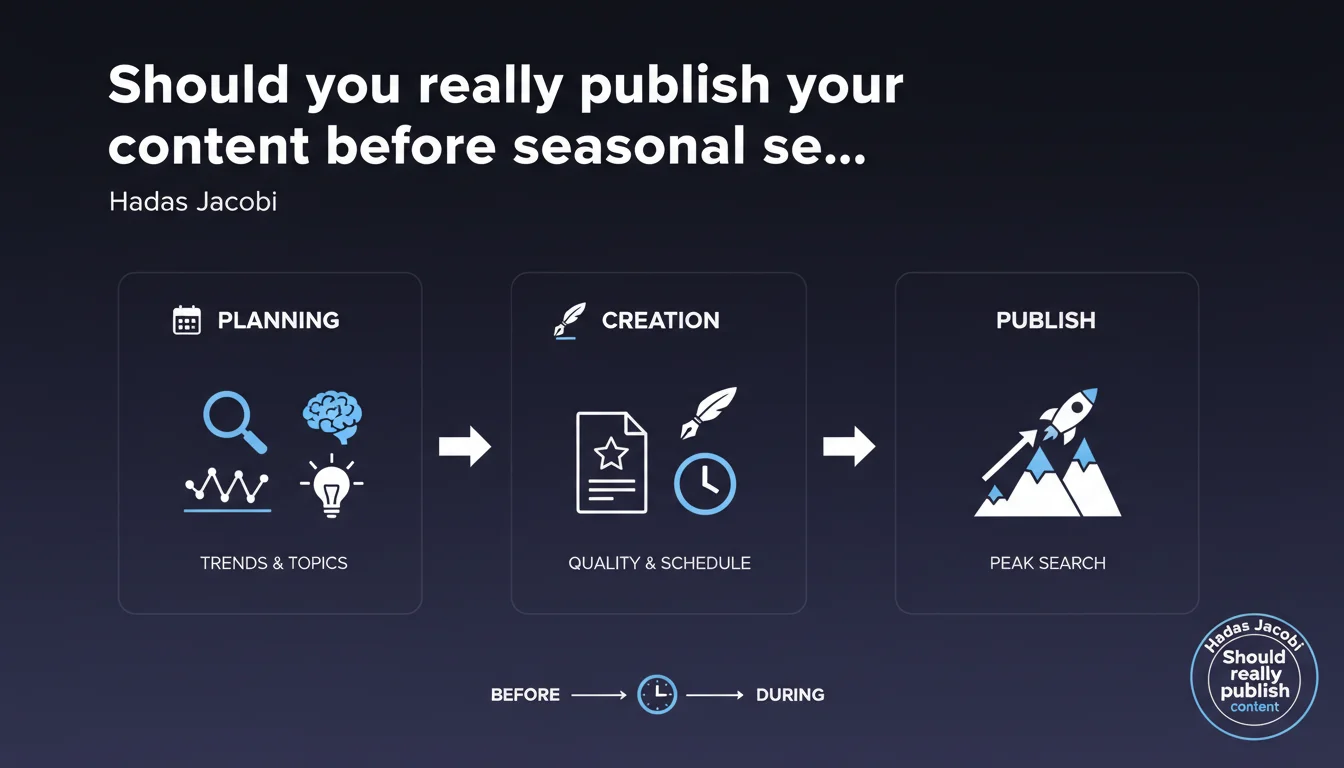
Google recommends identifying seasonal trends in search data to create a strategic content calendar. The goal: publish high-quality content just before predictable search peaks. An approach that seems obvious on paper, but raises several tactical questions in the field.
What you need to understand
What does Google actually mean by "seasonal trends"?
Seasonal trends refer to these predictable fluctuations in search volume around specific topics. Winter sales, back-to-school season, Black Friday, year-end holidays, tax season — all periods when users massively search for specific information.
Google suggests anticipating these peaks rather than chasing them. The principle: your content must be indexed, crawled, and have started accumulating relevance signals before demand explodes.
Why publish "just before" and not during the peak?
The answer lies in the timing of organic search. Freshly published content doesn't rank instantly — except in rare cases. Google needs time to discover it, index it, evaluate its quality, user signals, and comparative authority.
Publishing at peak time means arriving on a battlefield already occupied by better-established content. Anticipating by a few weeks (or even months for ultra-competitive queries) gives your page time to build algorithmic credibility before the massive influx of searches.
Where do you find these predictable search data sources?
Google provides several tools: Google Trends to observe annual cycles, Search Console to identify historical variations on your own queries, and planning data in Google Ads which displays monthly volume forecasts.
The exercise involves overlaying this information to spot recurring patterns. If "best electric scooter" spikes every December, you know you need to publish or refresh your guide by late October-early November.
- Seasonal trends are predictable fluctuations in search volume around recurring topics
- Publishing before the peak allows content to be indexed, evaluated, and ranked before demand surges
- Google Trends, Search Console, and Google Ads provide actionable data to identify these cycles
- Anticipation timing varies by competition: from a few weeks to several months
SEO Expert opinion
Is this recommendation really that new?
Let's be honest: no. The idea of publishing seasonal content in anticipation isn't revolutionary. Every seasoned SEO professional already works with editorial calendars aligned to business cycles and search trends.
What's interesting is that Google formalizes this practice and presents it as a formal best practice. It confirms that the algorithm actually rewards content that's already established when demand takes off — rather than a race during the peak.
What's the real operational difficulty?
The problem doesn't lie in the concept, but in execution at scale. Identifying trends for 3-4 flagship topics is doable manually. But building a structured editorial calendar for hundreds of queries, with publication deadlines optimized by competition level? That requires tools, rigor, and genuine strategy prioritization.
Google's statement also remains vague on one critical point: how far in advance? The answer varies enormously depending on domain authority, niche competition, and your previous seasonal content performance history. [To verify]: Google provides no concrete timeframe, leaving wide room for interpretation.
What happens if you publish too early?
There's an underestimated risk: publishing 6 months before a seasonal peak can dilute the freshness effect of your content when it matters most. If your article on "best Father's Day gift" goes live in January, it may have lost relevance signals by June.
The solution? Publish with reasonable timing (2-3 months before a competitive query), then refresh the content a few weeks before the peak. That combines anticipation and freshness — but Google doesn't state this explicitly here.
Practical impact and recommendations
How do you practically build this seasonal content calendar?
First step: extract historical search data on your priority topics. Google Trends, Search Console, and ideally a third-party tool (Ahrefs, Semrush, etc.) to cross-reference monthly volumes. Identify recurring peaks over at least 2-3 years to avoid one-off anomalies.
Next, segment your content by priority level: high-business-potential queries first, then secondary informational queries. For each topic, determine the optimal publication window based on your domain authority and observed competition.
Integrate these milestones into an editorial management tool (Trello, Notion, Asana, or a structured spreadsheet) with automated reminders for writing, approval, publishing, and pre-peak refreshing.
What errors should you absolutely avoid?
Classic mistake: publish seasonal content then forget about it. A "top Christmas gifts" article published in October can be outpaced by competitors who update their lists in November. Freshness matters, even for anticipated content.
Another trap: neglecting internal linking consistency. If your seasonal content sits isolated without links from established pages, it'll take longer to build authority. Plan links from already well-ranked content to accelerate crawling and relevance recognition.
Finally, don't publish "just to publish." Mediocre seasonal content won't benefit from any algorithmic boost just because it's early. Quality remains non-negotiable.
How do you verify your strategy is working?
Track the evolution of rankings and organic traffic week by week as you approach the peak. If your content climbs in visibility 4-6 weeks before the peak, that's a good sign. If nothing moves, it's either a quality problem or poorly calibrated timing.
Also analyze click-through rates and time-on-page: well-anticipated content should not only rank, but also engage. If user metrics are weak, Google may deprioritize your page even if it got there first.
- Extract historical search data over at least 2-3 years to identify reliable cycles
- Segment seasonal content by business priority and competition level
- Determine optimal publication window (2-3 months for competitive queries)
- Plan content refreshes a few weeks before the peak to strengthen freshness
- Integrate the calendar into an editorial management tool with automated reminders
- Structure internal linking to boost crawl and authority of seasonal content
- Monitor rankings, organic traffic, and user signals ahead of the peak to adjust if needed
❓ Frequently Asked Questions
Combien de temps avant un pic saisonnier faut-il publier son contenu ?
Faut-il créer un nouveau contenu chaque année ou rafraîchir l'existant ?
Comment gérer les contenus saisonniers hors-saison ?
Google Trends suffit-il pour identifier les tendances saisonnières ?
Que faire si le pic de recherche est imprévisible ?
🎥 From the same video 10
Other SEO insights extracted from this same Google Search Central video · published on 25/09/2024
🎥 Watch the full video on YouTube →
💬 Comments (0)
Be the first to comment.