
Official statement
Other statements from this video 10 ▾
- □ Pourquoi Google réduit-il le SEO à seulement deux domaines principaux ?
- □ Existe-t-il vraiment des secrets pour être classé premier sur Google ?
- □ Pourquoi Google recommande-t-il Search Console plutôt que Trends pour les exigences techniques SEO ?
- □ Faut-il vraiment courir après les tendances montantes pour ranker ?
- □ Google Trends est-il vraiment efficace pour identifier les bons mots-clés ?
- □ Google Trends peut-il vraiment révéler vos opportunités SEO manquées ?
- □ Faut-il vraiment publier son contenu avant les pics de recherche saisonniers ?
- □ Pourquoi l'optimisation géographique conditionne-t-elle vos résultats SEO ?
- □ Google Trends peut-il vraiment booster votre stratégie vidéo YouTube ?
- □ Pourquoi les tendances de recherche YouTube diffèrent-elles de celles du web Google ?
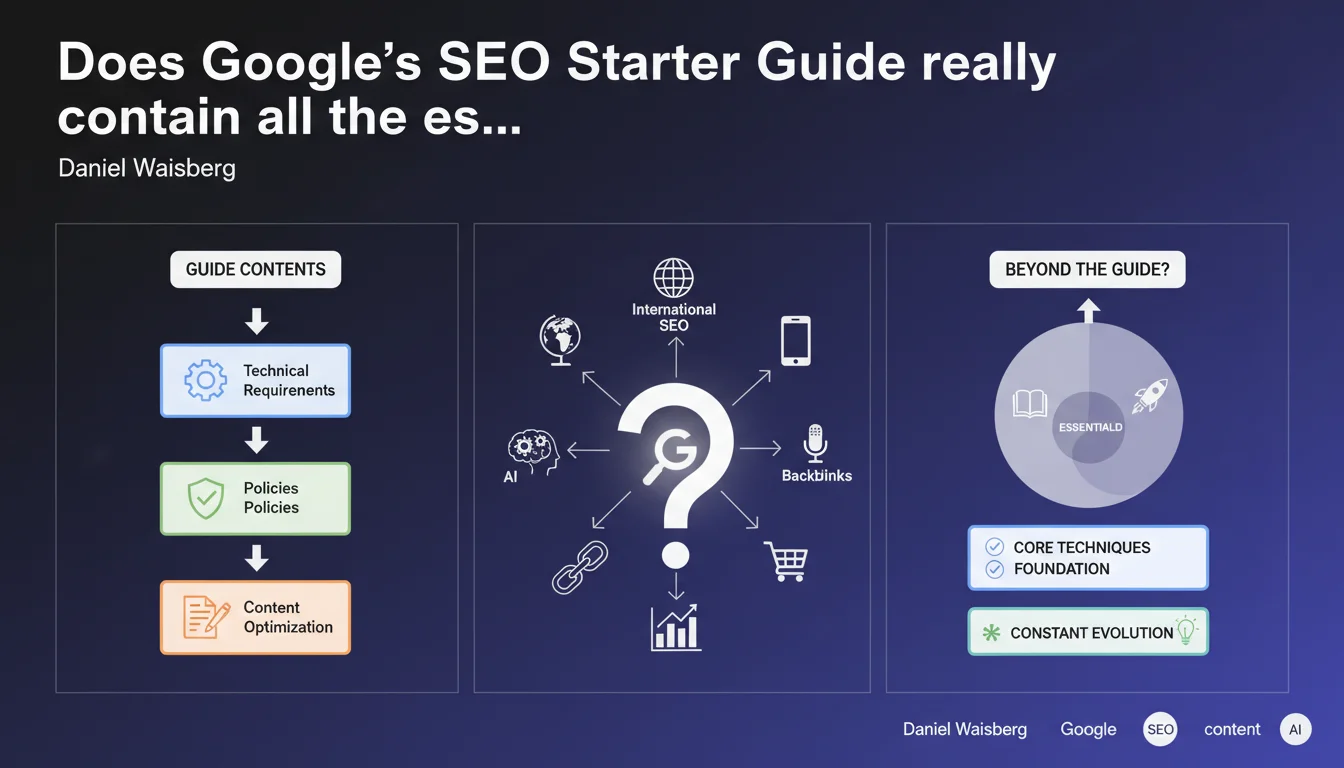
Google refers to its SEO Starter Guide as the official reference for fundamental SEO techniques. The guide covers technical aspects, policies, and content optimization — but is it still sufficient given the current complexity of algorithms?
What you need to understand
Why does Google consistently redirect users to this guide?
The SEO Starter Guide is the official bible that Google has been pushing for years. Daniel Waisberg reminds us here that the most important techniques are listed in it — implying: no need to look elsewhere or follow self-proclaimed gurus.
The guide covers three pillars: technical requirements (crawl, indexation, speed), policies (spam, misleading content), and content optimization (structure, semantics, UX). It's a solid foundation, but that's exactly the problem — it's just a foundation.
Does this guide truly reflect the complexity of today's algorithm?
The Starter Guide dates back several iterations and remains deliberately generalist. It doesn't cover in depth behavioral signals, the precise impact of generative AI on SERPs, or the subtleties of useful content post-HCU (Helpful Content Update).
Google maintains this document as an official reference, but professionals know that the devil is in the details — those details that are precisely missing from a guide intended for beginners.
What are the limitations of this prescriptive approach?
By referring to the Starter Guide, Google avoids committing to more complex or nuanced questions. It's a fallback position: "You haven't even applied the basics, so don't come complaining."
For a site that already respects these fundamentals, this guide provides no answers to advanced issues: semantic cannibalization, silo architecture, thematic authority optimization, post-Penguin link-building strategies.
- The guide covers fundamental technical, policy, and content aspects
- It remains deliberately generalist and intended for beginners
- Advanced problems are not addressed
- Google uses it as a fallback position to avoid nuanced debates
SEO Expert opinion
Is this statement consistent with practices observed in the field?
Yes and no. The Starter Guide does indeed contain the essential fundamentals. A site that doesn't respect these basics has no chance of ranking — that's a fact.
But in practice, two sites can apply the Starter Guide to the letter and get radically different results. Why? Because advanced ranking factors — domain authority, semantic depth, engagement signals, contextual freshness — aren't detailed in this guide.
What nuances should be added to this official recommendation?
The guide is necessary, not sufficient. [To be verified]: Google claims these techniques are "the most important," but never quantifies their relative weight in the algorithm. Does respecting meta tags have the same impact as impeccable technical architecture? Obviously not.
Furthermore, the guide doesn't mention certain levers that are nonetheless crucial: long-term content strategy, optimization of the brand entity, building thematic authority through internal linking and semantic clusters. These aspects go far beyond the scope of a "starter guide."
In what cases does this rule clearly fall short?
For sites competing on competitive keywords, the Starter Guide is an entry ticket, not a performance guarantee. An e-commerce store selling running shoes will never outrank competitors by sticking to the basics.
News sites, UGC platforms, marketplaces — all require specific SEO strategies that the guide doesn't address. Let's be honest: a generic document can't cover the diversity of business models and search intents.
Practical impact and recommendations
What should you do concretely with this statement?
First step: audit your site in light of the Starter Guide. Make sure the fundamentals are flawless — title/meta tags, heading structure, robots.txt, XML sitemap, loading time, mobile-first.
Then don't stop there. Identify advanced optimization opportunities: semantic analysis of competitors, entity mapping, internal linking optimization by thematic clusters, content strategy aligned with actual search intents.
What mistakes should you avoid after reading this statement?
Classic mistake: treating the Starter Guide as a final checklist. It's only a starting point. Once the basics are respected, the real SEO work begins — and that's where the difference is made.
Another pitfall: ignoring indirect signals. Google will never officially say that click-through rates or dwell time are ranking factors, but the observed correlations are too strong to be neglected. The guide remains silent on these behavioral aspects.
How can you verify that your strategy goes beyond the strict minimum?
Ask yourself these questions: does your content really answer the user intent, or does it merely respect on-page best practices? Does your architecture facilitate thematic discovery by crawlers? Does your internal linking strategy create visible topical authority?
If you check the Starter Guide boxes but your performance stagnates, it's a sign you need to level up. Advanced optimizations require specialized expertise, constant monitoring, and iterative testing.
- Audit the site according to Starter Guide criteria (technical, policies, content)
- Identify gaps in architecture and internal linking
- Analyze competitors to spot advanced levers being used
- Optimize semantics and content clusters
- Measure behavioral signals (CTR, time on page, bounce rate)
- Implement an evolving content strategy
❓ Frequently Asked Questions
Le SEO Starter Guide de Google est-il suffisant pour bien ranker ?
Pourquoi Google renvoie-t-il toujours vers ce guide plutôt que de donner des réponses précises ?
Quels aspects SEO importants ne sont pas couverts par le Starter Guide ?
Faut-il ignorer le Starter Guide si on est déjà un SEO avancé ?
Comment savoir si mon site respecte déjà les recommandations du guide ?
🎥 From the same video 10
Other SEO insights extracted from this same Google Search Central video · published on 25/09/2024
🎥 Watch the full video on YouTube →
💬 Comments (0)
Be the first to comment.