
Official statement
Other statements from this video 10 ▾
- □ Are there really any secrets to ranking first on Google?
- □ Does Google's SEO Starter Guide really contain all the essential techniques you need to rank higher?
- □ Why does Google recommend Search Console over Trends for SEO technical requirements?
- □ Do you really need to chase every emerging trend to rank higher in Google?
- □ Is Google Trends really effective for identifying the right keywords?
- □ Can Google Trends really uncover your hidden SEO opportunities?
- □ Should you really publish your content before seasonal search peaks hit?
- □ Is geographic optimization the missing piece that's holding back your SEO results?
- □ Can Google Trends really accelerate your YouTube video strategy?
- □ Why do YouTube search trends differ so dramatically from traditional Google web search?
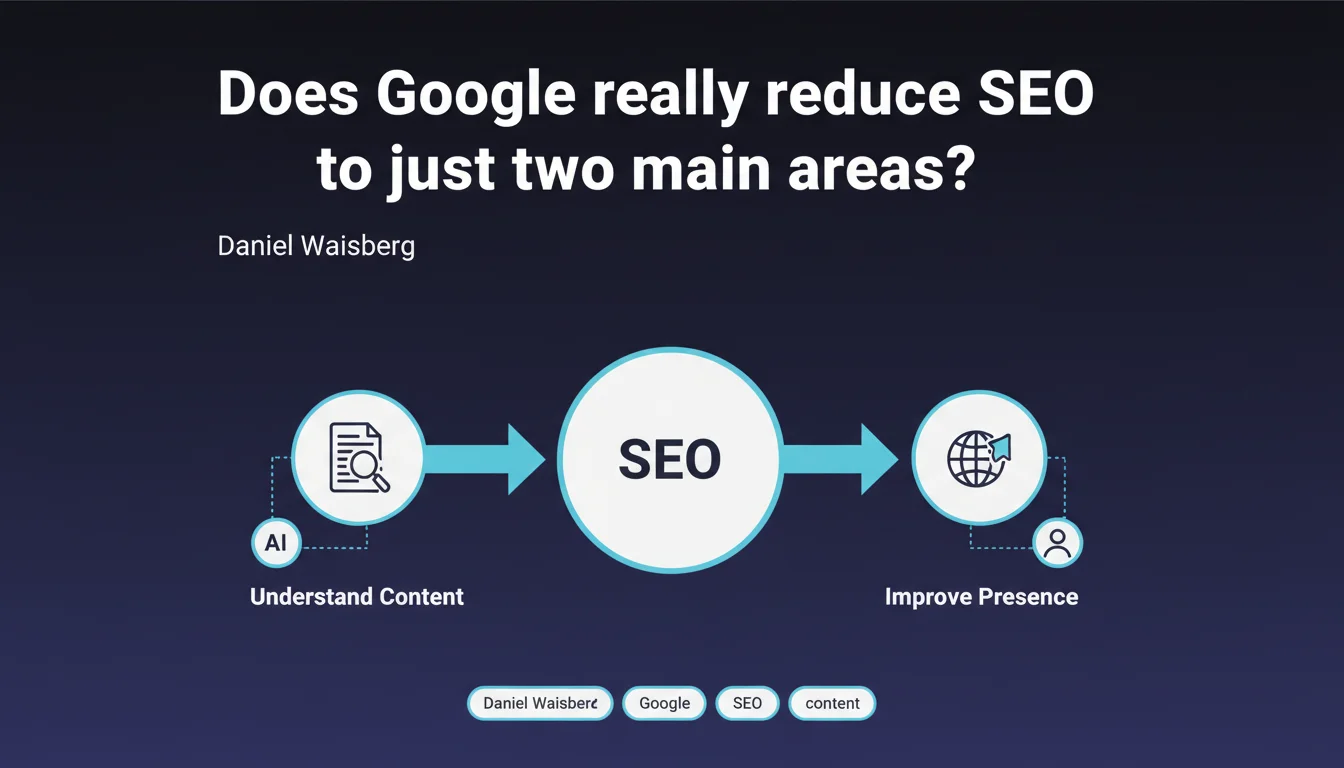
Daniel Waisberg claims that SEO boils down to two axes: helping search engines understand your content, and improving your visibility in search results. This oversimplification glosses over entire aspects of SEO — technical optimization, popularity, user experience — and primarily reflects the vision Google wants to promote, not necessarily the ground reality.
What you need to understand
Does this definition really cover all of SEO?
On the surface, yes: making content understandable by search bots (crawling, indexation, semantic markup) and optimizing SERP presence (titles, meta tags, featured snippets) are indeed core pillars. But reducing SEO to these two areas ignores vast segments: popularity (backlinks, authority), technical performance (speed, mobile-first, Core Web Vitals), site architecture, internal linking.
This is a Google-centric vision — logical for a Google spokesperson — but incomplete for practitioners who know that organic search is a much broader ecosystem.
Why does Google frame SEO this way?
Because this definition serves its interests: it emphasizes content quality (which Google publicly values) and compliance with best practices it dictates. By presenting SEO as a duo of "understanding + visibility," Google sidesteps topics where it has less direct control — notably the importance of external popularity signals (backlinks) or complex technical trade-offs.
This simplification also makes communication easier for beginners, but it dilutes the true complexity of the profession.
What are the risks of this binary vision?
Taking this statement literally can lead to neglecting essential levers. A site that's perfectly understandable and well-presented in SERPs can stagnate if it lacks authority, quality backlinks, or if its technical structure hinders crawling. Popularity doesn't fit into this framework — yet it remains a significant ranking factor.
Another blind spot: post-click user experience. Google mentions "helping users find your site," but says nothing about what happens next — bounce rate, engagement, conversions. These behavioral signals influence rankings, even though Google prefers to downplay them publicly.
- Understandable content ≠ performing content: well-tagged text that's poorly structured or poorly targeted won't rank.
- SERP visibility ≠ qualified traffic: an eye-catching rich snippet without real relevance generates clicks, not engagement.
- Popularity and authority remain pillars that this definition overlooks.
- Technical performance (speed, mobile, Core Web Vitals) doesn't clearly fit into these two "areas."
- Site architecture and internal linking: essential, but absent from this simplified framework.
SEO Expert opinion
Is this statement consistent with what we observe in practice?
Partially. The two axes mentioned — content understanding and SERP presence optimization — are indeed at the heart of Google's official recommendations. But in reality, top-performing sites have much more: a solid architecture, a robust link profile, flawless user experience.
On competitive queries, perfectly tagged content isn't enough. Domain popularity, measured partly through quality backlinks, remains a decisive lever — even though Google prefers highlighting content to discourage artificial practices. [To verify]: no public data allows precise quantification of the respective weight of these factors in the current algorithm.
What nuances should we add to this binary vision?
SEO doesn't break down into two separate domains. It's better to think in terms of four interdependent pillars: content, technical, popularity, user experience. Google tends to underestimate the importance of popularity (backlinks, authority) publicly to avoid validating practices it seeks to control.
Let's be honest: a technically flawless site without external authority will struggle to rank on competitive verticals. Conversely, an authoritative site can compensate for certain technical weaknesses — short-term. Waisberg's simplification sidesteps these trade-offs.
When does this rule not fully apply?
On ultra-competitive markets (finance, health, law), the battle isn't just about content understanding or SERP presence. Domain authority, content freshness, and E-E-A-T signals (expertise, experience, authority, trustworthiness) take precedence. A new site, even impeccably optimized, will take months to break through without an authority foundation.
Another blind spot: large e-commerce sites with massive catalogs. Technical performance (crawl budget, pagination, facets) becomes as critical as content itself. Neglecting this axis because it doesn't fit the "understanding + visibility" framework would be a strategic error.
Practical impact and recommendations
What should you concretely do to cover these two areas?
Start by auditing how Google understands your content: HTML markup (headings, semantic structure), structured data (Schema.org), crawlability (robots.txt, XML sitemap, pagination). Use Google Search Console to detect unindexed pages or coverage errors.
On the SERP visibility side, optimize metadata (title, meta description), target featured snippets (concise answers, lists, tables), work on rich snippets (reviews, FAQs, products). Monitor your positions and CTR to identify quick-win opportunities.
What mistakes should you avoid when applying this approach?
Don't fall into the trap of over-optimization technically at the expense of everything else. A perfectly tagged site without quality backlinks won't outrank better-established competitors. Balance is key.
Another pitfall: neglecting post-click user experience. Google increasingly measures behavioral signals (visit duration, bounce rate, engagement). Optimizing only for SERP appearance without caring for user journey creates a gap between visibility and performance.
How can you verify your site complies with this approach?
- Audit indexation coverage via Search Console: valid pages, excluded pages, errors.
- Check semantic markup: hierarchical headings, structured data, breadcrumbs.
- Test crawlability: robots.txt, sitemap, server response time, crawl budget.
- Optimize SERP metadata: compelling titles, persuasive meta descriptions, rich snippets.
- Analyze CTR by query to spot underperforming pages despite good positions.
- Complement with popularity (backlink profile) and UX (Core Web Vitals, mobile-first) audits.
❓ Frequently Asked Questions
Le SEO se résume-t-il vraiment à ces deux domaines ?
Pourquoi Google insiste-t-il sur la compréhension du contenu plutôt que sur les backlinks ?
Optimiser uniquement pour la visibilité SERP suffit-il à générer du trafic qualifié ?
Cette approche fonctionne-t-elle sur des marchés très concurrentiels ?
Faut-il privilégier la compréhension du contenu ou la visibilité SERP ?
🎥 From the same video 10
Other SEO insights extracted from this same Google Search Central video · published on 25/09/2024
🎥 Watch the full video on YouTube →
💬 Comments (0)
Be the first to comment.