
Official statement
Other statements from this video 10 ▾
- □ Pourquoi Google réduit-il le SEO à seulement deux domaines principaux ?
- □ Existe-t-il vraiment des secrets pour être classé premier sur Google ?
- □ Le SEO Starter Guide de Google contient-il vraiment toutes les techniques essentielles pour ranker ?
- □ Pourquoi Google recommande-t-il Search Console plutôt que Trends pour les exigences techniques SEO ?
- □ Faut-il vraiment courir après les tendances montantes pour ranker ?
- □ Google Trends est-il vraiment efficace pour identifier les bons mots-clés ?
- □ Google Trends peut-il vraiment révéler vos opportunités SEO manquées ?
- □ Faut-il vraiment publier son contenu avant les pics de recherche saisonniers ?
- □ Pourquoi l'optimisation géographique conditionne-t-elle vos résultats SEO ?
- □ Google Trends peut-il vraiment booster votre stratégie vidéo YouTube ?
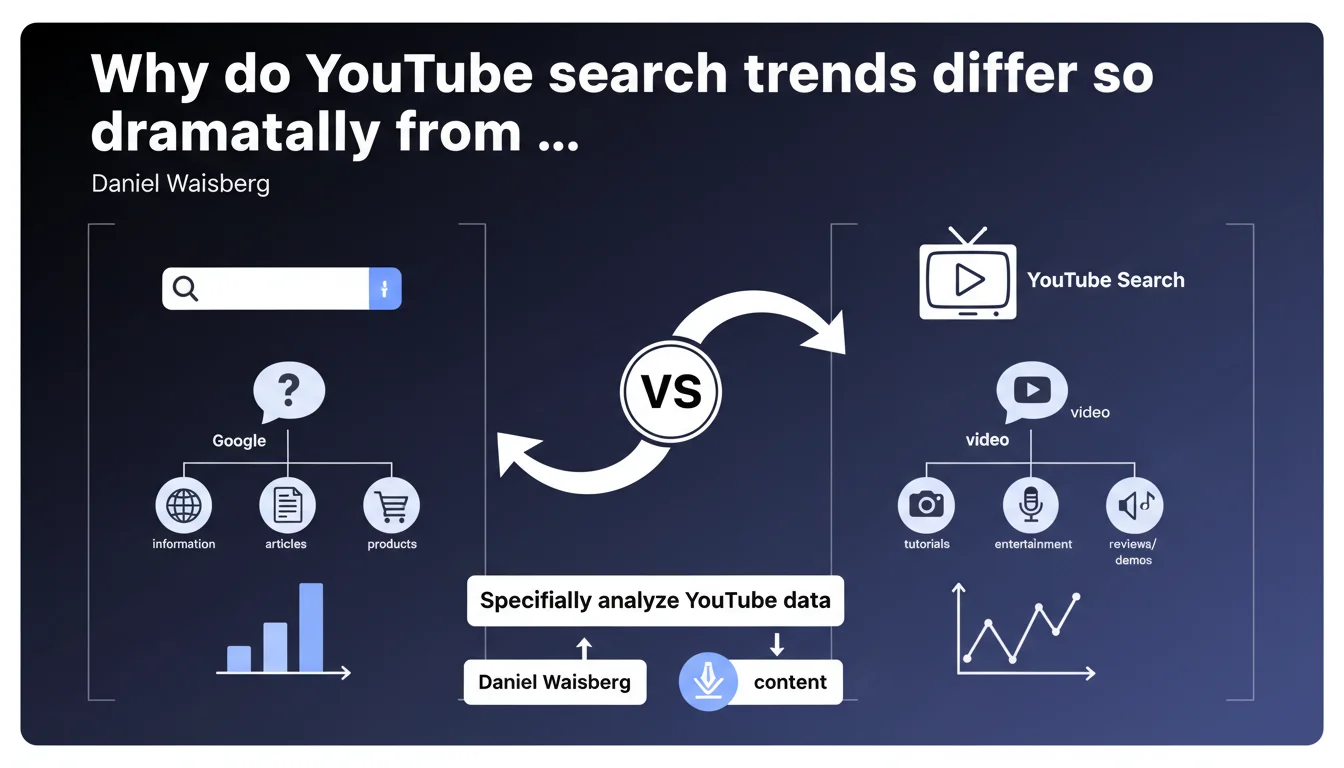
Google confirms that search trends on YouTube do not reflect those of classic web search, even for identical topics. In practical terms: your keyword strategy for web SEO cannot be directly transposed to your video strategy. Each platform requires specific data analysis.
What you need to understand
Why this distinction between YouTube and web search?
Google operates two distinct engines with radically different user behaviors. On web search, the user seeks a quick answer or a text resource. On YouTube, they seek video content, often to learn, be entertained, or deepen their knowledge of a subject.
This difference in intent modifies the queries themselves — their phrasing, their length, their semantics. A topic that is popular in web SEO can be niche on YouTube, and vice versa. The trend cycles don't synchronize either: a peak in interest on Google Search does not automatically trigger an equivalent peak on YouTube.
What concrete data confirms this gap?
Daniel Waisberg does not detail the precise metrics that support this claim. [To verify]: we lack quantified examples or documented case studies from Google. Professionals observe this gap empirically, but Google does not publish a quantified correlation between web search volumes and YouTube. Tools like Google Trends allow you to compare these two sources — the divergence is often glaring. But without access to granular historical YouTube Search Console data, analysis remains incomplete for many publishers.
What mechanisms explain these divergences?
Several technical and behavioral factors come into play. The YouTube recommendation algorithm prioritizes engagement (watch duration, likes, comments) while web search prioritizes informational relevance and freshness. Ranking signals therefore differ structurally.
YouTube queries often include terms like "tutorial," "review," "vlog," absent from web searches. Conversely, web queries are more transactional or purely informational. Synonyms and semantic variations are not distributed the same way across both platforms.
- Search intentions diverge: textual information vs engaging video content
- Trend cycles do not overlap between YouTube and web search
- Ranking signals are distinct (video engagement vs informational relevance)
- Query formulations vary: transactional web keywords vs video terms (tutorial, review)
- Google does not provide public quantified correlation between web and YouTube volumes
SEO Expert opinion
Is this statement consistent with real-world observations?
Yes, without ambiguity. Any professional who has managed both web SEO and YouTube optimization simultaneously notices this gap. Search volumes for a given keyword can vary by a factor of 10 between the two platforms, in either direction. Long-tail queries also differ: what converts in a blog article doesn't necessarily work as a video title.
The problem is that Google does not publish a detailed methodology to quantify this divergence. We know it exists, we measure it with our tools, but Google remains vague about the thresholds and content categories most impacted. [To verify]: do certain sectors (tech, lifestyle, finance) show more pronounced gaps than others? No official data available.
What nuances should be added to this statement?
Be careful not to artificially oppose YouTube and web search as two separate universes. Google increasingly integrates video results into classic SERPs — notably via video carousels and featured video snippets. A well-optimized YouTube video can therefore also capture traffic from web search, even if native trends differ.
Furthermore, some queries with strong visual components (DIY tutorials, recipes, fitness) show stronger convergence between both platforms. Users seek the same thing, but via two different interfaces. In these cases, a synchronized cross-platform strategy makes sense — not a strict dichotomy.
In what cases does this rule not fully apply?
Strong brands benefit from a halo effect: if a user searches for "[brand name] + [product]," they will often do so on both Google and YouTube. Trends converge because the intention is navigational, not purely informational.
Similarly, during major events (product launches, breaking news), search peaks temporarily synchronize between web and YouTube. But once the peak subsides, the curves diverge again. Let's be honest: this Google statement describes the norm, not the exception.
Practical impact and recommendations
What should you do concretely for a YouTube video strategy?
First step: analyze YouTube Search Console data (if you have access via YouTube Studio). Identify which queries actually generate impressions and clicks on your channel. Never start with a web keyword list assuming it applies as-is.
Use Google Trends in comparison mode "Web Search" vs "YouTube Search" for each strategic keyword. Spot volume and seasonality gaps. Supplement with third-party tools like TubeBuddy or VidIQ to analyze competition and autocomplete suggestions specific to YouTube.
What mistakes should you avoid when planning video content?
Don't rely solely on web search volumes to prioritize your video topics. An article that performs well in web SEO can flop on YouTube if the intent doesn't match. Conversely, a niche topic on the web can explode on YouTube if the visual dimension or tutorial format adds real value.
Also avoid neglecting YouTube metadata (title, description, tags, chapters) under the assumption that "it's like classic SEO." The signals considered differ: engagement (thumbnail CTR, watch duration, retention) carries much more weight than on a blog article. And that's where it gets tricky for many traditional SEO-focused publishers.
How do you verify that your strategy is aligned with YouTube trends?
Set up regular monitoring of query sources driving traffic in YouTube Studio. Cross this data with your web SEO tools to identify cross-platform opportunities — where trends converge — and gaps where YouTube offers unexploited potential.
Systematically test your assumptions: publish videos on topics with high YouTube volume but low web volume, and measure results. Adjust your editorial calendar based on actual performance, not assumptions based on web search alone.
- Analyze YouTube Search Console data to identify actual queries from your video audience
- Use Google Trends in Web vs YouTube comparison mode for each strategic keyword
- Never mechanically transpose a web keyword list to YouTube without validation
- Supplement with third-party tools (TubeBuddy, VidIQ) to analyze YouTube-specific autocomplete and competition
- Prioritize topics based on volumes and intentions specific to YouTube, not just web
- Optimize YouTube metadata (title, description, tags) accounting for engagement signals
- Regularly monitor query sources driving traffic in YouTube Studio
- Cross web and YouTube data to identify cross-platform opportunities and unexploited gaps
- Test and adjust your video editorial calendar based on measured actual performance
❓ Frequently Asked Questions
Peut-on utiliser les mêmes mots-clés pour le SEO web et YouTube ?
Comment mesurer l'écart de tendances entre Google et YouTube pour un sujet donné ?
Les vidéos YouTube peuvent-elles quand même ranker dans la recherche web classique ?
Quels outils utiliser pour analyser les tendances de recherche YouTube ?
Faut-il créer du contenu vidéo sur tous les sujets qui performent en SEO web ?
🎥 From the same video 10
Other SEO insights extracted from this same Google Search Central video · published on 25/09/2024
🎥 Watch the full video on YouTube →
💬 Comments (0)
Be the first to comment.