
Official statement
Other statements from this video 10 ▾
- □ Pourquoi Google réduit-il le SEO à seulement deux domaines principaux ?
- □ Existe-t-il vraiment des secrets pour être classé premier sur Google ?
- □ Le SEO Starter Guide de Google contient-il vraiment toutes les techniques essentielles pour ranker ?
- □ Pourquoi Google recommande-t-il Search Console plutôt que Trends pour les exigences techniques SEO ?
- □ Faut-il vraiment courir après les tendances montantes pour ranker ?
- □ Google Trends peut-il vraiment révéler vos opportunités SEO manquées ?
- □ Faut-il vraiment publier son contenu avant les pics de recherche saisonniers ?
- □ Pourquoi l'optimisation géographique conditionne-t-elle vos résultats SEO ?
- □ Google Trends peut-il vraiment booster votre stratégie vidéo YouTube ?
- □ Pourquoi les tendances de recherche YouTube diffèrent-elles de celles du web Google ?
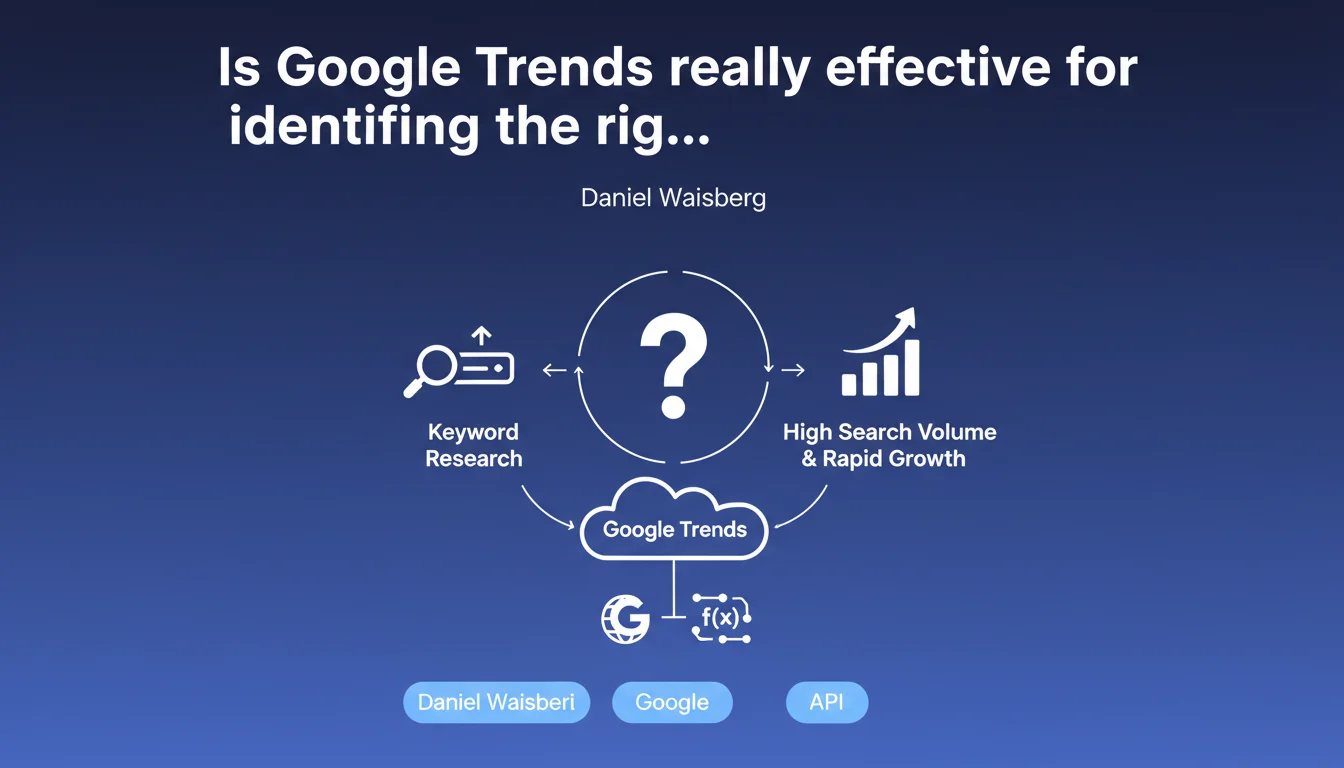
Google officially validates the use of Trends for keyword research, particularly for spotting high-volume terms or rapidly growing search queries. The tool becomes a recognized source for adjusting your semantic strategy. The question remains whether raw data alone is sufficient to make informed decisions.
What you need to understand
This official statement positions Google Trends as a legitimate tool in the SEO professional's arsenal. Not a revelation — many already use it — but validation that counts.
The emphasis is on two axes: high search volume and rapid growth. This is an important distinction because it points toward two different strategies.
Why is Google communicating about Trends now?
Because the tool has existed for years but remains underutilized relative to its real power. Google is positioning it clearly in the keyword research workflow, alongside — or complementing — Search Console and Keyword Planner.
What changes is the official recognition: Trends is not just a gadget for journalists or trend analysts. It has a place in SEO strategy, period.
What does this mean concretely for a practitioner?
That you can now justify using Trends in your audits and recommendations without being asked "but is it reliable?". Google says yes, it's reliable for identifying emerging trends and relative volumes.
But be careful: Trends doesn't provide absolute volumes. It provides relative indices on a scale of 100. It's not a substitute for traditional keyword research tools — it's a strategic complement.
- Google officially validates Trends for SEO keyword research
- The tool identifies terms with high volume and those with rapid growth
- Data is relative, not absolute — does not replace traditional volumetric tools
- Useful for detecting emerging trends before the competition
- Complements Search Console and Keyword Planner in the SEO workflow
SEO Expert opinion
Is this statement consistent with practices observed in the field?
Yes, absolutely. Experienced SEOs have been using Trends for a long time to identify seasonal opportunities, local trends, and interest spikes on specific queries. The official statement simply legitimizes an existing practice.
What's interesting is that Google emphasizes rapid growth. It's a clear signal: the tool isn't just for tracking what's already working, but for anticipating what's going to rise. That's where the real added value lies.
What nuances should be applied to this statement?
Google doesn't specify how to interpret the data. An index of 100 on Trends doesn't mean 100,000 monthly searches — it could be 10,000 or 1 million. You need to cross-reference with other sources to get usable volumes.
Another point: Trends is excellent for detecting macro trends, less so for ultra-specific niches. If your keyword has too low a volume, it won't appear in the tool at all. [To verify]: the reliability of data on long tails remains unclear.
In what cases does this approach reach its limits?
Trends is powerful for news content, seasonal topics, and emerging trends. But it becomes much less relevant in ultra-stable markets or highly technical B2B niches where volumes barely vary at all.
If your sector evolves slowly and your keywords are consistent year after year, Trends won't bring much to the table. In that case, prioritize Search Console and analysis of existing rankings.
Practical impact and recommendations
What should you do concretely with Google Trends?
Integrate Trends into your keyword research workflow, but not as your only source. Use it to spot seasonal peaks, anticipate growth surges, and identify content opportunities before the competition.
In practice: before validating a keyword list, run your main terms through Trends. If a keyword is in constant decline, think twice before investing budget on it. Conversely, a term with rapid growth can justify prioritized content production.
What mistakes should you avoid with this tool?
Don't take relative indices as absolute volumes. Don't rely solely on an upward curve without checking the competition and search intent behind the term.
Another pitfall: confusing media trend with sustainable SEO opportunity. A search spike tied to current events can disappear as quickly as it appeared. Make sure the trend is part of a longer-term dynamic before dedicating resources to it.
- Integrate Trends into your keyword research workflow, not as a unique source
- Identify seasonal peaks and emerging trends before the competition
- Systematically cross-reference with Keyword Planner, Ahrefs, Semrush, or Search Console
- Check geographic trends to adjust local strategy
- Don't confuse relative index with absolute volume
- Analyze trend duration before investing budget
- Use related queries to enrich your semantic field
Google Trends becomes an officially recommended tool for keyword research, particularly effective at detecting emerging trends and seasonal opportunities. But it doesn't replace traditional volumetric tools — it complements them.
Strategic exploitation of Trends requires a certain finesse in analysis and the ability to cross-reference multiple data sources. If this approach seems complex to you or if you want to maximize your chances of capturing the right trends at the right time, guidance from a specialized SEO agency can make all the difference.
❓ Frequently Asked Questions
Google Trends donne-t-il des volumes de recherche absolus ?
Peut-on utiliser Trends pour des mots-clés de niche très spécifiques ?
Trends est-il utile pour le SEO local ?
Comment savoir si une tendance détectée est durable ?
Trends remplace-t-il la Search Console pour la recherche de mots-clés ?
🎥 From the same video 10
Other SEO insights extracted from this same Google Search Central video · published on 25/09/2024
🎥 Watch the full video on YouTube →
💬 Comments (0)
Be the first to comment.